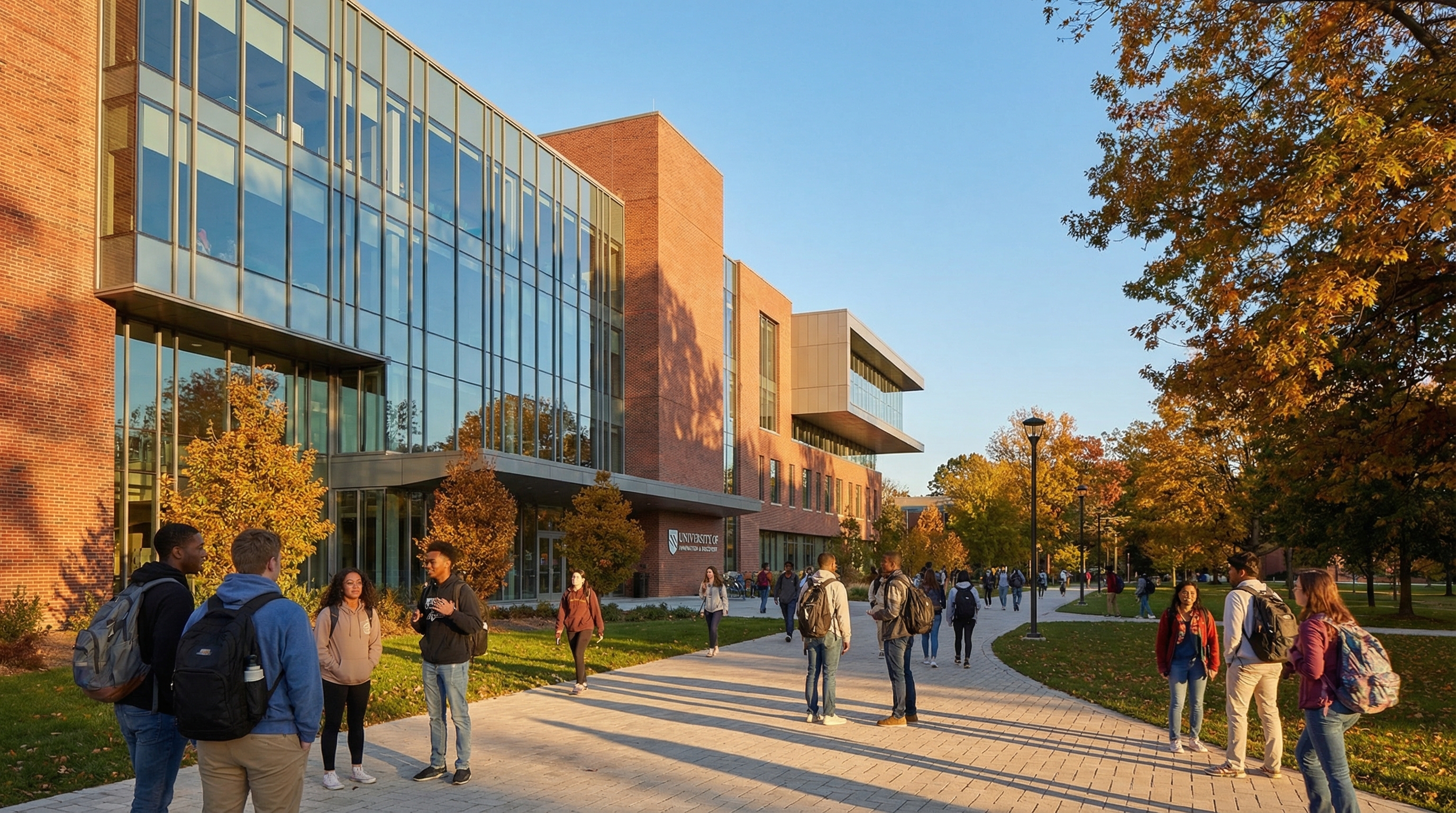
Working adults pursuing a bachelor's in human resources can choose from asynchronous online, hybrid, evening cohort, and competency-based formats. IRS Section 127 provides up to $5,250 per year in tax-free employer tuition assistance, and Prior Learning Assessment can convert workplace experience into college credit. HR specialists earn a median salary of $72,910, with HR managers reaching $140,030 according to BLS May 2024 data.
$72,910
HR Specialist
BLS median 2024
$5,250
Tax-Free Aid
IRS Sec. 127/yr
2-3 yrs
Completion
With transfers
+8%
Job Growth
2024-2034
Source: NCES
Choosing the Right Format
Source: BLS OES May 2024
Cornell University
Why #1: Cornell University
Cornell's MILR through the Ivy League ILR School offers unmatched prestige and outcomes, with graduates earning a $97,473 average starting salary at elite employers.
Cornell University offers a 48-credit Master of Industrial and Labor Relations (MILR) through its Ivy League ILR School. The on-campus program produces graduates with a $97,473 average starting salary in HR, with top employers including Estee Lauder, JPMorgan, and S.C. Johnson.
Program Highlights
- Specializations: Industrial and Labor Relations
- Ivy League ILR School
- 48 credits
- On-campus only
- $97,473 avg starting salary
Key Strengths
- Specializations: Industrial and Labor Relations
- Ivy League ILR School
- 48 credits
- On-campus only
Program
- 48 credits
Sources
Rutgers University-New Brunswick
Why #2: Rutgers University-New Brunswick
An AACSB-accredited HR program with the personalized attention of a mid-size private university and proximity to major Northeast employers.
Rider University offers a BSBA in Human Resource Management with AACSB accreditation. The campus-based program provides a comprehensive HR curriculum within a mid-size private university setting.
Program Highlights
- AACSB-accredited
- Campus-based
- 357 annual HR graduates (IPEDS 2023)
Key Strengths
- AACSB-accredited
- Campus-based
- 357 annual HR graduates (IPEDS 2023)
Admissions
- GPA: 2.5
Program
- 120 credits
Prerequisites
Bachelor's admission requirements
Sources
Penn State University
Why #3: Penn State University
Penn State's MS in HRER combines the strength of a Big Ten research university with SHRM alignment and flexible campus or World Campus online delivery.
Penn State offers a 39-credit MS in HR and Employment Relations with MSCHE accreditation and SHRM alignment. Available on campus and online through World Campus, with a 3.2 GPA minimum.
Program Highlights
- SHRM-aligned curriculum
- Specializations: HR and Employment Relations
- 39 credits
- Campus + World Campus online
- MSCHE accredited
Key Strengths
- SHRM-aligned curriculum
- Specializations: HR and Employment Relations
- 39 credits
- Campus + World Campus online
Admissions
- GPA: 3.2
Program
- 39 credits
Prerequisites
Bachelor's degree
Sources
Who Should Consider a Bachelor's in HR for Working Adults
- You have 60 or more transfer credits from prior coursework
- You left college for work, family, or financial reasons and want to finish
- You want the fastest path to a bachelor's using existing credits and Prior Learning Assessment
- Programs like UMGC and Penn State World Campus are built for your situation
- You work in HR but hit a ceiling without a bachelor's degree
- You want to qualify for HR specialist roles at the $72,910 median salary
- Your employer offers tuition assistance under IRS Section 127 ($5,250/year tax-free)
- You want to stack a SHRM-CP certification on top of your degree
- You manage people but lack formal HR training
- You want to formalize skills in employee relations, compliance, or talent management
- BLS projects 8% growth for HR specialists through 2033, faster than average
- You need a program that values your professional experience through PLA credits
- You want to graduate with a degree and SHRM-CP in the same timeframe
- Your target employers require or prefer SHRM certification
- You want maximum credential ROI from a single educational investment
- You prefer programs aligned with SHRM's 9 behavioral competencies and 15 knowledge areas
Paying for It: Employer Assistance and Financial Aid
The single best funding source for a working adult's bachelor's degree is the employer sitting across from you right now. Under IRS Section 127, employers can provide up to $5,250 per year in tax-free educational assistance. That money is tax-deductible for the company and tax-free for you, which makes it one of the most efficient compensation benefits in the tax code. At a program costing $7,000 to $10,000 per year, employer assistance can cover the majority of your tuition. The irony for HR professionals is that you may already administer this benefit for your coworkers without using it yourself.
Several major employers have gone well beyond the Section 127 minimum. Amazon's Career Choice program covers 100% of tuition at partner schools for hourly employees. Starbucks' partnership with Arizona State University provides full tuition coverage for an online bachelor's degree. UPS Earn & Learn offers up to $25,000 in tuition assistance over a part-time employee's career. Walmart's Live Better U program covers tuition and fees at multiple partner universities. If you work for a large employer, check whether they have a similar arrangement before shopping for programs on your own.
Working adults are also eligible for federal financial aid, and many do not realize it. The FAFSA is not just for 18-year-olds. Part-time students qualify for Pell Grants (up to $7,395 for the 2024-2025 award year), and adult students who are financially independent often qualify for more aid than they expect because the formula no longer considers parental income. Federal student loans carry lower interest rates than private alternatives, and income-driven repayment plans can keep monthly payments manageable while you are still in school.
The return on investment calculation for a working adult looks very different from a traditional student's. You are not giving up four years of income. You are adding tuition costs on top of an existing salary, which means the breakeven point arrives much faster. An HR coordinator earning $45,000 who completes a bachelor's degree and moves into an HR specialist role at the $72,910 median has added roughly $28,000 in annual earnings (BLS, May 2024). If the degree cost $25,000 out of pocket after employer assistance, that investment pays for itself in under a year.
Tax benefits stack on top of everything else. Beyond the Section 127 exclusion, the American Opportunity Tax Credit and Lifetime Learning Credit can reduce your tax bill by up to $2,500 or $2,000 respectively per year. Student loan interest is deductible up to $2,500 annually. These credits and deductions interact with employer assistance in specific ways, so consult a tax professional to maximize your total benefit. The point is that the sticker price of a bachelor's degree is almost never what a working adult actually pays.
The Psychology of Adult Learning
Adults do not learn the same way that 19-year-olds do, and the best programs for working professionals are built on that understanding. Malcolm Knowles' theory of andragogy, developed through decades of research on adult education, identifies five principles that distinguish adult learners from children. Adults need to know why they are learning something. They bring a reservoir of experience that serves as a learning resource. They are ready to learn when life demands it. They are oriented toward problem-solving rather than subject mastery. And they are motivated by internal factors like career advancement and personal satisfaction rather than external grades.
For HR professionals, these principles are not just academic theory. They are the foundation of the training and development function that many of you already practice at work. Understanding how you learn best gives you an advantage in choosing the right program and study strategies. If you have spent years designing onboarding programs or facilitating professional development workshops, you already have an intuitive grasp of instructional design. Use that expertise on yourself. Build a study schedule that mirrors the learning principles you apply to employee development.
The experience reservoir is particularly relevant for adult HR students. When a textbook describes progressive discipline, you have actually issued written warnings. When a course covers benefits administration, you have navigated open enrollment. When an assignment asks you to analyze organizational culture, you have lived through a merger or a leadership transition. This prior knowledge is not just background; it is a cognitive framework that makes new information stick faster because you have existing mental models to attach it to. Programs that leverage this through case-based learning and portfolio assessments respect your experience instead of ignoring it.
Identity transition is the psychological challenge that most adult education marketing ignores. Becoming a student again after years as a professional involves a real shift in how you see yourself. You go from being the expert in your office to being a novice in a classroom. That discomfort is normal, and it fades quickly once you realize that your professional experience gives you a perspective that younger students simply cannot match. The most successful adult students lean into their expertise during discussions and projects rather than trying to suppress it.
Self-directed learning is the throughline connecting all five of Knowles' principles. Adults learn best when they have control over their pace, their focus areas, and the application of new knowledge. This is why competency-based and asynchronous programs tend to produce strong outcomes for experienced professionals. You are not waiting for a professor to tell you what matters. You already know what gaps exist in your knowledge, and you are filling them with purpose. The programs that recognize this and give you autonomy will feel like a better fit than those that treat you like a first-time undergraduate.
How to Evaluate HR Bachelor's Programs as a Working Professional
Verify Regional Accreditation
Confirm the institution holds regional accreditation through HLC, MSCHE, SACSCOC, or another recognized agency. Regional accreditation determines whether your credits transfer, whether your degree qualifies you for graduate school, and whether employers recognize it. This is non-negotiable.
Check for Business School Accreditation
Look for AACSB accreditation (roughly 6% of business schools worldwide) or ACBSP accreditation for teaching-focused institutions. These signal higher standards for faculty qualifications and curriculum rigor beyond what regional accreditation requires.
Confirm SHRM Curriculum Alignment
Programs aligned with SHRM's curriculum guidelines cover the 9 behavioral competencies and 15 knowledge areas that define professional HR practice. Students in SHRM-aligned programs can sit for the SHRM-CP exam during their final year, graduating with both a degree and a professional credential.
Get a Written Transfer Credit Evaluation
Before enrolling, request a formal transfer credit evaluation in writing. Ask specifically: How many credits will transfer? Does the program accept CLEP or DSST exam credits? What professional certifications (PHR, SHRM-CP) receive credit? The answers determine whether you finish in 2 years or 4.
Review Prior Learning Assessment (PLA) Policies
PLA allows you to convert workplace experience, professional training, and on-the-job skills into college credit through portfolio assessments, challenge exams, or competency demonstrations. Most adult learners earn 6 to 12 PLA credits. Ask about the process, cost per credit, and maximum credits allowed.
Evaluate Scheduling Flexibility
Ask: Are courses asynchronous or do they require fixed login times? Are there multiple start dates per year or just fall and spring? Can you pause enrollment without losing credits? These structural features determine whether you will actually finish, not just enroll.
Assess Career Services for Adult Learners
You do not need help writing your first resume. You need help repositioning an existing career and connecting with employers who value non-traditional candidates. Ask what career support the program offers specifically to working adults and degree completers, and whether alumni networks include fellow adult learners.
Request Program-Specific Outcomes Data
Overall institutional graduation rates can be misleading for adult-serving programs. Instead, ask for program-specific completion rates, time-to-degree for transfer students, and employment outcomes for graduates. Programs that track and share these metrics are more confident in their results than those that deflect.
Career Paths
Salary by Experience Level
Frequently Asked Questions About HR Bachelor's Programs for Working Adults
HR completions volume, CIP breadth, multi-level depth
SHRM alignment (+15), AACSB (+10) or ACBSP (+5)
IPEDS 6-year graduation rate
Carnegie 2021 classification
IPEDS reporting completeness
Sources
- 1.Bureau of Labor Statistics, Occupational Employment and Wage Statistics (OES) — May 2024 salary data. HR Specialists (SOC 13-1071): $72,910 median, +8% projected growth 2024-2034. HR Managers (SOC 11-3121): $140,030 median, +5% projected growth 2024-2034.
- 2.Integrated Postsecondary Education Data System (IPEDS) — 2023 data year. Institutional data on enrollment, graduation rates, tuition, program completions (CIP 52.1001, 52.1002, 52.1003), acceptance rates, and Carnegie classifications for all ranked schools.
- 3.SHRM Academic Initiative & HR Curriculum Guidebook — SHRM alignment data for academic programs. Curriculum guidelines covering 9 behavioral competencies and 15 knowledge areas. SHRM-CP exam eligibility for students in aligned programs.
- 4.IRS Publication: Tax Benefits for Education — Section 127 employer educational assistance exclusion ($5,250 per year tax-free). American Opportunity Credit and Lifetime Learning Credit details. Student loan interest deduction ($2,500 maximum).
Related Resources

Taylor Rupe
Education Researcher & Data Analyst
B.A. Psychology, University of Washington · B.S. Computer Science, Oregon State University
Taylor combines training in behavioral science with data analysis to evaluate HR education programs. His research methodology uses IPEDS completion data, BLS employment statistics, and SHRM alignment data to produce evidence-based program rankings.