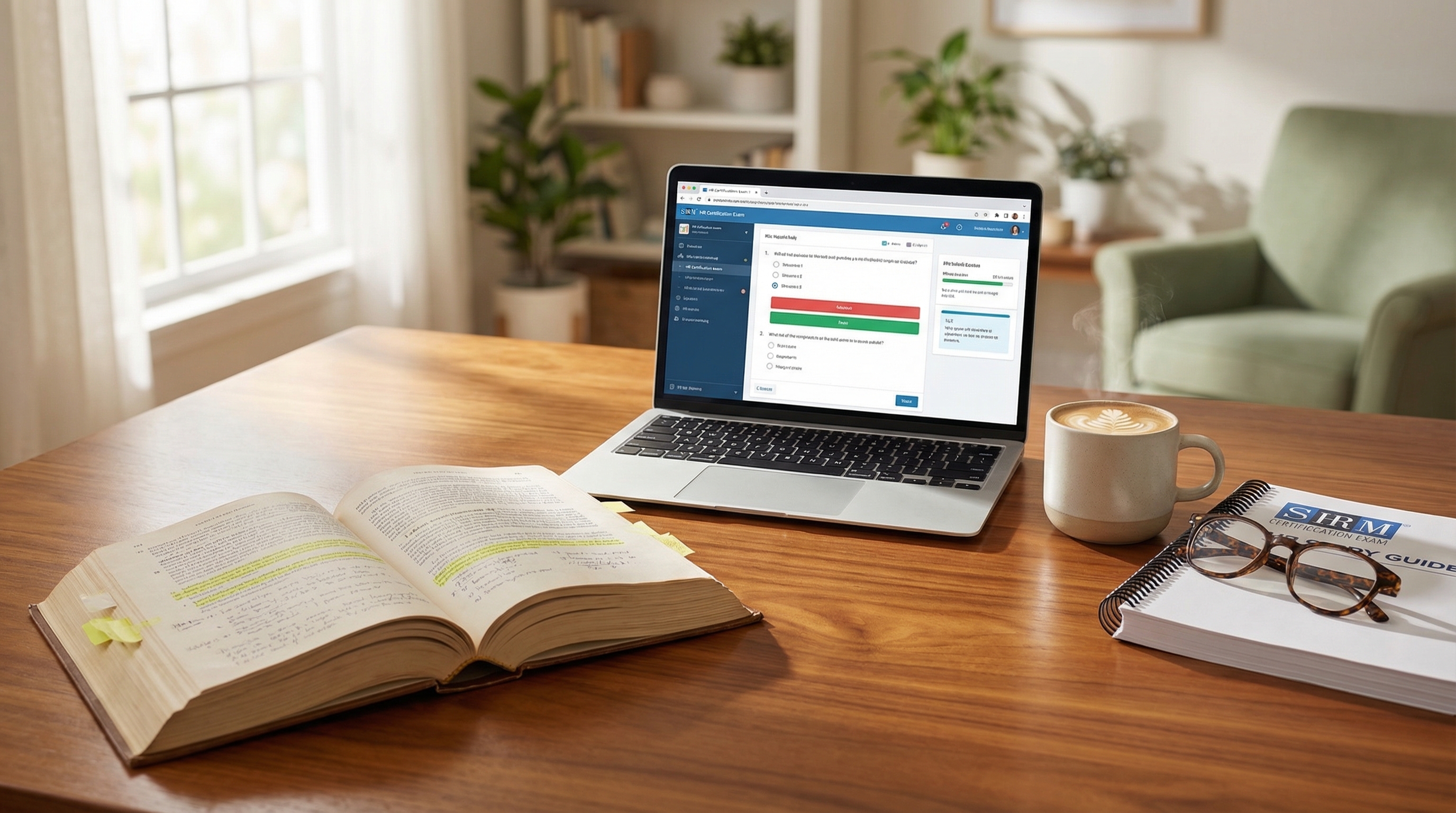
What Are the Best HR Certifications in 2026?
The best HR certifications for 2026 are SHRM-CP and PHR for operational HR professionals, and SHRM-SCP and SPHR for senior leaders. SHRM-CP costs $350-$499 (varies by SHRM membership and timing) with no degree or experience requirement. PHR costs $495 with a 72% pass rate (HRCI, December 2025). SPHR costs $595 with a 76% pass rate. aPHR ($400, 71% pass rate) is the entry-level option with no experience floor. Specialty credentials (CCP for compensation, CEBS for benefits, CPTD for L&D, GPHR for global HR) round out the top 10.
SHRM-CP and PHR remain the two best HR certifications for most professionals in 2026. Senior credentials (SHRM-SCP, SPHR) unlock director and VP roles, while specialty certifications (CCP, CEBS, CPTD) provide differentiation for professionals committed to a specific HR function. Industry analyses report a 5-15% salary premium for certified HR professionals over uncertified peers. Total exam investment ranges from $400 (aPHR) to $5,000+ (multi-exam specialty bundles like WorldatWork CCP).
10
Certifications Compared
5-15%
Industry-Cited Salary Premium
71-76%
HRCI Published Pass Rates (2025)
$400-$5K+
Total Investment Range
How We Ranked These Certifications
We evaluated each certification across four factors: salary impact (verified premium from Payscale and SHRM surveys), employer recognition (how often the credential appears in job postings and requirements), accessibility (eligibility requirements, cost, and time to complete), and career acceleration (how the credential affects promotion velocity and access to senior roles). Foundational certifications rank highest because they deliver the largest marginal benefit for the broadest population of HR professionals.
Every cost figure comes from the certifying body's published 2026 fee schedule. Pass rates are industry estimates based on candidate surveys and prep provider data, since SHRM and HRCI do not officially publish pass rates. Salary premiums reference Payscale compensation data and SHRM's certification impact surveys. We excluded discontinued certifications and credentials with minimal employer recognition.
Top 10 HR Certifications Compared (2026 Verified Data)
| Rank | Certification | Provider | Total Cost | Experience Required | Pass Rate (2025) | Best For |
|---|---|---|---|---|---|---|
| 1 | SHRM-CP | SHRM | $350-$499 (member EB to non-member std) | None | Not publicly disclosed | Generalists, business partners, career changers |
| 2 | PHR | HRCI | $495 ($100 app + $395 exam) | 1-4 years HR (varies by degree) | 72% (Dec 2025) | Compliance-heavy roles, US employment-law focus |
| 3 | SHRM-SCP | SHRM | $350-$499 (verify on SHRM site) | 3+ yr strategic HR or 3 yr SHRM-CP transitioning | Not publicly disclosed | HR Directors, VPs, aspiring CHROs |
| 4 | SPHR | HRCI | $595 ($100 app + $495 exam) | 4-7 years strategic HR (varies by degree) | 76% (Dec 2025) | Senior HR leaders, policy-makers |
| 5 | aPHR | HRCI | $400 ($100 app + $300 exam) | None — high school diploma minimum | 71% (Dec 2025) | Career changers, students, entry-level pre-HR |
| 6 | CCP | WorldatWork | $5,000-$15,000 (multi-exam bundle) | None (assumes comp experience) | Varies by exam; not aggregated | Compensation analysts and managers |
| 7 | CEBS | IFEBP | ~$4,000 (5 courses + exams) | None (assumes benefits experience) | Varies by exam | Benefits specialists and managers |
| 8 | CPTD | ATD | $1,099-$1,500 exam (member vs non) | 5+ years in talent development | Not published | L&D directors, training managers |
| 9 | GPHR | HRCI | $595 ($100 app + $495 exam) | 2-4 years global HR experience | Not published | Global HR, international mobility |
| 10 | SHRM People Analytics | SHRM | ~$500-$800 | SHRM certification recommended | Knowledge assessment (no pass rate published) | HRIS analysts, people analytics roles |
The Top 4 HR Certifications in Detail
The most widely pursued HR certification in 2026, backed by SHRM's 325,000+ member network. The exam tests both HR knowledge and behavioral competency through situational judgment questions. SHRM removed the experience requirement in 2024, making it accessible to career changers and recent graduates. Standard exam fee: $595 for SHRM members, $695 for non-members. Early-bird rates save $75-$100. Total investment with study materials: $1,000-$1,800. Recertification: 60 PDCs every 3 years. See our SHRM-CP guide for full details.
Key Skills
Common Roles
- HR Generalist
- HR Business Partner
- HR Specialist
HRCI's foundational credential, established in 1976 and still the gold standard for technical HR knowledge. The PHR tests deeper knowledge mastery than SHRM-CP, with heavy emphasis on U.S. employment law, compliance, and HR operations. Requires 1-4 years of experience depending on education level ($100 application fee + $395 exam fee = $495 total). Pass rate is roughly 60%, making it more challenging than SHRM-CP. Total investment with study materials: $700-$1,400. Many government, healthcare, and manufacturing employers still prefer PHR specifically. See our PHR guide.
Key Skills
Common Roles
- HR Specialist
- HR Generalist
- Compliance-focused roles
SHRM's senior credential for strategic HR leaders who develop policy and align HR with business objectives. The exam focuses on strategic decision-making, organizational effectiveness, and executive-level situational judgment. Requires 6-7 years of HR experience (or 3 years with SHRM-CP). Exam fee: $595 members, $695 non-members. Pass rate: approximately 60%. Total investment: $600-$1,200. See our SHRM-SCP guide and the SHRM-CP vs SHRM-SCP comparison.
Key Skills
Common Roles
- HR Director
- VP of HR
- Chief HR Officer
HRCI's senior credential for HR leaders operating at the policy-making and strategy level. Covers workforce planning, organizational development, advanced employment law, and HR strategy. Requires 4-7 years of experience depending on education ($100 application fee + $495 exam fee = $595 total). Pass rate: approximately 58%, the lowest of the major HR certifications. Total investment: $700-$1,500. See our SPHR guide and SPHR vs SHRM-SCP comparison.
Key Skills
Common Roles
- Senior HR Manager
- HR Director
- VP of HR
Entry-Level vs Senior Certifications: When to Pursue Each
The certification that makes sense for you depends almost entirely on where you are in your career. Getting the timing right matters more than which certification family (SHRM vs HRCI) you choose.
If you have 0-2 years of experience (or none at all), your options are aPHR ($400, no experience needed) or SHRM-CP ($595-$695, no experience needed since 2024). The aPHR is lower risk and lower cost, but carries less weight with employers. SHRM-CP delivers more career impact but is a harder exam. If you can pass it, SHRM-CP is the better investment. If you want to build confidence first, start with aPHR and upgrade later.
At 3-6 years, foundational certification (SHRM-CP or PHR) delivers maximum ROI if you are not yet certified. The 14-25% salary premium will compound over the remaining decades of your career. This is also when you should explore whether your employer reimburses certification costs. Many HR departments cover exam fees and study materials as professional development. Start planning for senior certification eligibility.
At 7+ years, senior certifications (SHRM-SCP or SPHR) validate strategic leadership capability. These unlock HR Director, VP, and CHRO roles that often list senior certification as required or strongly preferred. If you already hold SHRM-CP or PHR, adding the senior credential is a natural progression. If you are specializing in a function like compensation or benefits, consider adding CCP or CEBS instead.
Industry-Specific and Specialty Certifications
Beyond the core SHRM and HRCI credentials, specialty certifications demonstrate deep expertise in a single HR function. These are most valuable after you already hold a foundational certification and have committed to a specialization.
CCP (Certified Compensation Professional) from WorldatWork is the premier compensation credential. It requires completing 10 exams covering job analysis, market pricing, pay equity, variable pay, and executive compensation. Total cost ranges from $5,000 to $15,000 depending on study method and WorldatWork membership. Compensation and benefits managers earn a $140,360 median (BLS SOC 11-3111, May 2024), and CCP holders command the top end of that range.
CEBS (Certified Employee Benefit Specialist) from IFEBP validates comprehensive benefits expertise across health plans, retirement programs, and regulatory compliance (ERISA, COBRA, ACA). It requires completing 5 courses with exams at $580 per exam (2026 pricing). Total investment: approximately $4,000 including study materials. CEBS holders often work as benefits directors, total rewards leaders, or benefits consultants.
CPTD (Certified Professional in Talent Development) from ATD serves learning and development leaders. The exam costs $999 for ATD members or $1,500 for non-members and requires 5+ years of talent development experience plus 60 hours of continuing education. Training and development managers earn a $127,090 median (BLS SOC 11-3131, May 2024), and CPTD validates the strategic L&D capability those roles demand.
How to Choose Your First HR Certification
Check what your employer prefers
Look at internal job postings for HR roles one or two levels above yours. Do they list SHRM-CP, PHR, or both? If your organization has a strong preference for one family, start there. Also check if your employer offers tuition reimbursement or certification bonuses.
Assess your eligibility honestly
SHRM-CP no longer requires experience. PHR requires 1-4 years depending on your education. [aPHR](/certifications/aphr/) requires nothing. If you are early in your career, SHRM-CP or aPHR may be your only options. Use the [HRCI eligibility tool](https://www.hrci.org/certifications/eligibility-tool) and [SHRM's credential guide](https://www.shrm.org/credentials/certification) to confirm.
Match the exam format to your strengths
SHRM-CP is roughly 50% situational judgment (how would you handle this scenario?) and 50% knowledge. PHR is almost entirely knowledge-based with deeper technical content. If you are strong on practical application, SHRM-CP may be easier. If you prefer studying factual content and employment law, PHR may suit you better. See our [PHR vs SHRM-CP comparison](/certifications/phr-vs-shrm-cp/).
Budget for the full investment
Exam fees are only part of the cost. Budget $200-$800 for study materials (SHRM Learning System, HRCI prep courses, or third-party providers like Mometrix or HRStudyPro). Plan for 60-150 hours of study time over 2-5 months. Factor in the $100-$165 recertification fee every 3 years.
Set a target exam date and work backward
SHRM offers testing windows (May-July and December-February). HRCI offers year-round computer-based testing at Pearson VUE centers. Pick a date 3-5 months out, build a study schedule, and commit to it. Candidates who study 80-120 hours over a structured timeline have the highest pass rates.
Don't stack certifications unnecessarily
Holding SHRM-CP and PHR and a specialty credential doesn't make you three times as credentialed. One strong foundational certification provides 90% of the credential benefit. Add a second only when it serves a specific career purpose, like both SHRM-SCP and SPHR for maximum flexibility at the executive level.
Career Paths
Certified HR Specialists earn at the upper end of the $72,910 median range, with 14-15% premium over uncertified peers in similar roles.
HR Managers with certification credentials command the top quartile of the $140,030 median. Most director-track roles require senior certification.
Specialty-certified comp and benefits managers earn a $140,360 median. CCP and CEBS validate the deep functional expertise these roles demand.
CPTD-certified training managers are positioned for senior L&D leadership, with a $127,090 median salary for training and development managers.
Salary by Experience Level
Frequently Asked Questions
Sources
- 1.Bureau of Labor Statistics. Occupational Employment and Wage Statistics — Salary data for HR Managers (SOC 11-3121), HR Specialists (SOC 13-1071), Comp/Benefits Managers (SOC 11-3111), Training Managers (SOC 11-3131). May 2024 estimates.
- 2.SHRM. Certification Exam Options and Fees — SHRM-CP and SHRM-SCP exam fees, testing windows, eligibility requirements, and early-bird pricing for 2026.
- 3.HRCI. Exam Fees — aPHR ($400), PHR ($495), SPHR ($595), GPHR ($595) exam and application fees for 2026.
- 4.Payscale. SHRM-CP Salary Data — Compensation data for SHRM-CP holders including salary premium over non-certified professionals.
- 5.WorldatWork. CCP Certification — CCP program structure, 10-exam requirement, and fee schedule for members and non-members.
- 6.IFEBP. CEBS Exam Fees — CEBS 2026 exam fees ($580 per exam including two attempts), study guide costs, and program structure.
- 7.ATD. CPTD Certification — CPTD exam fees ($999 members, $1,500 non-members), eligibility, and testing windows.
Related Certification Guides

Taylor Rupe
Education Researcher & Data Analyst
B.A. Psychology, University of Washington · B.S. Computer Science, Oregon State University
Taylor combines training in behavioral science with data analysis to evaluate HR education programs. His research methodology uses IPEDS completion data, BLS employment statistics, and SHRM alignment data to produce evidence-based program rankings.