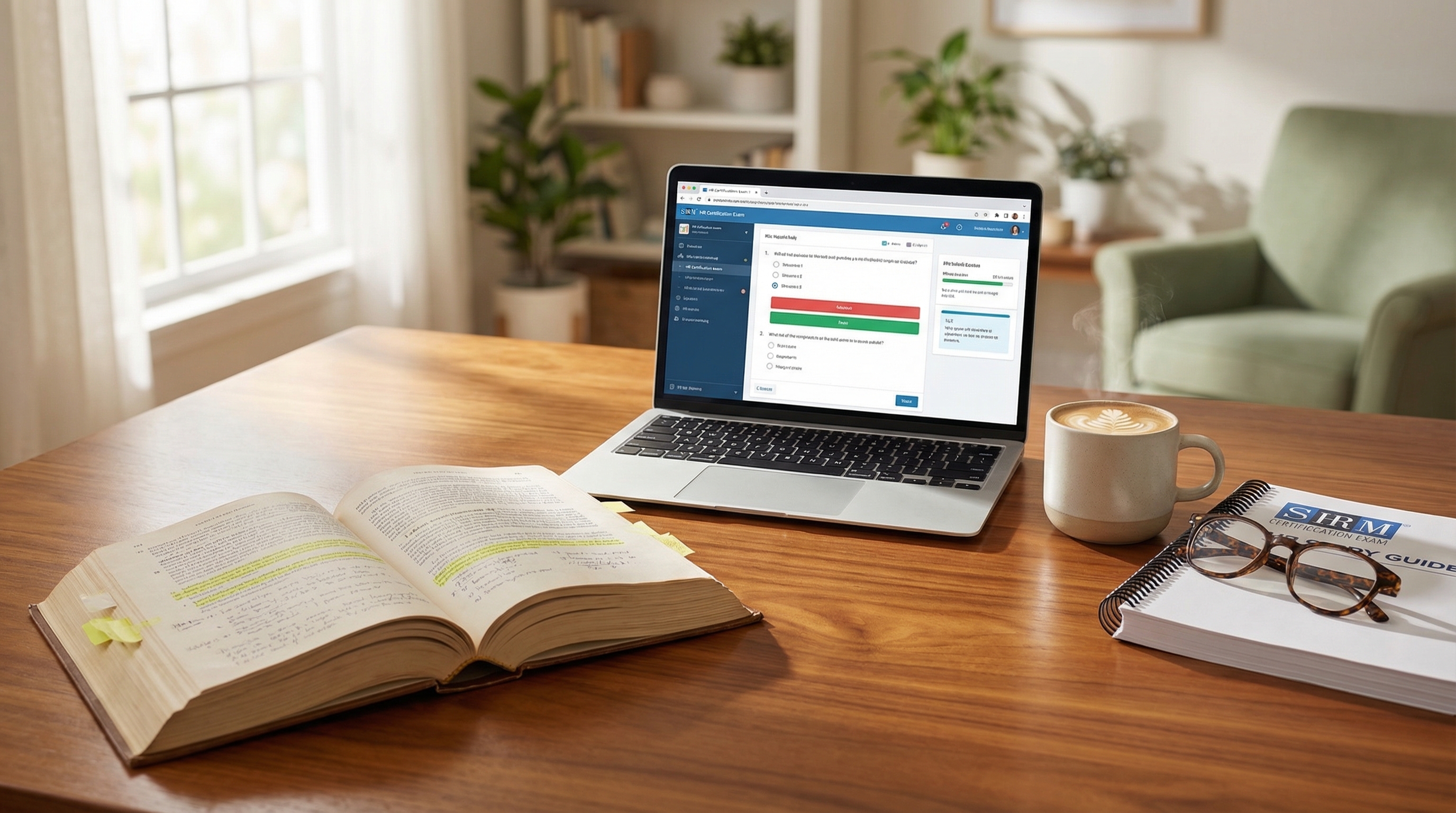
What is aPHR Certification?
The aPHR (Associate Professional in Human Resources) is HRCI's entry-level credential — the only HR certification with zero experience or HR work history required. The exam costs $400 total ($100 non-refundable application fee + $300 exam fee), runs 90 questions over 1 hour 45 minutes of testing time, and is open to anyone with a high school diploma or equivalent. As of December 31, 2025, the aPHR pass rate is 71% per HRCI, with 10,184 active credential holders and 2,145 candidates tested in calendar year 2025.
- 1.aPHR is HRCI's only certification with zero experience requirement. High school diploma minimum, no degree or HR work history needed
- 2.The exam is 90 multiple-choice questions over 1 hour 45 minutes of testing (plus 30 minutes admin), with 65 scored items and 25 unscored pretest items administered through Pearson VUE or OnVUE remote proctoring
- 3.Pass rate is 71% as of December 31, 2025 per HRCI Pass Rates — comparable to PHR (72%) and SPHR (76%). 2,145 candidates tested in 2025; 10,184 active aPHR holders worldwide
- 4.Total cost is $400: a $100 non-refundable application fee plus a $300 exam fee. Recertification requires 45 credits every 3 years at $169
- 5.aPHR isn't a prerequisite for PHR — it's an optional starting credential. Most candidates use it to demonstrate HR commitment while accumulating the 1-4 years of experience needed for PHR or moving directly to SHRM-CP (no experience required)
None
Experience Required
90
Exam Questions (65 scored)
71%
Pass Rate (Dec 2025)
$400
Total Cost ($100 + $300)
What's aPHR?
The Associate Professional in Human Resources (aPHR) is HRCI's entry-level certification, and it exists for one specific reason: to give people who are new to HR a way to prove they're serious. Unlike PHR or SPHR, which require years of professional HR experience, aPHR has no experience requirement at all. You can be a career changer, a recent graduate, or someone who's never set foot in an HR department. If you can pass the exam, you earn the credential.
The certification covers foundational HR knowledge: operations, recruitment basics, compensation fundamentals, employee relations, and compliance. Think of it as proof that you understand how HR works at a conceptual level, even if you haven't done the work professionally yet. When a hiring manager sees aPHR on your resume, they know you invested real time and money learning HR fundamentals and passed a legitimate exam. That matters when you're competing against other entry-level candidates who have nothing to show beyond a degree.
One thing to be clear about: aPHR isn't a prerequisite for PHR. It's an optional starting point. Many people skip it entirely and go straight to PHR or SHRM-CP once they have enough experience. Others use aPHR as a stepping stone to show commitment while they build the 1-4 years of experience needed for those higher credentials. Either approach works. The question is whether having aPHR now helps you get your foot in the door faster.
Who Should Actually Get aPHR
If you're transitioning from another field (administrative work, customer service, retail management, anything), aPHR gives you something concrete to point to. You can't control whether hiring managers care about your previous experience, but you can show them you know HR fundamentals. The certification won't replace experience, but it shortens the conversation about whether you're serious about HR. See our breaking into HR guide for the full career change playbook.
As a recent graduate without HR experience, you may have finished your degree in HR, business, or psychology but don't have the 1-2 years of professional experience that PHR requires. aPHR gives you an immediate credential while you're job hunting and building experience. It's particularly useful if your degree wasn't in HR specifically, because it validates that you've studied the HR body of knowledge.
If you're already working in an HR-adjacent role, whether as an HR coordinator, HR assistant, or office administrator with some HR responsibilities, aPHR validates what you already know and positions you for a move into a dedicated HR specialist or generalist role. It's a small investment that says you're ready for more.
Some people should skip it entirely. If you already have 2+ years of professional HR experience, go straight to PHR or SHRM-CP. Those certifications carry more weight and open more doors. aPHR is specifically valuable when you don't yet qualify for the bigger credentials. Using it as a bridge makes sense. Staying at aPHR when you could pursue PHR doesn't.
What the Exam Actually Covers
The aPHR exam is 90 multiple-choice questions over 1 hour 45 minutes of testing time (plus 30 minutes of administrative time, for 2 hours 15 minutes total seat time). Of the 90 questions, 65 are scored and 25 are unscored pretest items HRCI is evaluating for future exams. You won't know which are which, so answer everything seriously. The exam is computer-based and offered at Pearson VUE testing centers or via OnVUE remote proctoring. (Source: HRCI aPHR page.)
The exam tests foundational HR understanding, not strategic thinking. You need to know what HR does and why, not how to redesign an organization's talent strategy. HRCI publishes the current exam content outline directly — always check HRCI's aPHR page for the latest domain weights before testing, since these are reviewed periodically.
HR Operations is historically the largest domain. It covers policies and procedures, HRIS basics, record-keeping, and HR metrics fundamentals. If you understand what an HR department does on a daily basis, you'll handle this section well. Employee Relations covers workplace policies, employee communication, conflict basics, and employment law fundamentals. You need to know the basics of Title VII, ADA, and FMLA, but not at the depth PHR requires.
Recruitment and Selection tests your understanding of job analysis, recruiting sources, interviewing fundamentals, and onboarding. Compensation and Benefits covers pay structures, benefits basics, and total rewards concepts. Human Resource Development and Retention addresses training basics, performance management, and employee engagement. HR Operations and Recruitment together typically make up the bulk of the exam — if you have to prioritize study time, focus there.
How to Prepare
Most people need 40-80 hours of study spread over 1-3 months. If you have an HR degree or have been working in HR-adjacent roles, you'll probably need less. If you're coming from a completely unrelated field, plan for the higher end. The exam tests breadth of foundational knowledge, so you need to cover all five domains even if some feel more natural than others.
HRCI partners with exam prep providers for aPHR study materials. Budget $200-$400 for a quality study guide and practice question bank. The most effective approach for most people: work through a comprehensive study guide chapter by chapter, then take practice exams to identify weak areas, then focus your remaining study time on those gaps. Free supplementary resources like HR podcasts, SHRM articles, and YouTube content can reinforce concepts, but they shouldn't be your primary study material.
Focus your heaviest study on HR Operations (33%) and Recruitment and Selection (22%), which together make up over half the exam. Practice with sample questions to get comfortable with the format and pacing. When you're consistently scoring 75%+ on practice exams, you're ready. The approximately 70% pass rate means structured preparation works. Don't overthink it, but don't wing it either.
Source: Bureau of Labor Statistics, Occupational Outlook Handbook
What Comes After aPHR
The immediate goal after earning aPHR is landing an entry-level HR position. Roles that aPHR supports include HR coordinator, HR assistant, recruiting coordinator, benefits coordinator, and payroll assistant. The BLS reports 944,300 HR specialist positions nationally with 78,700 annual openings, and many of those entry-level openings are filled based on demonstrated knowledge rather than years of experience. aPHR gives you that demonstrated knowledge.
Most aPHR holders plan to advance to PHR once they've accumulated 1-4 years of professional HR experience (the exact requirement depends on your education level). PHR validates deeper technical knowledge and qualifies you for HR specialist, HR generalist, and supervisory roles. The aPHR-to-PHR progression is a natural HRCI pathway. Some people also consider SHRM-CP instead, which no longer requires experience to sit for the exam. See our PHR vs SHRM-CP comparison to decide which path makes more sense for you.
The salary impact is real at the entry level. aPHR holders report earning 10-15% more than non-certified peers in comparable roles. At a $40,000-$50,000 starting salary, that's $4,000-$7,500 more per year for a $420-$595 investment. The ROI is strong. But the bigger value is access: aPHR gets your resume past the initial screening by giving hiring managers a reason to take you seriously when you don't have traditional HR credentials yet.
Steps to Earn aPHR
No Experience Required
aPHR is HRCI's only certification with zero experience or education requirements. High school diploma is the minimum. Career changers, recent graduates, and HR newcomers can all apply.
Apply Through HRCI
Submit your application at [hrci.org](https://www.hrci.org/). Application fee: $100 (non-refundable). Exam fee: $300. Total: $400.
Study 40-80 Hours Over 2-3 Months
HRCI prep materials run $200-$400. Focus on HR Operations (33%) and Recruitment and Selection (22%), which together make up over half the exam. Aim for 75%+ on practice exams.
Pass the 2.25-Hour Exam
100 multiple-choice questions (90 scored + 10 pretest). Available at Pearson VUE testing centers or via remote proctoring. Pass rate is approximately 70%.
Maintain with 45 Recertification Credits Every 3 Years
Earn credits through professional development, conferences, and HR learning activities. If you advance to [PHR](/certifications/phr/) within three years, you won't need to maintain aPHR separately.
Frequently Asked Questions
Sources
- 1.SHRM. Society for Human Resource Management — Industry surveys, benchmarks, certification standards, and HR best practices
- 2.HRCI. HR Certification Institute — PHR, SPHR, GPHR, and aPHR certification requirements, eligibility, and exam information
Related Guides

Taylor Rupe
Education Researcher & Data Analyst
B.A. Psychology, University of Washington · B.S. Computer Science, Oregon State University
Taylor combines training in behavioral science with data analysis to evaluate HR education programs. His research methodology uses IPEDS completion data, BLS employment statistics, and SHRM alignment data to produce evidence-based program rankings.