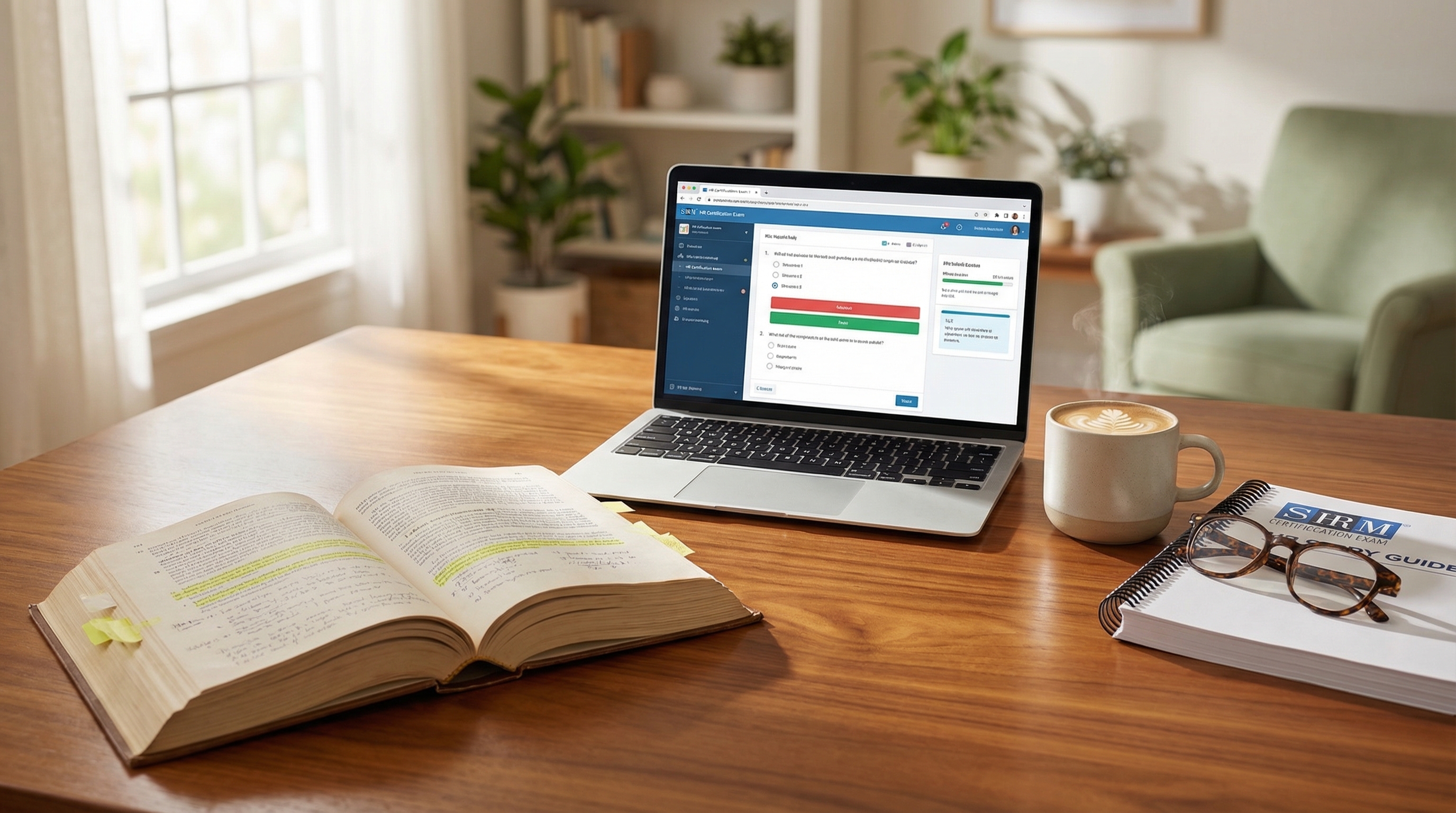
The HR certification process takes 3-6 months from decision to exam day. Step one is choosing between SHRM (SHRM-CP or SHRM-SCP) and HRCI (aPHR, PHR, or SPHR) based on your experience level, employer preference, and exam style. Study for 60-150 hours over 2-5 months, register for an exam window, and pass a 3-4 hour proctored exam. Recertify every 3 years with 60 professional development credits. Total cost: $400-$1,800 depending on certification level and study materials.
3-6 mo
Typical Timeline
80-120 hrs
Optimal Study Time
60-70%
First-Time Pass Rate
14-25%
Salary Premium After Passing
The Certification Process at a Glance
Getting HR certified is not as complicated as certification bodies sometimes make it seem. The core process is: verify you meet eligibility requirements, choose your certification, register and pay the exam fee, study for 2-5 months, take a proctored computer-based exam, and maintain your credential through professional development every 3 years. Most candidates complete the entire journey in 3-6 months.
The hardest part is not the exam itself, it is the study discipline. Candidates who dedicate 80-120 hours of structured study time over 3-5 months have the highest pass rates. The candidates who fail are typically those who underestimate the preparation required or cram in the final weeks. This guide gives you a realistic timeline and the specific resources that produce results.
7 Steps to Getting HR Certified
Step 1: Assess your eligibility and career stage
Review your years of HR experience and education level. [aPHR](/certifications/aphr/) requires no experience or degree. [SHRM-CP](/certifications/shrm-cp/) dropped its experience requirement in 2024. [PHR](/certifications/phr/) requires 1-4 years depending on education. [SHRM-SCP](/certifications/shrm-scp/) and [SPHR](/certifications/sphr/) require 4-7+ years. Use [HRCI's eligibility tool](https://www.hrci.org/certifications/eligibility-tool) and [SHRM's credential guide](https://www.shrm.org/credentials/certification) to confirm your options.
Step 2: Choose SHRM or HRCI (and which level)
Both certification families are respected. SHRM-CP emphasizes behavioral competency and situational judgment. PHR emphasizes technical knowledge and employment law depth. Check your employer's preference, review job postings in your target market, and match the exam format to your strengths. See the SHRM vs HRCI comparison table below and our [PHR vs SHRM-CP guide](/certifications/phr-vs-shrm-cp/).
Step 3: Register and choose your exam window
SHRM exams run in two windows: May-July and December-February. Register at [shrm.org](https://www.shrm.org/credentials/certification). HRCI exams are available year-round at Pearson VUE testing centers. Register at [hrci.org](https://www.hrci.org/certifications/apply-for-certification). Pick a date 3-5 months out to build in adequate study time. Both organizations charge a non-refundable application fee, so commit before registering.
Step 4: Get study materials and build a plan
The SHRM Learning System ($820+) is the official SHRM-CP/SCP prep resource. HRCI offers official prep materials ($399-$599). Third-party options include Mometrix, HRStudyPro, and Workology at $100-$400. Build a weekly study schedule working backward from your exam date. Aim for 10-15 hours per week over 8-12 weeks. Alternate between reading content, practice questions, and timed practice exams.
Step 5: Study for 80-120 hours over 3-5 months
Focus on the areas where your knowledge is weakest, not the topics you already know well. For SHRM-CP, spend extra time on situational judgment questions since they make up roughly half the exam. For PHR, prioritize employment law (FMLA, ADA, FLSA, Title VII) and compensation/benefits technical content. Take at least 3 full-length practice exams under timed conditions before exam day.
Step 6: Take the exam and pass
Both SHRM and HRCI exams are 3-4 hours at a proctored testing center or approved remote proctoring setup. SHRM-CP has 134 questions (24 pre-test). PHR has 90 scored questions plus 25 pre-test. Arrive early, bring valid photo ID, and manage your time. You cannot go back to previous sections on the HRCI exam, so answer every question before moving on. Results are provided immediately for HRCI exams and within a few weeks for SHRM.
Step 7: Maintain through recertification
All major HR certifications require 60 professional development credits every 3 years, or you can retake the exam. Earn credits through SHRM or HRCI-approved activities: conferences, webinars, courses, publishing, teaching, or volunteer HR leadership. Most active HR professionals earn enough credits through normal professional development without extra effort. Recertification fees: $165-$210 (SHRM) or $169 (HRCI).
SHRM vs HRCI Certification Paths Side by Side
HR Certification Levels Explained
HRCI's entry-level credential for career changers, students, and anyone new to HR. No experience or degree required. Validates foundational HR knowledge across operations, recruitment, compensation, employee relations, and compliance. Exam: 65 scored questions + 25 pre-test over 1 hour 45 minutes. Cost: $400 total. Pass rate: approximately 75%. Valid for 3 years. See our aPHR guide.
Key Skills
Common Roles
- HR Assistant
- HR Coordinator
- Career changers
The two foundational certifications that most HR professionals pursue. SHRM-CP validates both behavioral competency and knowledge through situational judgment questions. PHR validates deep HR knowledge mastery with emphasis on U.S. employment law. Both deliver a 14-25% salary premium. SHRM-CP: $595-$695, no experience required. PHR: $495, requires 1-4 years experience. These are the credentials that appear most frequently in HR job postings.
Key Skills
Common Roles
- HR Generalist
- HR Specialist
- HR Business Partner
Senior certifications for HR leaders operating at the strategic and policy-making level. SHRM-SCP focuses on aligning HR with business strategy through advanced situational judgment. SPHR validates deep strategic HR mastery and organizational leadership. Both require significant experience (4-7+ years). Salary premium: 20-30%. These unlock HR Director, VP, and CHRO roles.
Key Skills
Common Roles
- HR Director
- VP of Human Resources
- CHRO
Eligibility Requirements Explained
Eligibility requirements vary significantly by certification and have changed recently, particularly for SHRM. Here is the current state as of 2026.
aPHR: No HR experience required. No degree required. High school diploma or equivalent is the only prerequisite. This is genuinely open to anyone. Cost: $100 application + $300 exam = $400 total.
SHRM-CP: SHRM removed the experience requirement in 2024, making this credential accessible to students, career changers, and early-career professionals. No degree requirement either. This was a significant change that expanded the candidate pool considerably. Cost: $595 (SHRM members) or $695 (non-members). Early-bird pricing saves $75-$100.
PHR: Requires HR experience that scales with education level. With a master's degree: 1 year. With a bachelor's: 2 years. With less than a bachelor's: 4 years. Experience must be in an HR role, not just any professional experience. Cost: $100 application + $395 exam = $495 total.
SPHR: Requires strategic-level HR experience. With a master's: 4 years. With a bachelor's: 5 years. With less than a bachelor's: 7 years. HRCI evaluates whether your experience qualifies as 'strategic' HR. Cost: $100 application + $495 exam = $595 total.
SHRM-SCP: Requires 6-7 years of HR experience in a strategic role, or 3 years if you already hold SHRM-CP. The experience must involve developing HR strategy and policies, not just implementing them. Cost: $595 (members) or $695 (non-members).
Source: Industry estimates from Workology, HRStudyPro, and prep provider surveys
Study Timeline and Resources That Actually Work
The data is clear: 80-120 hours of structured study over 3-5 months produces the best outcomes. Candidates who study fewer than 60 hours fail at much higher rates. Candidates who study more than 150 hours report diminishing returns and burnout. Build a weekly plan of 10-15 hours and protect that time.
Recommended study resources by certification: For SHRM-CP and SHRM-SCP, the SHRM Learning System ($820+) is the gold standard. It includes the SHRM Body of Applied Skills and Knowledge (BASK), practice questions, and flashcards. Third-party alternatives like Workology ($297) and Mometrix ($79.99) are solid supplements. For PHR and SPHR, HRCI's official prep materials ($399-$599) align directly with the exam content outline. Sandra Reed's PHR/SPHR study guides from SHRM publishing are widely recommended.
A proven study approach: Weeks 1-4, read through all content areas and take notes on unfamiliar concepts. Weeks 5-8, work through practice questions by topic area, spending extra time on your weakest domains. Weeks 9-12, take 3+ full-length timed practice exams and review every wrong answer. The final two weeks should be light review of high-yield topics, not cramming new material.
Exam Day: What to Expect and How to Succeed
SHRM exams are offered at Prometric testing centers and through remote proctoring. HRCI exams are at Pearson VUE centers. Both require government-issued photo ID that exactly matches your registration name. Arrive 30 minutes early. You cannot bring notes, phones, watches, or food into the testing room. Some centers provide earplugs or noise-canceling headphones.
Time management is critical. SHRM-CP gives you 4 hours for 134 questions (roughly 1.8 minutes each). PHR gives you 3 hours for 115 questions (roughly 1.6 minutes each). Do not spend more than 2 minutes on any single question. Flag difficult questions and return to them if time permits. For HRCI exams, note that you cannot go back to previous sections, so answer every question before moving forward.
For SHRM situational judgment questions, focus on what SHRM would consider the best HR response, not what you might actually do in your specific workplace. These questions test SHRM's competency model, not workplace pragmatism. For PHR knowledge questions, watch for absolute words like 'always' and 'never' since these answers are usually wrong. Eliminate two clearly wrong options first, then choose between the remaining two.
Source: Bureau of Labor Statistics, Occupational Outlook Handbook
Recertification: Keeping Your Credential Active
All major HR certifications expire after 3 years unless you recertify. SHRM requires 60 Professional Development Credits (PDCs). HRCI requires 60 recertification credits. You can also retake the exam instead of earning credits, but most professionals choose the credit route because it integrates naturally with ongoing professional development.
Credit-earning activities include: attending conferences and chapter meetings, completing online courses and webinars, publishing articles or research, teaching or mentoring, serving in HR leadership volunteer roles, and completing additional certifications. Both SHRM and HRCI have online tracking systems where you log activities throughout the 3-year cycle. Start logging from day one instead of scrambling at the end.
Recertification fees: SHRM charges $165 (members) or $210 (non-members). HRCI charges $169 for PHR/SPHR/GPHR. If your certification lapses, both organizations offer reinstatement options that vary by how long the credential has been expired. Maintaining active certification is significantly easier and cheaper than re-earning it.
Frequently Asked Questions
Sources
- 1.SHRM. Certification Exam Options and Fees — SHRM-CP and SHRM-SCP exam fees, testing windows, and eligibility for 2026.
- 2.HRCI. Exam Fees and Eligibility — aPHR, PHR, SPHR, GPHR fee schedules and eligibility requirements.
- 3.HRCI. PHR Certification Requirements — PHR eligibility criteria by education level and experience.
- 4.Workology. Pass Rates for SPHR, PHR, SHRM-CP, SHRM-SCP — Industry estimates for HR certification pass rates based on candidate surveys.
- 5.Payscale. SHRM-CP Salary Impact — Salary premium data for SHRM-CP certified professionals.
- 6.Bureau of Labor Statistics. Occupational Employment and Wage Statistics — HR Specialist (SOC 13-1071) and HR Manager (SOC 11-3121) salary data, May 2024.
Related Guides

Taylor Rupe
Education Researcher & Data Analyst
B.A. Psychology, University of Washington · B.S. Computer Science, Oregon State University
Taylor combines training in behavioral science with data analysis to evaluate HR education programs. His research methodology uses IPEDS completion data, BLS employment statistics, and SHRM alignment data to produce evidence-based program rankings.