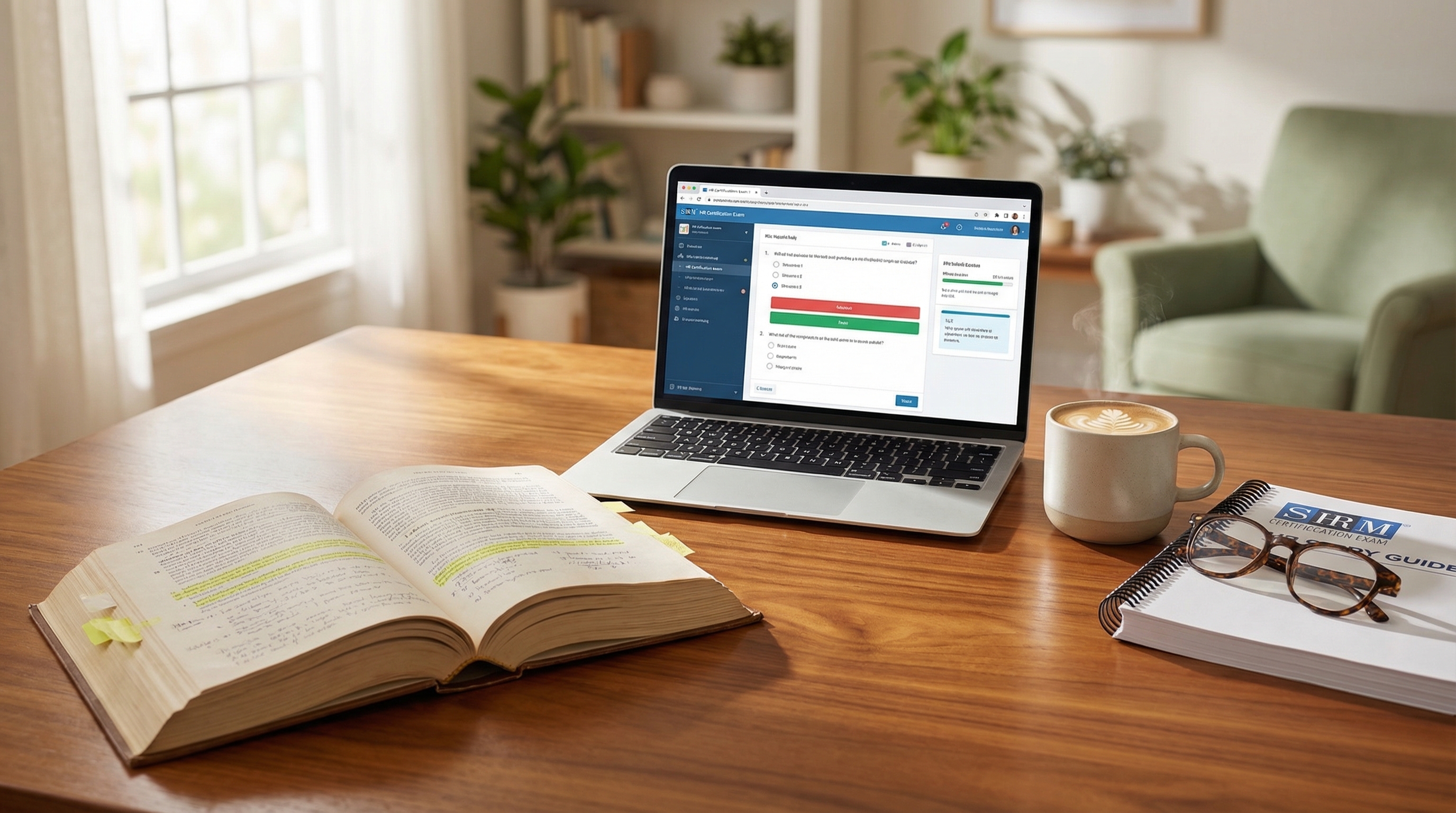
- 1.This phr certification guide highlights that PHR requires 1-4 years of professional HR experience depending on your education level. No experience workaround exists
- 2.The exam is 175 questions over 3 hours. Employee and Labor Relations alone makes up 39% of your score
- 3.Pass rate sits at approximately 60%, lower than SHRM-CP (~70%). This reflects PHR's emphasis on deep knowledge mastery
- 4.Total cost ranges from $600-$1,500 including application fee ($100), exam fee ($395-$495), and study materials ($200-$800)
- 5.PHR holders earn a measurable premium more than non-certified peers at equivalent levels. That premium compounds over your entire career
175
Exam Questions
3 hours
Exam Duration
~60%
Pass Rate
60 credits
Recertification/3yrs
What's PHR?
The Professional in Human Resources (PHR) is a certification from the HR Certification Institute (HRCI), the organization that has been credentialing HR professionals since 1976. PHR validates that you have deep, technical knowledge of how HR actually works: employment law, compensation structures, employee relations, talent management, and learning and development. This isn't a certification about HR strategy or organizational design. It's about knowing the rules, the regulations, and the operational mechanics of running an HR function.
PHR focuses heavily on U.S. employment law and practices, which makes it particularly relevant if you work in domestic HR roles. Title VII, ADA, FMLA, FLSA, OSHA, NLRA: these laws drive a significant portion of the exam. If the idea of memorizing employment law details makes you groan, that's worth knowing upfront. PHR rewards people who can retain and apply detailed knowledge. If you're the kind of person who'd rather work through workplace scenarios intuitively, SHRM-CP might be a better fit for how your brain works.
Typical PHR holders include HR generalists, HR specialists, benefits coordinators, recruiting managers, and HRIS administrators. The credential tells employers you've demonstrated comprehensive HR knowledge required for independent professional practice. Many PHR holders advance to SPHR as their careers move into strategic leadership. Others add SHRM-CP or SHRM-SCP for dual-certification coverage.
Eligibility Requirements
PHR requires professional HR experience, and the amount depends on your education. HRCI uses an education-experience matrix that's straightforward: more education means less experience required. All experience must be in professional-level HR positions where HR is your primary responsibility. Administrative support roles with occasional HR tasks usually don't count.
With a master's degree or higher, you need 1 year of professional HR experience. With a bachelor's degree, 2 years. Without a bachelor's degree, 4 years. Part-time HR experience counts proportionally: working 20 hours/week in HR for 2 years equals 1 year of full-time equivalent. Contract and consulting work qualifies if you can document professional-level HR responsibilities.
Qualifying experience means work in recognized HR functions: recruitment and selection, compensation and benefits administration, training and development, employee relations, HR compliance, HRIS management, and HR policy implementation. The experience needs to involve professional judgment and independent decision-making, not just filing paperwork. An HR coordinator role usually qualifies. An office manager who occasionally helps with onboarding probably doesn't.
The application process starts with submitting an eligibility application through HRCI's online system before registering for the exam. HRCI reviews your education and experience documentation and approves eligible candidates within 1-2 weeks. Once approved, you get a 120-day window to schedule and complete your exam. The application fee is $100 (non-refundable, separate from the exam fee). HRCI audits a percentage of applications, so keep accurate records of your HR work history.
If you don't qualify yet because you're short on experience, consider aPHR (no experience required) or SHRM-CP (which recently removed its experience requirement). Both give you a credential while you build the experience needed for PHR. See our HR career path guide for how certification fits into your long-term trajectory.
Is PHR Right for You?
- 2-5 years of professional HR experience
- Operational HR role with compliance responsibilities
- You're good at retaining detailed knowledge
- Your employer or industry values HRCI credentials
Things to Know
- Budget $600-$1,500 total
- Plan for 80-150 hours of study over 3-5 months
- Employment law knowledge is critical for passing
- Your employer prefers SHRM credentials
- You prefer scenario-based testing over knowledge recall
- You graduated from a SHRM-aligned program
- You want the SHRM networking ecosystem
Things to Know
- SHRM-CP no longer requires experience
- Higher pass rate (~70%) may reflect different testing approach
- Both are widely respected by employers
- 5+ years of strategic HR experience
- You're already making policy-level decisions
- Director or VP-level responsibilities
- You want to skip PHR and go straight to senior
Things to Know
- SPHR has a lower pass rate (~55%)
- Tests strategic thinking, not just knowledge
- May be more credential than you need right now
- Less than 1-2 years of HR experience
- Career changer entering HR
- Want an HRCI credential while building experience
- Tighter budget for certification
Things to Know
- aPHR carries less weight than PHR
- Good stepping stone to PHR in 1-3 years
- Lower cost and shorter prep time
Exam Domains and Content
The PHR exam tests knowledge across five domains. Understanding the weighting tells you where to spend your study time. The exam emphasizes practical application within U.S. employment law context. Some questions test factual recall, but most assess your ability to apply HR principles to realistic workplace situations.
Employee and Labor Relations (39%) is the big one. Nearly 4 out of 10 questions come from this domain. It covers employment law (Title VII, ADA, FMLA, FLSA, OSHA), workplace policies, discipline and termination, union organizing, collective bargaining, grievance handling, workplace investigations, and employee communication. Strong performance here often determines whether you pass. If employment law doesn't come naturally to you, this domain needs the most study time.
Business Management (20%) covers HR's role in organizational effectiveness: strategy alignment, change management, HR metrics and analytics, technology applications, and risk management. You need to understand how HR supports broader business objectives. Workforce planning, organizational development, and HR budgeting all appear here.
Talent Planning and Acquisition (16%) covers workforce planning, recruiting strategies, selection methods, interviewing, candidate assessment, onboarding, and employment branding. Think of the full talent acquisition lifecycle from planning through a new hire's first weeks.
Total Rewards (15%) encompasses compensation philosophy, pay structures, benefits administration, regulatory compliance (ERISA, COBRA, ACA), incentive programs, and employee recognition. You need to understand both strategic design and operational administration of rewards programs.
Learning and Development (10%) rounds out the exam with training needs assessment, program design, delivery methods, evaluation, performance management, and succession planning. The smallest domain by weight, but you still need solid knowledge here.
Exam Format and Scoring
The PHR exam is 175 multiple-choice questions over 3 hours at Pearson VUE testing centers or through remote proctoring. Of those questions, 150 are scored and 25 are unscored pretest items being evaluated for future exams. You won't know which are which, so treat every question like it counts. The exam is available year-round.
All questions have four answer options. Some test straight factual recall ("Which law requires.."). Most present realistic workplace situations and ask what you'd do: "An employee files a complaint alleging discrimination. What should the HR manager do first?" Many questions have multiple plausible answers, and you need to identify the best one. Reading carefully matters because the details in the scenario often determine the correct response.
HRCI uses scaled scoring where 500 represents passing on a 100-700 scale. The exact number of correct answers needed to pass varies by exam form because scoring adjusts for question difficulty. You see a preliminary pass/fail result immediately after finishing. Official score reports come within 24-48 hours through your HRCI account, showing performance by domain so you know where to focus if you need to retake.
You can mark questions for review and navigate back and forth throughout the exam. A basic on-screen calculator is available. Personal items (phones, watches) must be stored outside the testing area. Remote proctoring requires a webcam, stable internet, and a private space.
How to Prepare for PHR
Plan for 80-150 hours of study over 3-5 months. The approximately 60% pass rate means this exam demands serious preparation. You can't cram for PHR because it tests comprehensive knowledge across all domains, not just a few key topics. Candidates with HR degrees covering employment law need less preparation than those whose education was in unrelated fields.
HRCI partners with exam prep providers for official study materials. Budget $200-$800 depending on format. Popular options include HRCI's online learning modules, third-party study guides, and comprehensive prep courses. Many candidates combine a primary study guide with supplementary practice question banks. The study materials you choose matter less than how consistently you use them.
Allocate your study time proportional to domain weighting. Employee and Labor Relations (39%) deserves roughly 40% of your preparation effort. Set a consistent weekly schedule of 10-15 hours over 3-4 months. Focus on understanding why, not just what. The exam tests application, so knowing a law exists isn't enough. You need to know when it applies, what it requires, and what happens when it's violated. Pay particular attention to Title VII, ADA, FMLA, FLSA, NLRA, and OSHA.
Practice exams are essential. Take them under timed conditions to build stamina and pacing. When you get a question wrong, don't just note the correct answer. Understand why your answer was wrong and why the correct answer is better. Aim for consistent 75-80% scores on practice exams before scheduling your official test. If you're below 70% in any domain, that domain needs more work.
What PHR Actually Costs
Total investment ranges from $600 to $1,500 depending on your study approach. Many employers reimburse certification costs as professional development, so ask before you pay out of pocket. The ROI argument is easy to make: certified HR staff earn 14-15% more and bring validated competency that reduces organizational risk.
The application fee is $100 (non-refundable). The exam fee runs $395-$495 depending on testing format. If you fail and retake, you pay the full exam fee again but the application fee is waived within your eligibility period. Study materials add $200-$800 depending on format. Self-study guides run $50-$150. Comprehensive prep courses with practice exams run $400-$800.
The return on investment is strong. At the HR specialist median salary of $72,910 (BLS May 2024), a 14-15% premium translates to $10,000-$17,000 more per year. Even at maximum investment ($1,500), first-year ROI exceeds 500%. Beyond direct compensation, PHR qualifies you for positions that require or prefer certification, which accelerates your career trajectory.
Salary Impact
PHR certification produces measurable salary impact across career levels. The premium reflects validated knowledge that employers value, particularly in roles involving compliance, employee relations, and independent HR judgment.
At the specialist level, PHR holders report median salaries of $72,000-$80,000, compared to the $72,910 median for all HR specialists reported by the BLS. The premium compounds at senior levels: PHR holders advancing to HR manager roles report compensation that exceeds the $140,030 general HR manager median. Beyond base salary, many employers require or strongly prefer PHR for mid-level HR positions, meaning the credential affects which jobs you can even get, not just how much they pay.
Industry and location affect the certification premium. Government agencies and healthcare organizations particularly value formal HR credentialing and often list PHR as a job requirement. Large employers in competitive markets show stronger credential preferences. Manufacturing and traditional industries with long HRCI history continue to value PHR highly. See our HR Salary Guide for comprehensive analysis by certification, industry, and location.
Honest Assessment: When PHR Is and Isn't Worth It
PHR delivers strong ROI for HR professionals in compliance-heavy environments. If your work involves navigating employment law, managing employee relations investigations, or administering benefits programs, PHR validates the exact knowledge employers need you to have. Government agencies, healthcare organizations, and manufacturing companies frequently require or strongly prefer PHR, and in those sectors the credential directly affects which jobs you can access.
The credential is particularly valuable if you plan to build a career around technical HR mastery. PHR holders who specialize in compliance, employee relations, or total rewards find that the deep knowledge the exam demands continues paying dividends. The HRCI credential pathway (aPHR to PHR to SPHR) provides a clear progression that maps to career advancement.
But PHR isn't the right investment for everyone. If you don't yet meet the experience requirement (1-4 years depending on education), don't wait. Get SHRM-CP or aPHR now and add PHR later. Waiting years for eligibility while competitors get certified costs you more in lost salary premium than any exam fee.
If memorizing employment law details makes you miserable, PHR will be a slog. The Employee and Labor Relations domain is 39% of the exam. That's not a weakness you can compensate for with strength elsewhere. If you prefer scenario-based thinking over knowledge recall, SHRM-CP tests the same professional capability through a format that may suit you better. Both credentials carry equal weight with most employers.
If you work at a small company or startup where credential requirements don't exist, PHR may not change your compensation or standing. Small employers value what you can do over what letters follow your name. And if you're already in a senior strategic role, skip PHR entirely and pursue SPHR or SHRM-SCP instead. PHR validates operational knowledge you've already proven.
Source: HRCI Certification Data
Recertification Requirements
PHR requires recertification every three years. You have two options: earn 60 recertification credits through professional development activities, or retake the exam. Almost everyone goes the credit route.
Earning credits is straightforward. Continuing education courses, HR conferences, webcasts, college coursework, professional memberships, teaching HR courses, publishing HR content, and volunteer leadership in HR organizations all count. HRCI's online system tracks your credit accumulation and sends reminders as your deadline approaches. Most active HR professionals earn enough credits through normal career development without much extra effort.
The recertification fee is $169 (credit pathway) or the full exam fee (retake pathway), due every three years. Credit-earning activities may involve their own costs (conferences, courses, memberships), but plenty of free options exist: HRCI webcasts, professional reading, workplace training delivery, and volunteer activities. Plan your professional development to accumulate credits naturally through activities that benefit your career regardless of recertification.
Career Path After PHR
Most PHR holders earn certification 2-5 years into their HR careers, after gaining enough experience to meet eligibility requirements and demonstrate knowledge mastery. At certification, typical roles include HR generalist, HR specialist, benefits coordinator, or HRIS analyst. Post-certification paths lead to senior specialist roles, HR business partner positions, or supervisory responsibility. Within 5-7 years of certification, many PHR holders advance to HR manager positions.
As you gain strategic HR experience, SPHR is the natural next step within the HRCI framework. SPHR requires 4-7 years of experience depending on education and validates strategic HR leadership capability. The PHR-to-SPHR progression demonstrates career advancement while maintaining credential continuity. Many HR directors and aspiring CHROs hold SPHR.
Some PHR holders also pursue SHRM-CP or SHRM-SCP to hold credentials from both major certifying bodies. This dual-certification approach provides flexibility across organizations with different credential preferences. Specialty certifications like CCP or CEBS complement PHR for professionals specializing in total rewards. Building a strategic credential portfolio supports long-term advancement.
Steps to Earn PHR
Verify Eligibility
PHR uses an education-experience matrix: master's degree + 1 year HR experience, bachelor's + 2 years, or no degree + 4 years. All experience must be in professional-level HR roles.
Apply Through HRCI
Submit an eligibility application at [hrci.org](https://www.hrci.org/). Application fee: $100 (non-refundable). Exam fee: $395. Total: $495. HRCI reviews and approves within 1-2 weeks.
Study 3-4 Months with Structured Materials
Budget 80-150 hours of preparation. HRCI prep materials run $200-$800 depending on format. Focus heavily on Employee and Labor Relations (39% of the exam). Aim for 75-80% on practice exams.
Pass the Exam at Pearson VUE
175 questions over 3 hours (150 scored + 25 pretest). Available year-round at Pearson VUE testing centers or via remote proctoring. Pass rate is approximately 60%.
Maintain with 60 Recertification Credits Every 3 Years
Earn credits through conferences, courses, webcasts, professional memberships, and HR volunteer activities. Recertification fee: $169. Most active HR professionals accumulate credits through normal career development.
Frequently Asked Questions
Sources
- 1.SHRM. Society for Human Resource Management — Industry surveys, benchmarks, certification standards, and HR best practices
- 2.HRCI. HR Certification Institute — PHR, SPHR, GPHR, and aPHR certification requirements, eligibility, and exam information
Related Guides

Taylor Rupe
Education Researcher & Data Analyst
B.A. Psychology, University of Washington · B.S. Computer Science, Oregon State University
Taylor combines training in behavioral science with data analysis to evaluate HR education programs. His research methodology uses IPEDS completion data, BLS employment statistics, and SHRM alignment data to produce evidence-based program rankings.