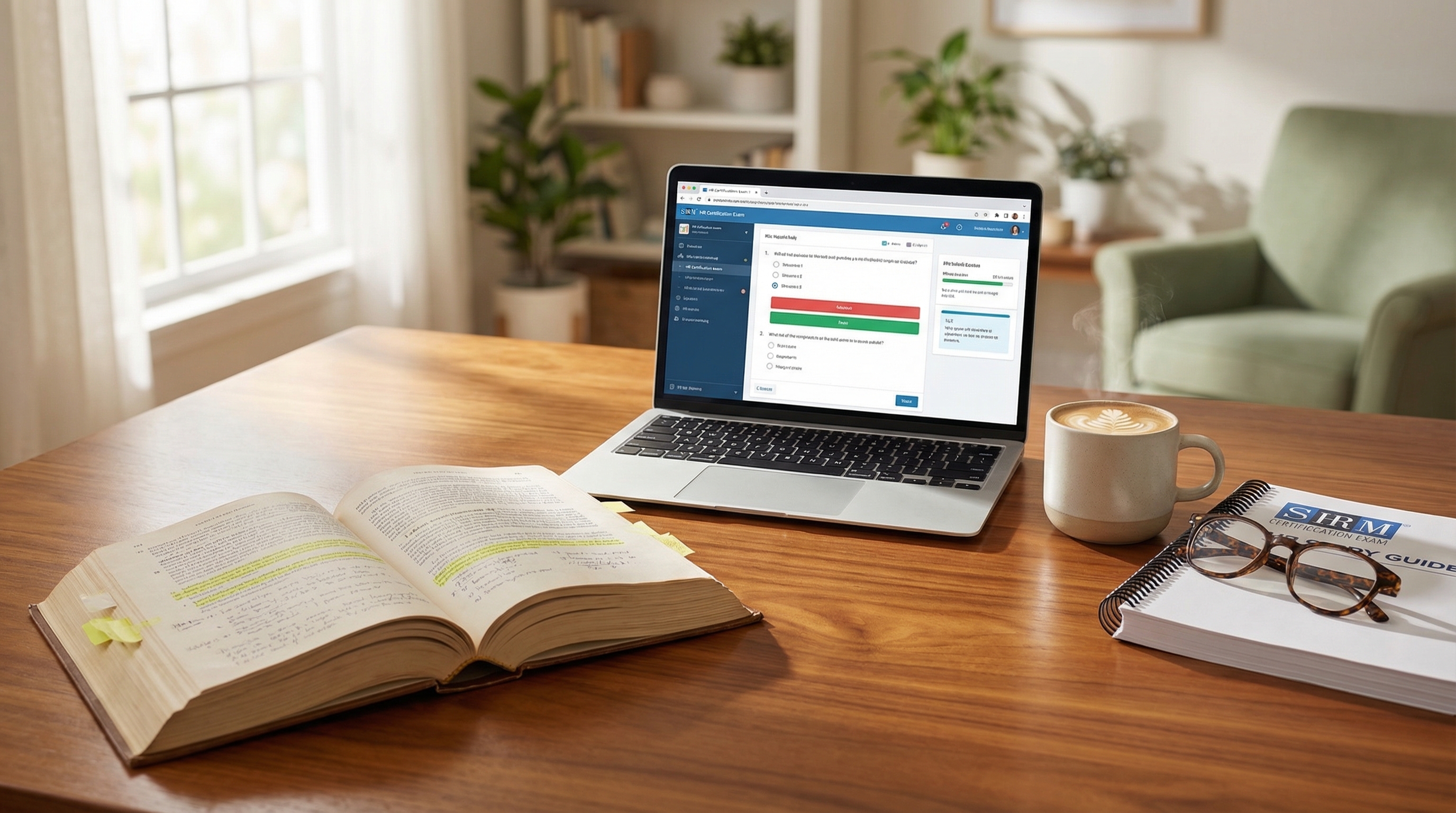
- 1.500+ universities offer HR curricula aligned with SHRM's Body of Applied Skills and Knowledge (SHRM BASK). Alignment is available at associate's, bachelor's, and master's levels
- 2.Students in aligned programs can sit for SHRM-CP in their final year of study, potentially graduating with both a degree and a professional certification
- 3.Your coursework IS your exam prep. Aligned programs cover the nine behavioral competencies SHRM tests, so you don't need separate study materials
- 4.SHRM alignment doesn't mean the program is 'better' than non-aligned programs. It means the curriculum maps to SHRM's framework. Other quality factors (faculty, career services, employer relationships) matter too
- 5.Find aligned programs in SHRM's searchable database at shrm.org/academics
400+
Aligned Programs
3 Levels
Associate-Master's
Early
Exam Eligibility
78,700
Annual HR Openings
What SHRM Alignment Actually Means
SHRM academic alignment means a program's HR curriculum covers the competencies defined in SHRM's Body of Applied Skills and Knowledge (SHRM BASK). SHRM reviews the curriculum, verifies adequate coverage of nine behavioral competencies and HR knowledge domains, and acknowledges the program's alignment. The program appears in SHRM's searchable database and can use SHRM alignment in its marketing.
In practical terms, this means your coursework maps to SHRM-CP exam content. You learn about leadership, business acumen, ethical practice, relationship management, consultation, and the functional HR areas that SHRM tests. When you sit for SHRM-CP, you'll encounter topics you studied in class rather than content you need to learn from scratch.
SHRM updates its competency model periodically based on industry research, and aligned programs update their curricula accordingly. This keeps aligned programs current with what employers actually need, which benefits students regardless of whether they pursue SHRM certification. The competency model reflects real HR practice, not just academic theory.
Benefits for Students
The biggest advantage is early certification eligibility. Students in aligned programs can sit for SHRM-CP in their final year of study. That means you could graduate with both a degree and a professional certification. In a field where 78,700 HR positions open annually (BLS 2024-2034), starting your career already certified gives you a real edge over candidates who need 1-3 more years before they can sit for the exam.
You also get built-in exam prep. Your education IS your preparation. You don't need to buy separate SHRM Learning System materials ($800-$1,100) or invest months in additional study. Your professors are essentially teaching you SHRM-CP content as part of your degree requirements. That saves both time and money.
The curriculum stays career-relevant too. SHRM's competency model reflects what employers actually want from HR professionals. Aligned programs stay current with industry practice, teaching skills that translate directly to entry-level HR jobs. You graduate knowing what matters, not just what's academically interesting.
Employer recognition is another benefit. Some employers specifically recruit from SHRM-aligned programs because they know graduates are prepared for professional practice. The alignment signals curriculum quality to hiring managers familiar with SHRM's framework.
Source: Bureau of Labor Statistics, Occupational Outlook Handbook
Finding SHRM-Aligned Programs
SHRM maintains a searchable database at shrm.org/academics. You can filter by degree level (associate's, bachelor's, master's), state, and delivery format (on-campus, online, hybrid). The database includes program contact information and current alignment status.
When evaluating programs, verify current alignment status, as alignment requires periodic renewal. Ask the program about SHRM-CP pass rates for recent graduates, what percentage of students pursue certification, and how closely the curriculum tracks SHRM's competency model. A program can be aligned on paper but vary in how effectively it prepares students.
Our bachelor's programs and master's programs guides highlight SHRM alignment where applicable. Online programs can also achieve alignment. If you're choosing between programs, SHRM alignment is a meaningful differentiator alongside other factors like location, cost, faculty quality, and career services.
What Alignment Doesn't Mean
SHRM alignment isn't accreditation. It's not the same as AACSB, ACBSP, or regional accreditation, which evaluate overall institutional and program quality. Alignment means the HR curriculum covers SHRM competencies. A poorly run program at a weak institution could technically achieve alignment. Consider alignment alongside other quality indicators.
Alignment isn't required for SHRM-CP. You can earn SHRM-CP regardless of where you studied or whether you studied HR at all. Alignment provides eligibility advantages and exam preparation benefits, but non-aligned graduates qualify by meeting standard eligibility criteria. If your preferred program isn't aligned, you can still pursue SHRM certification.
Alignment is SHRM-specific. It says nothing about HRCI credentials like PHR or SPHR. If you're leaning toward HRCI certification, SHRM alignment is less relevant to your plans, though the competency knowledge still transfers broadly.
Frequently Asked Questions
Sources
- 1.SHRM. Society for Human Resource Management — Industry surveys, benchmarks, certification standards, and HR best practices
- 2.AACSB International — Business school accreditation directory for verifying program quality
- 3.ACBSP. Accreditation Council for Business Schools and Programs — Business program accreditation verification
Related Guides

Taylor Rupe
Education Researcher & Data Analyst
B.A. Psychology, University of Washington · B.S. Computer Science, Oregon State University
Taylor combines training in behavioral science with data analysis to evaluate HR education programs. His research methodology uses IPEDS completion data, BLS employment statistics, and SHRM alignment data to produce evidence-based program rankings.