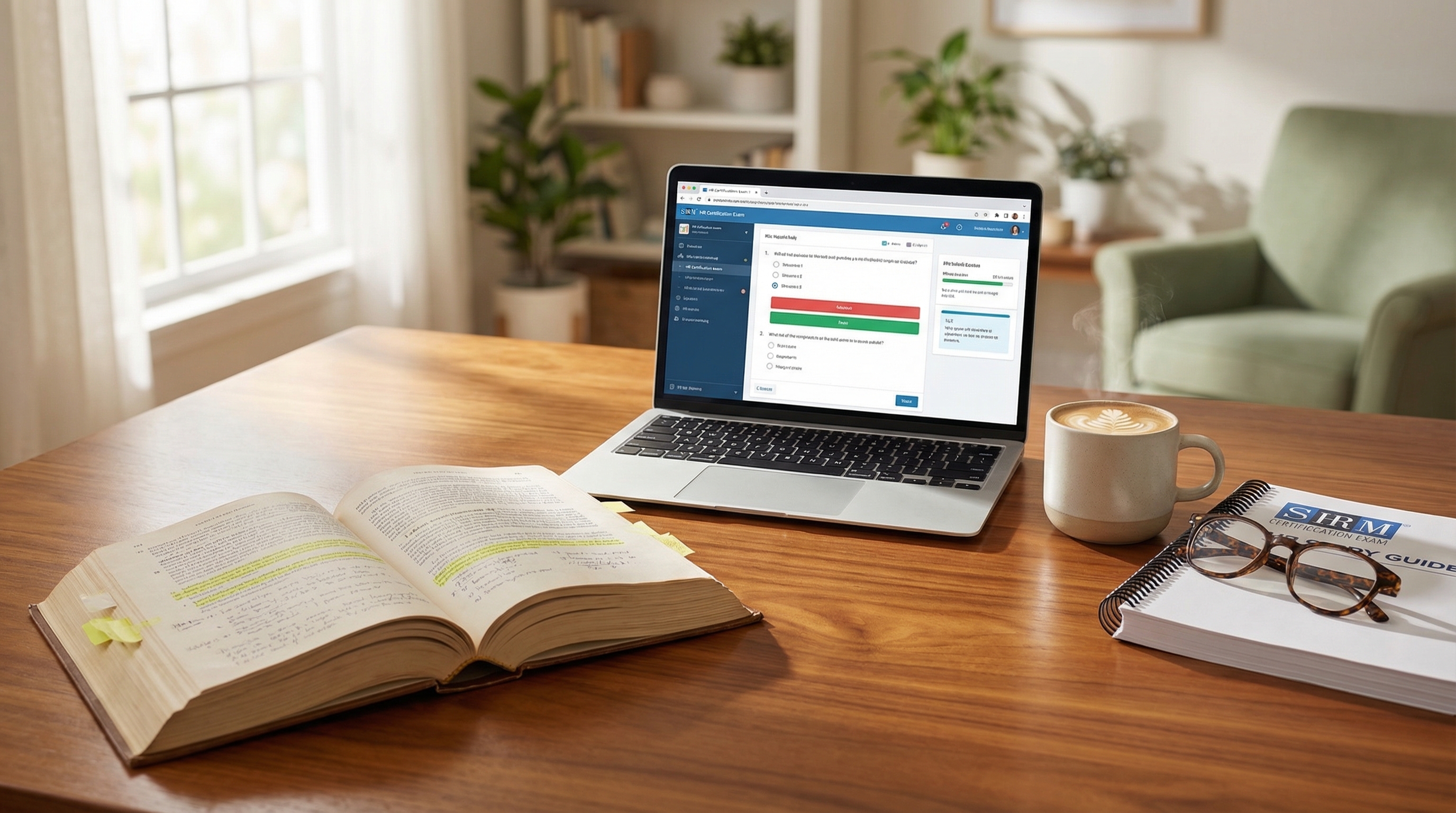
- 1.This shrm-cp certification guide highlights that SHRM-CP no longer requires HR experience or a degree to sit for the exam, making it accessible to career changers and students (SHRM Eligibility Criteria)
- 2.Exam fees range from $495 to $635 depending on SHRM membership and registration timing. Students pay $149-$209 (SHRM Exam Fees)
- 3.The exam tests 134 questions over 4 hours, mixing knowledge items with situational judgment scenarios that test how you'd actually handle workplace problems
- 4.Pass rate sits around 70%. Candidates who use the official SHRM Learning System pass at higher rates than those who self-study with third-party materials
- 5.PayScale data shows SHRM-CP holders earn a median of about $80,600, with the certification premium growing as you move into management roles
134
Exam Questions
4 hours
Exam Duration
~70%
Pass Rate
60 PDCs
Recertification/3yrs
What's SHRM-CP?
The SHRM Certified Professional (SHRM-CP) is a competency-based certification from the Society for Human Resource Management, the world's largest HR professional organization with over 325,000 members. Launched in 2014, it is one of the two most recognized HR certifications alongside the PHR from HRCI.
What makes SHRM-CP different from older HR certifications is how it tests you. Instead of just checking whether you memorized employment law and compensation formulas, the exam throws realistic workplace scenarios at you and asks what you'd actually do. You get a situation with competing priorities, political dynamics, and no perfect answer, and you have to pick the best path forward. That's closer to what HR work actually feels like.
SHRM-CP is designed for HR professionals at the operational level: HR generalists, coordinators, recruiters, benefits administrators, and business partners who implement policies and handle day-to-day HR functions. If you're the person employees come to with problems, and you're making judgment calls about how to handle them, SHRM-CP validates that you can do that well. For many professionals, it serves as the foundation before advancing to SHRM-SCP later.
Who Can Take the SHRM-CP Exam
The biggest change in recent years is that SHRM-CP no longer requires a degree or HR work experience to sit for the exam. According to SHRM's current eligibility criteria, the certification is open to anyone performing HR duties, currently enrolled students, and people pursuing a career in human resource management. SHRM recommends a basic working knowledge of HR practices or a degree from a SHRM-aligned program, but it's a recommendation, not a requirement.
This is a major shift. The old eligibility matrix required 1-4 years of HR experience depending on your education level. That's gone. If you're a career changer studying for the exam on your own, you can register. If you're a senior in a SHRM-aligned HR program, you can sit for it before you graduate. This makes SHRM-CP far more accessible than it used to be, and more accessible than the PHR, which still requires 1-4 years of professional HR experience.
That said, the exam itself hasn't gotten easier. Removing the experience gate just means SHRM trusts the exam to do the filtering. If you don't have real HR knowledge, the situational judgment questions will catch you. People who've actually handled employee relations issues, navigated compliance questions, and dealt with workplace conflict will find those scenarios familiar. If you're brand new to HR, plan for extra study time to build that contextual knowledge.
If you're completely new to the profession with zero HR background, consider whether the aPHR certification might be a better starting point. It's specifically designed for entry-level professionals, costs less, and gives you a credential to put on your resume while you build experience.
Is SHRM-CP Right for You?
- Working in an operational HR role
- New to HR or changing careers (no experience required)
- Employer values SHRM credentials
- Graduating from a SHRM-aligned program
Things to Know
- Budget for exam and study materials ($650-$1,800)
- 60-120 hours of study time over 2-4 months
- Commitment to recertification every 3 years
- Employer or industry prefers HRCI credentials
- You prefer testing on technical knowledge depth
- Government, healthcare, or manufacturing sector
- Planning to pursue SPHR later
Things to Know
- PHR requires 1-4 years HR experience
- Lower pass rate (~60%) than SHRM-CP (~70%)
- Different recertification requirements
- 7+ years of strategic HR experience
- Director or VP-level responsibilities
- Policy development and organizational strategy
- Already making strategic HR decisions
Things to Know
- SHRM-SCP doesn't require SHRM-CP first
- Exam is harder with lower pass rates
- Strategic focus vs operational focus
- No HR knowledge or background at all
- Career changer who wants a stepping stone
- Tighter budget for certification
- Want a credential while building experience
Things to Know
- Less recognized than SHRM-CP or PHR
- Lower cost and shorter prep time
- Good resume builder for entry-level roles
Exam Format and Content
The SHRM-CP exam gives you 134 questions over 4 hours (240 minutes) at Prometric testing centers. Of those 134 questions, 110 count toward your score and 24 are unscored pretest items being evaluated for future exams. You won't know which is which, so treat every question seriously. SHRM uses a scaled scoring system where 200 is passing on a 120-200 scale. They don't publish the exact number of correct answers needed because the scale adjusts for question difficulty.
There are two question types. Knowledge items test factual HR understanding: employment law, compensation principles, talent management practices, HR technology. Situational judgment items (SJIs) present realistic workplace scenarios and ask you to identify the best course of action among several plausible options. About 60% of the exam is knowledge items and 40% is situational judgment. The SJIs are where most people either succeed or struggle, because they test application, not recall.
Content areas span SHRM's Body of Applied Skills and Knowledge (SHRM BASK). The knowledge domains cover People (talent acquisition, employee engagement, learning and development), Organization (structure, technology, effectiveness), Workplace (employment law, safety, labor relations), and Strategy (business strategy, HR strategy, planning). The exam tests integration across these areas. You won't get a block of 20 employment law questions followed by 20 compensation questions. They're mixed, and many scenarios touch multiple domains at once.
SHRM Competency Model
Understanding the competency model matters because the situational judgment questions directly assess how you apply these competencies. SHRM developed the model by surveying thousands of HR professionals and organizational leaders to identify what actually distinguishes effective HR practitioners.
The technical competencies include HR Expertise (the foundational knowledge across HR disciplines), Business Acumen (understanding how organizations work and how HR contributes to business outcomes), Critical Evaluation (using data and evidence to inform decisions), and Consultation (providing credible guidance to stakeholders).
The behavioral competencies include Leadership and Navigation (leading initiatives and managing organizational politics), Ethical Practice (maintaining integrity and confidentiality under pressure), Relationship Management (building trust while maintaining professional boundaries), Communication (tailoring messages for different audiences), and Global and Cultural Effectiveness (working across diverse contexts).
When you hit a situational judgment question, you're really being asked: which competency applies here, and what does good application of that competency look like? An employee comes to you with a complaint about their manager. Do you prioritize Ethical Practice (confidentiality), Relationship Management (trust), or Leadership (taking action)? The right answer usually balances multiple competencies, which is exactly what the real work requires.
How to Prepare
Successful candidates invest 60-120 hours of study over 2-4 months. If you have an HR degree from a SHRM-aligned program, you'll probably need less. If you're coming from a different field, plan for the higher end. Either way, structured preparation makes a measurable difference in pass rates.
The SHRM Learning System is the official prep program and the most comprehensive option. It includes textbooks covering all knowledge domains, an online learning platform, practice questions in exam format, and progress assessments. It runs $800-$1,200 depending on membership and format. Expensive, but candidates who use it pass at higher rates. Many employers reimburse certification study materials as professional development, so ask before you pay out of pocket.
Set a fixed weekly schedule of 8-12 hours. Focus on understanding concepts rather than memorizing facts. The situational judgment questions can't be crammed for. They test how you think through problems. Practice with SJI-format questions extensively, because they feel different from standard multiple choice. When you get a practice question wrong, don't just note the right answer. Understand why the other options were wrong and what competency the question was testing. Join a study group through your local SHRM chapter for accountability and discussion. Take at least two timed practice exams under real conditions before test day.
For supplementary resources, LinkedIn Learning HR courses work well for visual learners. SHRM webcasts and chapter events build exam-relevant knowledge while earning PDCs you'll need later for recertification. If you're already working in HR, reflect on workplace scenarios you've navigated and how SHRM competencies applied. That real experience is the best preparation for the situational judgment portion.
What It Actually Costs
The total investment for SHRM-CP ranges from about $650 to $1,800 depending on your membership status, study approach, and registration timing. The breakdown based on current SHRM pricing.
Early-bird registration costs $495 for SHRM members and $595 for non-members (includes a $50 application fee). Standard registration costs more: $535 for members, $635 for non-members (includes a $125 application fee). Students get a significant break: $149 for SHRM student members, $209 for non-member students. Corporate pricing is available at $270. SHRM offers testing during two annual windows, Spring and Winter.
The official SHRM Learning System runs $800-$1,200. Third-party study guides cost $50-$150, and practice exam bundles run $100-$200. Some candidates pass using less expensive resources, though the official materials correlate with higher pass rates. Consider your learning style and budget.
The math on SHRM membership works out in your favor. Joining SHRM before you test saves about $100 on exam fees alone. If membership costs roughly $275-$300 per year, you're getting the exam discount plus access to member resources, PDC opportunities for recertification, and local chapter networking. For most people sitting for the exam, the membership pays for itself.
Talk to your employer before paying out of pocket. Most HR departments support certification as professional development. Many organizations cover the full cost of exam fees and study materials. Even if there's no formal policy, it's worth asking. The ROI argument is straightforward: certified HR staff make fewer compliance mistakes and bring validated competency to the role.
Salary Impact
Certification moves the needle on compensation, though the size of the premium depends on your career stage. PayScale data shows SHRM-CP holders earn a median of about $80,600. The BLS reports the median for all HR specialists (certified and non-certified) at $72,910. That gap widens as you advance into management.
At the HR manager level, the national median is $140,030 (BLS May 2024). Certified managers consistently report higher compensation than their non-certified peers in equivalent roles. SHRM's own research puts the certification salary premium at about 14% over non-certified professionals at similar experience levels.
Beyond the direct salary bump, certification influences hiring decisions. Scan HR job postings and you'll see "SHRM-CP preferred" or "SHRM-CP required" on a significant share of mid-level positions. In competitive markets, it's often the tie-breaker between equally qualified candidates. Government agencies and healthcare organizations are particularly likely to require or prefer credentials. See our HR Salary Guide for detailed compensation analysis.
Honest Assessment: When SHRM-CP Is and Isn't Worth It
SHRM-CP delivers clear ROI when you're applying to mid-level HR positions at organizations that list it in job postings. In competitive markets where equally qualified candidates compete for the same role, certification is often the deciding factor. Government agencies, healthcare systems, and large employers with formal credential requirements effectively make it a prerequisite. And if your employer covers the cost, the financial argument is settled.
The credential also works well for career changers entering HR. Since SHRM removed the experience requirement, SHRM-CP provides a way to signal commitment and validated knowledge when your resume doesn't yet show HR titles. It won't replace hands-on experience, but it demonstrates you've invested in learning the profession seriously.
But SHRM-CP isn't universally worth the $650-$1,800 investment. If you work at a startup or small company where the CEO doesn't know what SHRM stands for, certification probably won't change your standing or your salary. Small employers hire for what you can do, not what credentials you carry. Your ability to handle an employee relations crisis matters more than whether you passed an exam about it.
If you're unsure whether HR is your long-term career, this is an expensive way to test your commitment. Spend six months in an HR role first. If the work energizes you, invest in certification. If you're already counting down to Friday by Wednesday, no credential fixes that.
If you're already in a senior strategic role with 7+ years of experience, skip SHRM-CP entirely. It validates operational competency you've already demonstrated through your career. Go directly to SHRM-SCP, which validates the strategic work you're actually doing.
One factor worth acknowledging: SHRM's organizational decisions have drawn criticism. In 2024, SHRM dropped 'equity' from its DEI framework, prompting over 700 HR professionals to sign a petition and some to let certifications lapse. SHRM-CP remains widely recognized by employers regardless of organizational politics, but if SHRM's positions conflict with your professional values, PHR from HRCI is an equally respected alternative.
Source: Bureau of Labor Statistics, Occupational Outlook Handbook
Recertification
SHRM-CP certification must be renewed every three years. You have two options: earn 60 Professional Development Credits (PDCs) over your three-year cycle, or retake the exam. Almost everyone goes the PDC route.
Earning PDCs is easier than it sounds. Activities that count: SHRM conferences and seminars (1 PDC per hour), approved webcasts and online courses, local SHRM chapter events, academic coursework (15 PDCs per credit hour), professional development at work, and volunteer leadership in SHRM chapters. If you're an active HR professional attending a few events per year and doing normal professional development, you'll accumulate 60 PDCs without much extra effort. You can carry over up to 20 excess PDCs to your next cycle.
The processing fee is $165 for SHRM members and $210 for non-members, due every three years. If you miss your deadline and use the 60-day grace period, fees jump to $240 (member) and $285 (non-member). If you let certification lapse entirely, you have to retake the exam and pay the full exam fee. Set a calendar reminder six months before your cycle ends.
SHRM-CP vs PHR
This is the most common question in HR certification, and the honest answer is: both are widely respected, and no hiring manager will dismiss either one. The differences matter more for how you prepare than for how employers perceive you. For a detailed breakdown, see our PHR vs SHRM-CP comparison.
The biggest practical difference is eligibility. SHRM-CP now has no experience requirement. PHR still requires 1-4 years of professional HR experience depending on education. If you're new to HR or changing careers, SHRM-CP is your path. If you already have several years of HR experience, both options are open.
The exams test differently. SHRM-CP emphasizes behavioral competencies through situational judgment questions: here's a messy workplace situation, what do you do? PHR goes deeper on technical HR knowledge: employment law specifics, compensation formulas, labor relations procedures. If you think in terms of applying judgment to scenarios, SHRM-CP will feel natural. If you prefer demonstrating comprehensive technical mastery, PHR might align better.
Your workplace context matters too. If your employer engages with SHRM through membership, chapter participation, or academic partnerships, SHRM-CP provides better networking alignment. If your organization has a strong HRCI tradition (common in government, healthcare, and manufacturing), PHR may be the expected credential. Many senior HR professionals eventually hold both.
Steps to Earn SHRM-CP
Verify Eligibility
SHRM-CP is open to anyone performing HR duties, currently enrolled students, or people pursuing an HR career. No degree or experience is required, though SHRM recommends basic HR knowledge or a [SHRM-aligned program](/certifications/shrm-aligned-programs/).
Choose Your Study Approach
The official SHRM Learning System ($800-$1,200) correlates with higher pass rates. Third-party study guides run $50-$150. Budget 60-120 hours of study over 2-4 months.
Register Through SHRM
Apply at [shrm.org/certification](https://www.shrm.org/certification). Early-bird: $495 member / $595 non-member. Standard: $535 member / $635 non-member. Students: $149-$209.
Prepare and Pass the 4-Hour Exam
134 questions (110 scored) mixing knowledge items with situational judgment scenarios. Available at Prometric centers or via remote proctoring during Spring and Winter testing windows.
Maintain with 60 PDCs Every 3 Years
Earn Professional Development Credits through conferences, webcasts, chapter events, and workplace learning. Recertification fee: $165 member / $210 non-member.
Frequently Asked Questions
Sources
- 1.Bureau of Labor Statistics. Occupational Employment and Wage Statistics — Salary data and employment projections for HR occupations (May 2024)
- 2.SHRM. Society for Human Resource Management — Industry surveys, benchmarks, certification standards, and HR best practices
- 3.HRCI. HR Certification Institute — PHR, SPHR, GPHR, and aPHR certification requirements, eligibility, and exam information
Continue Exploring

Taylor Rupe
Education Researcher & Data Analyst
B.A. Psychology, University of Washington · B.S. Computer Science, Oregon State University
Taylor combines training in behavioral science with data analysis to evaluate HR education programs. His research methodology uses IPEDS completion data, BLS employment statistics, and SHRM alignment data to produce evidence-based program rankings.