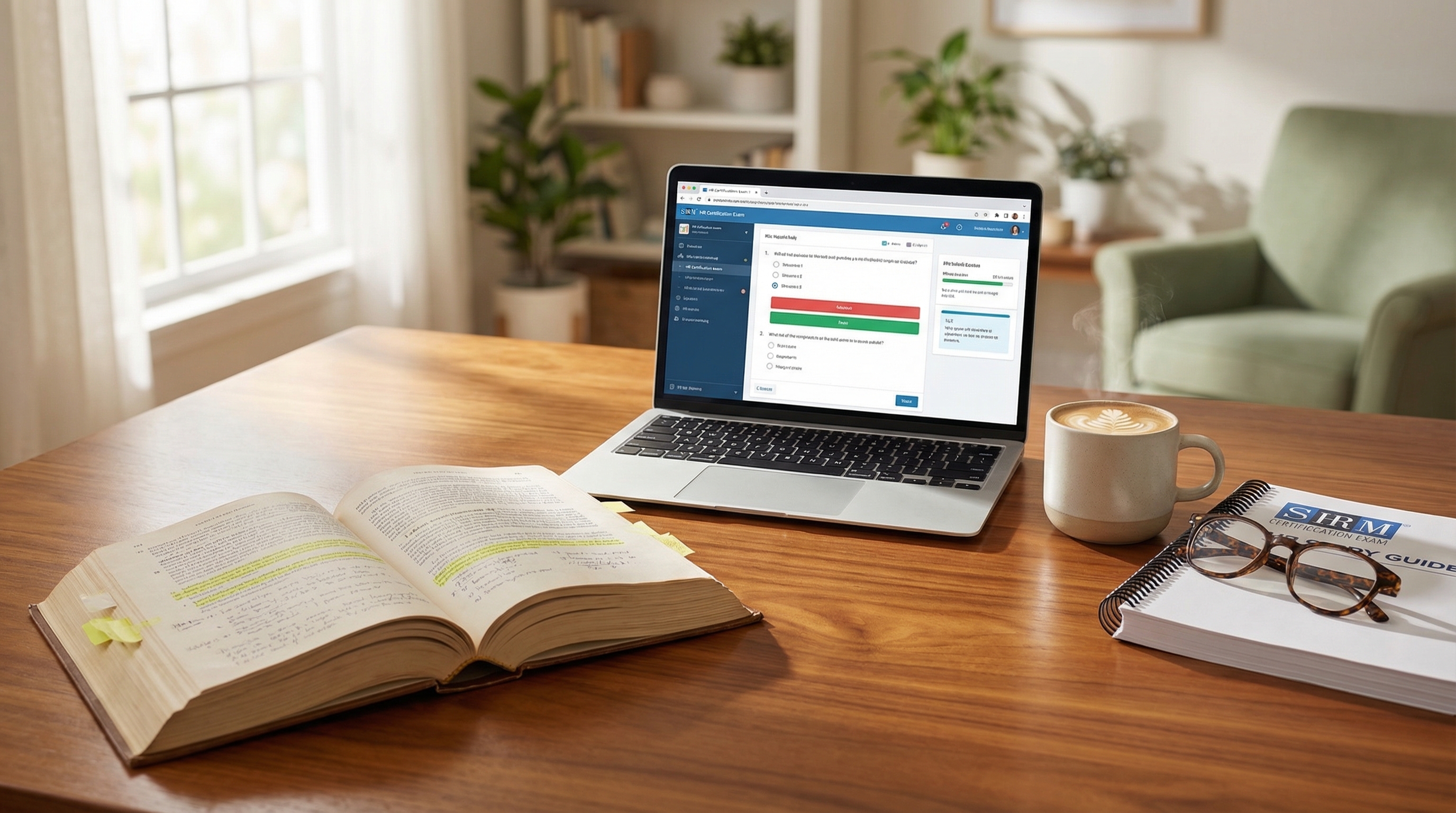
- 1.This shrm-scp certification guide highlights that SHRM-SCP from SHRM requires 3+ years of strategic HR experience. 'Strategic' means you develop policies, not just implement them
- 2.The exam is 134 questions over 4 hours, same structure as SHRM-CP but testing competencies at the leadership level. ~65% pass rate
- 3.Senior certified professionals earn 20-30% more than non-certified peers at equivalent experience levels. For senior HR roles paying $140,000+, that premium is significant
- 4.You don't need SHRM-CP first. If you meet SCP eligibility, you can pursue it directly
- 5.Positions you for HR director, VP of HR, Senior HR Business Partner, and CHRO roles
3+ yrs
Strategic Experience
~65%
Pass Rate
20-30%
Salary Premium
60 PDCs
Recertification/3yrs
What SHRM-SCP Actually Validates
The SHRM Senior Certified Professional (SHRM-SCP) validates that you can do the strategic work that senior HR leadership demands: developing workforce policies, translating business objectives into talent strategy, analyzing HR metrics for executive decision-making, and leading organizational change. While SHRM-CP proves you can execute HR effectively, SHRM-SCP proves you can lead it.
SHRM-SCP holders serve as HR directors, vice presidents of HR, senior HR business partners, and Chief Human Resources Officers. What they have in common isn't just seniority. It's strategic responsibility: they shape HR direction rather than implement someone else's decisions. The credential validates this capability to employers who need leaders, not just practitioners.
The exam tests SHRM's nine behavioral competencies at an advanced application level through situational judgment questions. These scenarios present the kinds of complex, ambiguous decisions that senior HR leaders face: balancing competing stakeholder interests, navigating organizational politics, and making calls with incomplete information and organization-wide consequences. If that sounds like your daily reality, SHRM-SCP may be right for you.
Who Qualifies for SHRM-SCP
SHRM-SCP requires 3+ years of strategic-level HR experience. The word 'strategic' is doing heavy lifting here. SHRM means experience developing HR policies (not administering them), analyzing workforce data for executive decisions (not running reports), and aligning HR programs with business objectives (not just implementing programs someone designed).
Typical qualifying roles include HR Director, VP of HR, Senior HR Business Partner, or HR Manager with genuine policy development responsibilities. But titles are unreliable indicators. A 'Senior HR Generalist' who develops the company's performance management policy and presents workforce analytics to the CEO has strategic experience. An 'HR Director' at a small company who processes payroll, handles benefits enrollment, and answers employee questions may not.
You don't need SHRM-CP before SHRM-SCP. The certifications are independent. If you have the strategic experience and meet eligibility, going directly to SCP is perfectly valid. Many professionals earn CP early and advance later, but that's a career timeline, not a prerequisite. SHRM verifies eligibility through the application process.
What the Exam Looks Like
The SHRM-SCP exam has 134 questions over 4 hours (110 scored), structurally identical to SHRM-CP. About 60% are knowledge items and 40% are Situational Judgment Items (SJIs). The difference is application level. SCP scenarios present strategic leadership challenges: How should a senior HR leader approach this workforce planning decision? How should you advise the CEO on this organizational restructuring? What's the best policy response to this compliance challenge?
The pass rate is approximately 65%, compared to ~70% for SHRM-CP. That gap reflects strategic depth, not trick questions. Candidates with genuine strategic experience often find the scenarios familiar because they mirror real leadership situations. Candidates without strategic experience may struggle because the 'best' answers require judgment that comes from actually doing the work, not just studying about it.
Scoring uses a 120-200 scale with 200 representing passing. SHRM adjusts for question difficulty. Preliminary results appear immediately after you finish, with official score reports within 24-48 hours. Testing is available at Prometric centers and through remote proctoring.
How to Prepare Effectively
Plan for 80-120 hours of focused study over 3-4 months. Your senior experience provides substantial foundational knowledge, but the exam tests SHRM's specific competency framework, which may differ from how your organization approaches HR. The SHRM Learning System is the benchmark for exam prep, with content specifically calibrated for the SCP application level.
Focus preparation on strategic content: workforce planning, organizational development, change management, HR metrics and analytics, and executive-level decision making. Practice SJIs extensively. The judgment questions require identifying the best strategic response among multiple reasonable options, which is harder than it sounds when you're not in the context of your actual organization.
Study groups with other senior HR professionals can be valuable. Local SHRM chapters often host senior certification prep programs. Beyond exam prep, the SHRM competency model provides a framework for ongoing professional development. Many SCP candidates report that preparation itself strengthened their strategic HR thinking, regardless of exam results.
Career Impact
SHRM-SCP delivers significant career value for HR professionals targeting leadership roles. Many organizations list SHRM-SCP as required or preferred for director, VP, and CHRO positions. The credential tells executive search firms and hiring committees that you've been assessed at the strategic leadership level, which reduces perceived risk when filling senior HR positions.
Senior certified professionals earn 20-30% more than non-certified peers at equivalent experience levels. For HR leaders earning above the $140,030 HR manager median (BLS May 2024), that premium represents $28,000-$42,000+ annually. Beyond salary, SHRM-SCP qualifies you for board advisory opportunities, executive networking, and strategic consulting engagements.
Maintaining SHRM-SCP requires 60 Professional Development Credits (PDCs) over three years. This keeps you engaged with evolving HR leadership practices and provides access to SHRM's senior certification community. The recertification process ensures the credential stays current and your continued professional growth is documented.
Honest Assessment: When SHRM-SCP Is and Isn't Worth It
SHRM-SCP is worth pursuing if your career trajectory points toward HR director, VP of HR, or CHRO. When job postings at that level list 'SHRM-SCP preferred' or 'senior HR certification required,' the credential directly unlocks opportunities. Executive recruiters use it as a screening criterion for senior HR leadership roles, and the 20-30% salary premium at leadership compensation levels represents substantial income.
The credential also makes sense if you consult or advise on HR strategy. Clients and boards expect credentialed advisors, and SHRM-SCP signals that your strategic judgment has been independently validated. If you already hold SHRM-CP and are moving into policy development and executive advising, SCP is the natural progression.
But SHRM-SCP isn't right for everyone at the senior level. If you don't have genuine strategic experience, meaning you develop HR policies rather than implement them, you'll struggle with the exam and the credential won't ring true. Having the title of 'HR Director' at a 50-person company where you still process payroll and handle onboarding isn't the same as setting workforce strategy for an organization. Be honest with yourself about whether your work is truly strategic before investing.
If you're content in an operational HR role and have no interest in executive leadership, senior certification adds cost without proportional benefit. SHRM-CP validates the work you're doing. There's no obligation to 'level up' a certification just because you've been in HR for a long time.
And if SHRM's recent organizational decisions give you pause, including dropping 'equity' from its DEI framework in 2024, consider that SPHR from HRCI validates comparable senior HR capability. Many experienced HR leaders hold both, and employers accept either as evidence of strategic readiness.
SHRM-SCP vs. SPHR: Which Senior Credential?
SHRM-SCP and SPHR are the two leading senior HR certifications. Both are respected. Both validate strategic capability. The choice often depends on your existing credential history, employer preferences, and which assessment style fits your brain. For detailed analysis, see our SPHR vs SHRM-SCP comparison.
SHRM-SCP tests behavioral competencies through situational judgment: how you'd apply strategic judgment to leadership scenarios. SPHR tests knowledge mastery across strategic HR domains: what you know about workforce planning, organizational development, and HR strategy. Neither approach is superior. They assess different dimensions of senior HR capability.
Many senior HR executives hold both. If you already have PHR, SPHR maintains HRCI continuity. If you hold SHRM-CP or engage actively with SHRM, SHRM-SCP provides natural progression. If you're building credentials for maximum flexibility, dual certification at the senior level demonstrates comprehensive mastery.
Steps to Earn SHRM-SCP
Confirm Strategic HR Experience
SHRM-SCP requires 3+ years of strategic HR experience: developing policies, advising executives, and leading organizational change. Operational HR experience alone doesn't qualify.
Invest in the SHRM-SCP Learning System
The official SHRM Learning System ($1,000-$1,500) is calibrated for SCP-level content. Budget 80-120 hours of study over 3-4 months. Practice situational judgment items extensively.
Register Through SHRM
Apply at [shrm.org/certification](https://www.shrm.org/certification). Early-bird: $495 member / $595 non-member. Standard: $535 member / $635 non-member.
Pass the 4-Hour Exam
134 questions (110 scored) with ~40% situational judgment items testing strategic leadership decisions. Pass rate is approximately 65%. Candidates with genuine strategic experience find the scenarios familiar.
Maintain with 60 PDCs Every 3 Years
Earn Professional Development Credits through SHRM events, senior-level professional development, and leadership activities. Recertification fee: $165 member / $210 non-member.
Frequently Asked Questions
Sources
- 1.SHRM. Society for Human Resource Management — Industry surveys, benchmarks, certification standards, and HR best practices
- 2.HRCI. HR Certification Institute — PHR, SPHR, GPHR, and aPHR certification requirements, eligibility, and exam information
Related Guides

Taylor Rupe
Education Researcher & Data Analyst
B.A. Psychology, University of Washington · B.S. Computer Science, Oregon State University
Taylor combines training in behavioral science with data analysis to evaluate HR education programs. His research methodology uses IPEDS completion data, BLS employment statistics, and SHRM alignment data to produce evidence-based program rankings.