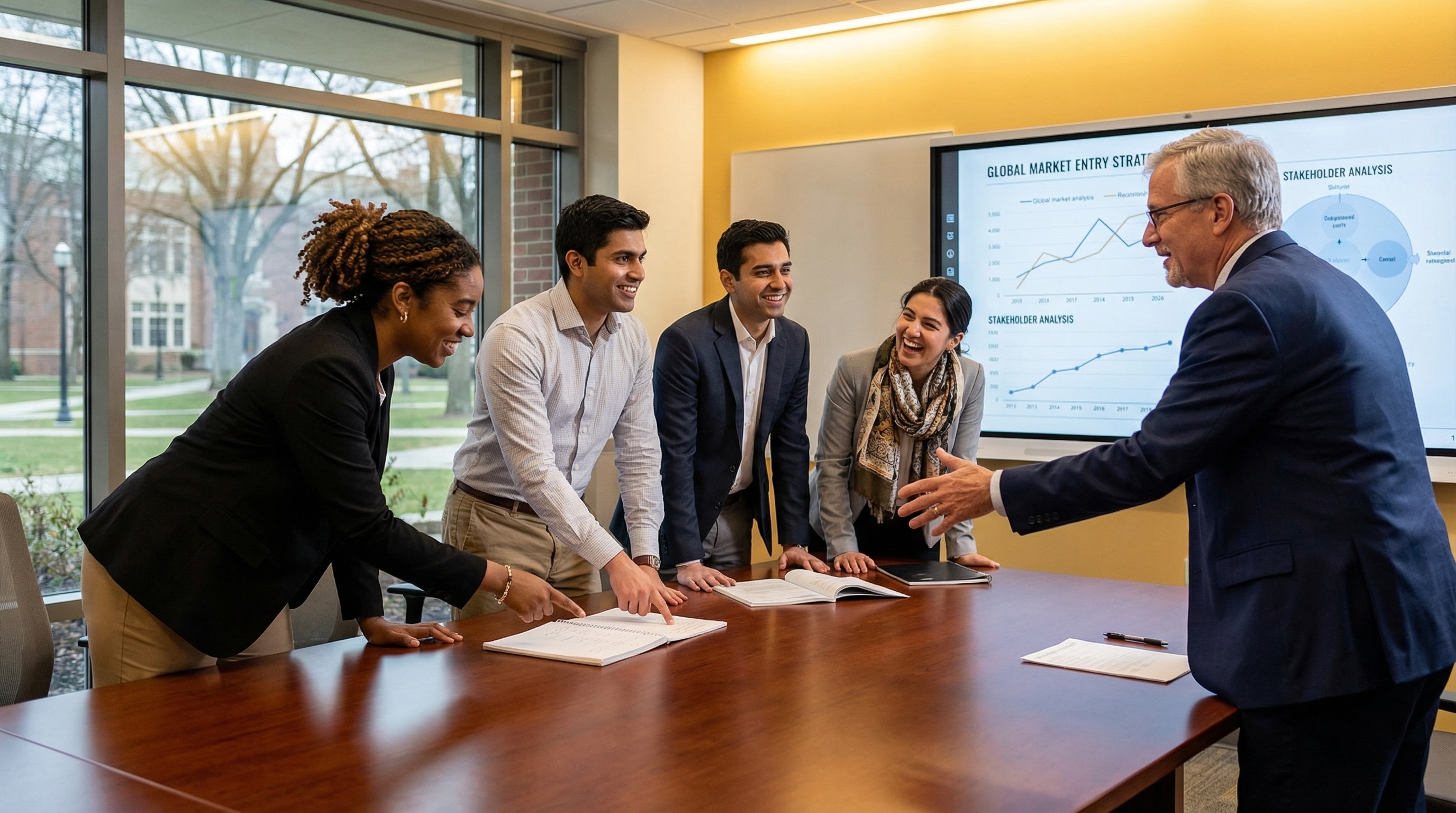
A master's in HR with a DEI concentration teaches compliance-focused inclusion skills -- pay equity analysis, accessible hiring design, and belonging measurement -- grounded in employment law and organizational psychology research. HR Managers with inclusion expertise earn a median of $140,030 (BLS 2024). Despite headline pullbacks, 49% of C-suite leaders are not rolling back DEI, and many organizations are rebranding rather than eliminating inclusion work.
$140,030
HR Manager Median Salary
+8%
HR Specialist Growth Rate
+11%
Training Specialist Growth
49%
C-Suite NOT Rolling Back DEI
What a DEI Concentration Covers
Frameworks for measuring and building psychological safety and belonging across demographic groups. Includes ERG (Employee Resource Group) strategy, inclusive leadership development, and belonging uncertainty interventions grounded in Walton's research at Stanford.
Key Skills
Common Roles
- VP of Culture and Belonging
- Employee Experience Director
- Inclusion Program Manager
Design and audit of hiring, promotion, and compensation systems to reduce bias and improve accuracy. Covers structured interviewing, pay equity analysis, and promotion velocity measurement across demographics -- practical skills tied to HR analytics and workforce data.
Key Skills
Common Roles
- Inclusive Talent Strategy Lead
- Diversity Program Coordinator
- Compensation Equity Analyst
Legal frameworks governing workplace diversity: Title VII, ADA, Section 508, EEOC reporting, and state-level pay transparency laws. Programs aligned with SHRM-SCP competencies integrate these under the 'People' and 'Organization' behavioral competency clusters.
Key Skills
Common Roles
- HR Compliance Manager
- GRC Analyst
- Employment Law Specialist
Connecting inclusion initiatives to business metrics: retention rates, engagement scores, and compliance audit readiness. Draws on organizational development and organizational psychology research to design evidence-based interventions at scale.
Key Skills
Common Roles
- Director of Inclusive Excellence
- OD Consultant
- Diversity Analytics Manager
Source: Stanford Social Innovation Review 2025
The Science of Inclusion: What Research Shows
The academic foundation of DEI work is not political theory -- it is organizational psychology and behavioral science. Several decades of peer-reviewed research have built a substantial evidence base around how demographic composition and inclusion practices affect organizational outcomes. Here is what the research actually says, with appropriate caveats.
Stereotype threat research, pioneered by Claude Steele and Joshua Aronson at Stanford in the mid-1990s, demonstrated that awareness of negative stereotypes about one's group can measurably impair cognitive performance. This effect has been replicated across hundreds of studies and has direct implications for assessment design, interview processes, and performance evaluation systems. HR professionals trained in this research design evaluation processes that reduce stereotype threat -- not as a political act, but because it produces more accurate talent assessment.
Belonging uncertainty research, led by Gregory Walton at Stanford, shows that people from underrepresented groups are more sensitive to environmental cues about whether they belong. Small interventions -- sometimes as brief as a single writing exercise -- have produced multi-year improvements in retention and performance in controlled studies. For HR, this translates to onboarding design, mentorship program structure, and workplace environment assessment. These are measurable, replicable interventions, not abstract commitments.
Team cognition research presents a more nuanced picture. A well-cited 2004 meta-analysis by van Knippenberg and Schippers found that diverse teams can outperform homogeneous ones on complex, non-routine tasks -- but only under specific conditions. Those conditions include psychological safety (Amy Edmondson's research at Harvard), structured information sharing, and inclusive leadership behaviors. Without those conditions, diverse teams actually underperform. This is a critical nuance that good DEI programs teach: diversity without inclusion infrastructure produces worse outcomes, not better ones.
Psychological safety itself -- the belief that one will not be punished for speaking up with ideas, questions, or mistakes -- is closely related to inclusion but distinct from it. Edmondson's research, most famously applied in Google's Project Aristotle, found psychological safety to be the single strongest predictor of team effectiveness. Inclusion practices, when well-designed, are essentially psychological safety interventions at organizational scale. This is the connection that master's-level coursework makes explicit, and it is the connection that differentiates trained professionals from well-meaning amateurs.
Cornell University
Why #1: Cornell University
Cornell's MILR through the Ivy League ILR School offers unmatched prestige and outcomes, with graduates earning a $97,473 average starting salary at elite employers.
Cornell University offers a 48-credit Master of Industrial and Labor Relations (MILR) through its Ivy League ILR School. The on-campus program produces graduates with a $97,473 average starting salary in HR, with top employers including Estee Lauder, JPMorgan, and S.C. Johnson.
Program Highlights
- SHRM-aligned curriculum
- AACSB-accredited business school
- Specializations: Industrial and Labor Relations
- Ivy League ILR School
- 48 credits
Key Strengths
- SHRM-aligned curriculum
- AACSB-accredited business school
- Specializations: Industrial and Labor Relations
- Ivy League ILR School
Program
- 48 credits
Sources
University of Southern California
Why #2: University of Southern California
Carries the USC brand and Trojan alumni network with a fast 12-month format, though the premium price and lack of SHRM alignment are trade-offs.
USC offers a 24-unit online Master of Science in Human Resource Management through Bovard College. The 12-month accelerated program costs $2,539 per unit ($60,936 total) with WSCUC accreditation but is NOT SHRM-aligned.
Program Highlights
- AACSB-accredited business school
- 12-month accelerated
- 24 units
- $2,539/unit ($60,936 total)
- NOT SHRM-aligned
Key Strengths
- AACSB-accredited business school
- 12-month accelerated
- 24 units
- $2,539/unit ($60,936 total)
Program
- 24 credits
Prerequisites
Bachelor's degree
Sources
University of Illinois Urbana-Champaign
Why #3: University of Illinois Urbana-Champaign
Choose UIUC for its deep specialization options in emerging areas like HR Data Analytics and International HR, backed by strong placement rates and competitive starting salaries.
The University of Illinois Urbana-Champaign offers a 48-credit Master of Human Resources and Industrial Relations (MHRIR) through its School of Labor and Employment Relations. The program is available on-campus and online with five specializations.
Program Highlights
- SHRM-aligned curriculum
- AACSB-accredited business school
- 5 specialization options including HR Data Analytics and Union Management
- 5 specializations
- 48-credit comprehensive program
Key Strengths
- SHRM-aligned curriculum
- AACSB-accredited business school
- 5 specialization options including HR Data Analytics and Union Management
- 5 specializations
Admissions
- GPA: 3
Program
- 48 credits
Prerequisites
Bachelor's degree
Sources
The Current DEI Landscape: What's Actually Happening
The DEI landscape in 2025-2026 is genuinely complicated, and anyone telling you it is simple is selling something. Federal executive orders issued in early 2025 put DEI programs under direct scrutiny, particularly in federal contracting and higher education. Several states have passed or proposed legislation restricting DEI training and offices. Some major employers -- Walmart, Meta, and others -- made public announcements about scaling back DEI-branded programs.
But the data tells a more nuanced story. A 2024 survey by Littler Mendelson, the employment law firm, found that 49% of C-suite leaders were not considering any DEI rollbacks. Only 8% were "seriously considering" changes. Meanwhile, 46% of companies maintained their existing DEI commitments, and 30% actually increased them. The rollback narrative is louder than the rollback reality.
What is happening is a large-scale rebranding. Fortune 100 companies mentioning "DEI" in earnings calls dropped from 43% in 2023 to 31% in 2024. But mentions of terms like "belonging," "diverse perspectives," and "inclusive culture" rose 59% over the same period. Companies are stripping the label while continuing -- and in some cases deepening -- the underlying work. A 2025 analysis from the Stanford Social Innovation Review described this as "DEI washing in reverse": organizations that talk less about diversity but whose hiring and promotion data tells a different story.
For HR professionals, this creates a specific kind of demand. Organizations need people who understand the legal boundaries that are shifting, the compliance requirements that remain (Title VII, ADA, EEOC reporting, state-level pay transparency laws), and how to design programs that achieve inclusion objectives without creating legal exposure. Navigating compliance enforcement has become the number-one priority for DEI practitioners in 2026 -- and that requires formal training, not just good intentions.
The regulatory landscape for DEI programs is evolving rapidly. Organizations should consult legal counsel before implementing or modifying diversity initiatives. What HR master's programs teach is the analytical and legal framework to participate in those conversations -- the compliance structures, the measurement tools, and the organizational behavior research that informs evidence-based practice.
Career Paths
HR Manager / Chief Diversity Officer
SOC 11-3121Many Chief Diversity Officers and VP-level inclusion leaders are classified under this SOC code. Master's degree typically required for advancement to senior positions. Job titles shifting to 'VP of Culture and Belonging,' 'Head of Inclusive Talent Strategy,' or 'Employee Experience Director.'
Training and Development Manager
SOC 11-3131Often oversee inclusion training programs, onboarding design, and organizational learning. Increasingly responsible for compliance training related to harassment, accessibility, and equitable policy implementation.
HR Specialist / Diversity Coordinator
SOC 13-1071Entry point for many DEI-trained graduates. Roles include Diversity Program Coordinator, Inclusion Analyst, and Belonging Program Manager. Faster-than-average growth at 8% through 2034.
Training and Development Specialist
SOC 13-1151Strongest growth rate at 11% through 2034. Specialist-level roles focused on designing and delivering inclusion training, accessibility programs, and equitable onboarding processes.
Salary by Experience Level
DEI Skills for HR Professionals
Core competencies developed in a master's DEI concentration, mapped to SHRM's IE&D framework (2024 update). These are professional competencies grounded in employment law, organizational development research, and workforce analytics.
Legal & Compliance
Title VII, ADA, ADEA, and state-level protections -- designing compliant policies in a rapidly shifting regulatory environment
Statistical methods for identifying and addressing compensation disparities across protected classes
EEO-1 Component 1 filing, adverse impact analysis, and proactive compliance documentation
ADA Title I, Section 508, and WCAG standards for workplace and digital accessibility
Measurement & Analytics
Survey design, psychometric validation, and longitudinal tracking of inclusion indicators
Tracking demographic patterns in attrition, advancement, and internal mobility
Pipeline analysis, representation benchmarking, and goal-setting methodologies
Organizational Design
Evidence-based interviewing, bias-reduced assessment, and panel calibration -- reducing stereotype threat per Steele & Aronson (1995)
Employee Resource Group design, executive sponsorship models, and measurable impact frameworks
Based on Walton's belonging uncertainty research -- structured interventions that improve retention across demographic groups
Evaluating HR DEI Master's Programs: What to Look For
Check SHRM Alignment and Accreditation
Programs aligned with SHRM's IE&D (Inclusion, Equity & Diversity) framework -- rebranded in 2024 -- integrate inclusion under the 'People' and 'Organization' competency clusters. This alignment matters for [SHRM-CP](/certifications/shrm-cp/) and SHRM-SCP exam preparation. Also verify AACSB or ACBSP accreditation for the business school.
Evaluate the Concentration Structure
The DEI concentration typically adds 0-2 courses beyond the core HR curriculum. At Cornell ILR, students select electives like 'Diversity and Inclusion in Organizations' and 'Employment Discrimination Law' from within the existing MILR elective pool. At Illinois, the concentration is integrated into the broader HR curriculum. Look for programs that connect inclusion coursework to employment law, HR analytics, and organizational development research.
Compare Format and Cost
Traditional full-time programs run 18-24 months. Part-time options take 2-3 years with evening/weekend schedules. Hybrid formats (USC Marshall, Michigan State) combine intensive residency weekends with online coursework. Public university tuition: $32,000 (Rutgers) to $43,700 (Michigan State) in-state. Private institutions: $64,500 (Columbia) to $66,600 (USC). Graduate assistantships can offset 25-75% of tuition.
Verify Admission Requirements
Most programs require a bachelor's degree (any field), minimum 3.0 GPA, 2-3 letters of recommendation, and a personal statement. Professional experience of 1-3 years is preferred but not universally required. GRE requirements have been waived by most programs since 2020. Check individual program pages for current policy.
Assess Career Placement and Research Backing
Prioritize R1 research universities where DEI coursework is integrated with labor relations, [HR analytics](/masters/hr-analytics/), and employment law. Programs at Cornell ILR and the University of Illinois produce graduates who can connect inclusion initiatives to business metrics. See our [most affordable master's programs](/masters/most-affordable/) for value-focused options, or our [best value programs](/masters/best-value/) ranking.
Data Sources
Salary data: Bureau of Labor Statistics Occupational Employment and Wage Statistics (OES), May 2024 release. SOC codes: 11-3121 (HR Managers), 13-1071 (HR Specialists), 11-3131 (Training and Development Managers), 13-1151 (Training and Development Specialists). Growth projections: BLS Employment Projections 2024-2034.
School rankings: IPEDS (Integrated Postsecondary Education Data System) 2023 completion data. CIP codes: 52.1001, 52.1002, 52.1003, 52.1099. Rankings use our 5-factor HR Program Quality Index: program strength (25%), graduation rate (20%), career outcomes (15%), Carnegie classification (12%), selectivity (10%), industry recognition (10%), institution stability (5%), data transparency (3%).
DEI landscape data: Littler Mendelson 2024 Annual Employer Survey; Fortune 100 earnings call analysis (2023-2024); Stanford Social Innovation Review, "The DEI Backlash: What the Data Actually Shows" (2025); SHRM IE&D framework (2024 update). Stereotype threat: Steele & Aronson (1995), Journal of Personality and Social Psychology. Belonging uncertainty: Walton & Cohen (2011), Science. Team cognition: van Knippenberg & Schippers (2004), Journal of Management. Psychological safety: Edmondson (1999), Administrative Science Quarterly; Google Project Aristotle (2015).
Frequently Asked Questions About DEI Master's in Human Resources
HR completions volume, CIP breadth, multi-level depth
SHRM alignment (+15), AACSB (+10) or ACBSP (+5)
IPEDS 6-year graduation rate
Carnegie 2021 classification
IPEDS reporting completeness
Sources
- 1.Bureau of Labor Statistics -- Occupational Employment Statistics — HR occupation salary and employment data (May 2024)
- 2.Society for Human Resource Management (SHRM) — HR industry research, benchmarks, and best practices
Related Resources

Taylor Rupe
Education Researcher & Data Analyst
B.A. Psychology, University of Washington · B.S. Computer Science, Oregon State University
Taylor combines training in behavioral science with data analysis to evaluate HR education programs. His research methodology uses IPEDS completion data, BLS employment statistics, and SHRM alignment data to produce evidence-based program rankings.