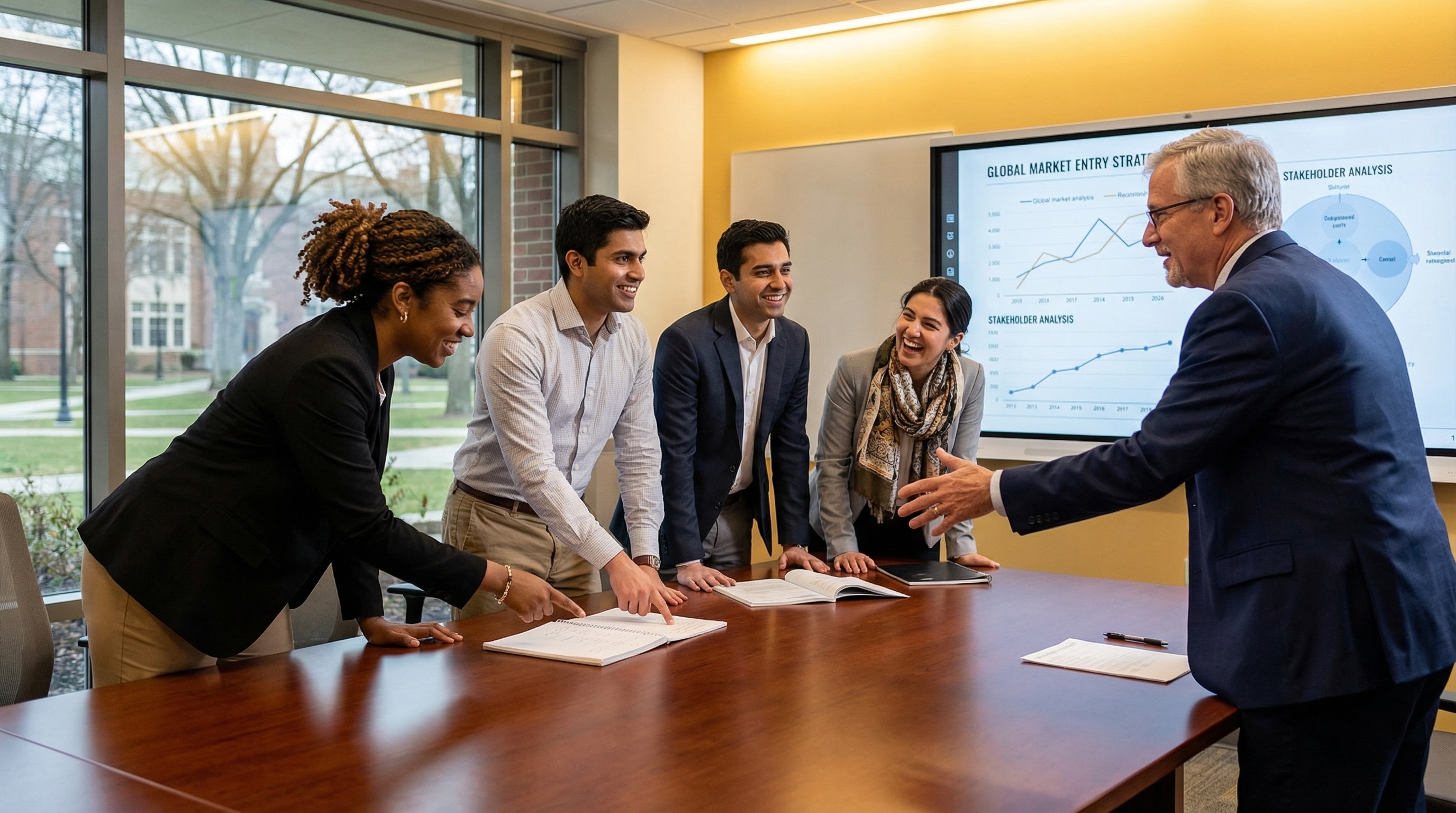
The best master's in HR programs for working adults offer evening, online, and hybrid formats that eliminate career interruption. Under IRS Section 127, employers can provide $5,250 per year tax-free toward tuition. HR Managers earn a median $140,030 (BLS 2024) versus $72,910 for HR Specialists, making the salary ROI substantial. Seven of the top 10 ranked programs carry SHRM curriculum alignment for direct certification exam preparation.
$140,030
HR Manager Median Salary
$72,910
HR Specialist Median Salary
$5,250/yr
Tax-Free Employer Assistance
+5%
HR Manager Job Growth
What 'Designed for Working Adults' Actually Means
The phrase gets thrown around a lot in graduate school marketing, but it means something specific when a program actually delivers on it. A master's in HR designed for working adults structures every element -- class scheduling, assignment deadlines, group project logistics -- around the assumption that students have full-time jobs, families, and commutes. That is a fundamentally different design philosophy than a traditional full-time program that bolts on an evening section as an afterthought.
What separates a genuinely adult-friendly program from a traditional one wearing flexible clothing is the absence of career interruption. You do not quit your job, relocate, or take a leave of absence. You keep earning, keep advancing, and ideally apply what you are learning in class to problems you are solving at work that same week. Some programs take this a step further with capstone projects that require students to tackle a real organizational challenge at their current employer -- turning your coursework into direct value for the company paying your tuition.
If you are comparing programs and one requires daytime attendance, a full-time commitment, or on-campus residency for more than a few weekends per year, it was not built for you. Check our guides on online master's programs and 1-year accelerated options for programs that explicitly prioritize schedule flexibility.
Comparing Program Formats
Source: Program format analysis
Source: BLS OES May 2024
Cornell University
Why #1: Cornell University
Cornell's MILR through the Ivy League ILR School offers unmatched prestige and outcomes, with graduates earning a $97,473 average starting salary at elite employers.
Cornell University offers a 48-credit Master of Industrial and Labor Relations (MILR) through its Ivy League ILR School. The on-campus program produces graduates with a $97,473 average starting salary in HR, with top employers including Estee Lauder, JPMorgan, and S.C. Johnson.
Program Highlights
- SHRM-aligned curriculum
- AACSB-accredited business school
- Specializations: Industrial and Labor Relations
- Ivy League ILR School
- 48 credits
Key Strengths
- SHRM-aligned curriculum
- AACSB-accredited business school
- Specializations: Industrial and Labor Relations
- Ivy League ILR School
Program
- 48 credits
Sources
University of Southern California
Why #2: University of Southern California
Carries the USC brand and Trojan alumni network with a fast 12-month format, though the premium price and lack of SHRM alignment are trade-offs.
USC offers a 24-unit online Master of Science in Human Resource Management through Bovard College. The 12-month accelerated program costs $2,539 per unit ($60,936 total) with WSCUC accreditation but is NOT SHRM-aligned.
Program Highlights
- AACSB-accredited business school
- 12-month accelerated
- 24 units
- $2,539/unit ($60,936 total)
- NOT SHRM-aligned
Key Strengths
- AACSB-accredited business school
- 12-month accelerated
- 24 units
- $2,539/unit ($60,936 total)
Program
- 24 credits
Prerequisites
Bachelor's degree
Sources
University of Illinois Urbana-Champaign
Why #3: University of Illinois Urbana-Champaign
Choose UIUC for its deep specialization options in emerging areas like HR Data Analytics and International HR, backed by strong placement rates and competitive starting salaries.
The University of Illinois Urbana-Champaign offers a 48-credit Master of Human Resources and Industrial Relations (MHRIR) through its School of Labor and Employment Relations. The program is available on-campus and online with five specializations.
Program Highlights
- SHRM-aligned curriculum
- AACSB-accredited business school
- 5 specialization options including HR Data Analytics and Union Management
- 5 specializations
- 48-credit comprehensive program
Key Strengths
- SHRM-aligned curriculum
- AACSB-accredited business school
- 5 specialization options including HR Data Analytics and Union Management
- 5 specializations
Admissions
- GPA: 3
Program
- 48 credits
Prerequisites
Bachelor's degree
Sources
Who Benefits Most from a Working Adult Program
- Currently earning around $72,910 (HR Specialist median) and targeting $140,030 (HR Manager median)
- Have 3-7 years of HR experience and need graduate credentials for the next role
- Want SHRM-aligned coursework that doubles as SHRM-SCP certification prep
- Employer offers tuition reimbursement you have not yet used
- Background in psychology, business, or social sciences with transferable people skills
- Need foundational HR knowledge plus a credential that signals competence to hiring managers
- Prefer a cohort model to build an HR professional network from scratch
- Want applied capstone projects to build an HR portfolio alongside the degree
- Already in management but targeting VP, CHRO, or consulting roles
- Need strategic competencies: HR analytics, organizational development, change management
- Value alumni network reach into Fortune 500 HR leadership (Cornell ILR, Minnesota Carlson)
- Prefer accelerated formats -- check 1-year programs for faster options
- Cannot commit to fixed weekly class times due to caregiving responsibilities
- Need fully asynchronous format with weekly (not daily) deadlines
- Prefer self-paced progress -- see online self-paced programs
- Plan to study during early mornings, late nights, or weekend blocks
Paying for It: Employer Assistance and Financial Aid
Check your employer's tuition reimbursement policy
Under IRS Section 127, employers can provide up to $5,250 per year in tax-free education assistance. That is $10,500 over a two-year program before you negotiate for a single dollar more. Many large employers go further: Amazon's Career Choice covers full tuition for select programs, Starbucks partners with ASU for 100% coverage, UPS offers up to $25,000 in lifetime benefits, and Walmart's Live Better U covers tuition and fees entirely. Even mid-size companies often offer $3,000 to $10,000 per year -- as an HR professional, you are uniquely positioned to find and negotiate these benefits.
File the FAFSA regardless of enrollment status
Working adults are often surprised to learn that FAFSA applies to graduate students regardless of employment or enrollment status. Part-time students qualify for federal Grad PLUS loans. Some programs offer merit-based scholarships specifically for working professionals, and a handful of [SHRM-aligned programs](/masters/shrm-aligned/) offer discounts for SHRM members.
Compare public vs. private university total costs
Several public universities in these rankings -- including the University of Illinois, Rutgers, Ohio State, and Penn State -- charge significantly less for in-state residents. Total program costs range from $65,000 to $80,000 at these schools versus $130,000+ at private institutions, with comparable career outcomes. See our [most affordable master's programs](/masters/most-affordable/) guide for a deeper comparison.
Build your ROI case with real salary data
HR Specialists (SOC 13-1071) earn a median of $72,910 per year (BLS 2024). HR Managers (SOC 11-3121) earn $140,030 -- a $67,120 annual salary jump. Even at Michigan State's $43,700/year tuition (highest public school in our top 10), total two-year cost is recovered within roughly 14 months of promotion. Training and Development Managers represent another high-value path at $127,090 median (BLS 2024).
Frame your pitch as a business investment
When approaching your employer, quantify what you bring back: specific skills (people analytics, compensation design, organizational development), certifications (SHRM-SCP eligibility), and project deliverables (many capstones produce real organizational value). Reference Section 127 explicitly and show how coursework maps to your current role's gaps. HR leaders pay attention when you speak their language.
How to Evaluate HR Master's Programs as a Working Professional
Verify accreditation and SHRM alignment first
Regional accreditation is non-negotiable -- without it, credits will not transfer and many employers will not recognize the degree. SHRM curriculum alignment means coursework maps to competencies tested on the [SHRM-CP and SHRM-SCP exams](/certifications/shrm-cp/), saving months of independent prep. AACSB accreditation (for business school-based programs) signals higher faculty and curriculum standards. Seven of our top 10 programs carry at least one of these recognitions.
Investigate career services for employed students
Most prospective students skip this entirely. Traditional career services help people find jobs -- what you need is different: salary negotiation coaching, internal promotion strategy, executive presence development, and access to recruiters who fill senior HR roles. Ask programs directly what career services look like for students who are already employed. If the answer is just 'resume workshops and job fairs,' the program was not designed for your career stage.
Assess the alumni network's professional reach
A strong HR alumni network functions as a permanent professional community. Cornell's ILR School and the University of Minnesota's Carlson School have alumni networks with deep reach into Fortune 500 HR leadership. Ask for alumni LinkedIn data or request introductions to recent graduates in your geographic area before committing.
Examine the capstone or culminating experience
The best programs for working adults design capstones that apply directly to your current organization: an employee engagement audit, a compensation restructuring proposal, or a DEI strategy. You walk away with a degree and a deliverable that demonstrates immediate ROI to your employer. If you want specialization paths that could shape your capstone focus, check our guides on [HR analytics](/masters/hr-analytics/), [organizational development](/masters/organizational-development/), and [talent management](/masters/talent-management/).
Ask how professors teach, not just what they teach
Do syllabi reference current workplace application? Are assignments framed as 'design a policy for your organization' or 'write a paper about policy design'? Do courses use simulations and case-based learning, or primarily lecture and exam? Programs with [SHRM-aligned curriculum](/masters/shrm-aligned/) tend toward applied, competency-based learning because SHRM's framework itself is built around workplace application.
The Psychology of Adult Learning
Going back to school at 32 or 38 or 44 feels different from going at 22, and there is a substantial body of research explaining why. Malcolm Knowles' theory of andragogy -- the study of how adults learn -- identifies several characteristics that distinguish adult learners from traditional undergraduates, and the best master's programs for working adults build their entire pedagogy around these differences.
The most important one: adults learn by connecting new information to existing experience. You are not coming into an HR master's program as a blank slate. You have managed employee conflicts, sat through painful performance review cycles, watched a reorganization go sideways, or built an onboarding process from scratch. Effective programs use that experience as raw material. Case studies hit differently when you have lived something similar. Compensation theory clicks faster when you have already struggled with pay equity questions in your own organization.
Adult learners are also more self-directed and problem-centered than traditional students. You are not taking a class because it is a prerequisite -- you are taking it because you need to solve something at work or build a capability you currently lack. Programs designed for working adults lean into this by structuring assignments around real workplace challenges rather than hypothetical scenarios. The best programs explicitly ask you to bring your organization's problems into the classroom. This is not just good pedagogy; it is how you get your employer excited about paying for your degree.
There is also identity research worth knowing about. Scholars who study adult students in professional programs consistently find that the transition back to "student" creates a temporary identity disruption -- you are an expert at work and a novice in class, sometimes simultaneously. Cohort models mitigate this because everyone in the room shares that dual identity. You are surrounded by professionals who understand that your question about talent analytics is not theoretical; it is something you need to present to your VP next Thursday.
Career Paths
HR Manager
SOC 11-3121Lead HR departments, develop policies, oversee recruitment and compliance. The most common promotion target for master's-holding HR professionals.
Compensation and Benefits Manager
SOC 11-3111Design pay structures, manage benefits programs, and ensure market-competitive compensation. Requires deep analytical and regulatory knowledge.
Training and Development Manager
SOC 11-3131Plan and coordinate workforce development programs. Strong growth driven by upskilling demands and organizational change management.
Labor Relations Specialist
SOC 13-1075Interpret labor contracts, manage union relations, and handle grievance procedures. Particularly relevant for public sector and manufacturing HR.
Salary by Experience Level
Data Sources and Methodology
*Salary data from the Bureau of Labor Statistics Occupational Employment and Wage Statistics (OES), May 2024 release. SOC 11-3121 (Human Resources Managers): $140,030 median annual wage. SOC 13-1071 (Human Resources Specialists): $72,910 median annual wage, +8% projected growth 2024-2034. SOC 11-3131 (Training and Development Managers): $127,090 median annual wage. Job growth projections from BLS Employment Projections, 2024-2034. Tuition and graduation rate data from the Integrated Postsecondary Education Data System (IPEDS), 2023 survey year. SHRM alignment data verified against SHRM's published list of academically aligned programs. Employer tuition assistance tax benefit per IRS Section 127, 26 U.S. Code 127. AACSB accreditation data from AACSB International. Rankings use a 5-factor weighted methodology detailed in our ranking methodology.*
Frequently Asked Questions About HR Master's Programs for Working Adults
HR completions volume, CIP breadth, multi-level depth
SHRM alignment (+15), AACSB (+10) or ACBSP (+5)
IPEDS 6-year graduation rate
Carnegie 2021 classification
IPEDS reporting completeness
Sources
- 1.Bureau of Labor Statistics -- Occupational Employment Statistics — HR occupation salary and employment data (May 2024)
- 2.Society for Human Resource Management (SHRM) — HR industry research, benchmarks, and best practices
Related Resources

Taylor Rupe
Education Researcher & Data Analyst
B.A. Psychology, University of Washington · B.S. Computer Science, Oregon State University
Taylor combines training in behavioral science with data analysis to evaluate HR education programs. His research methodology uses IPEDS completion data, BLS employment statistics, and SHRM alignment data to produce evidence-based program rankings.