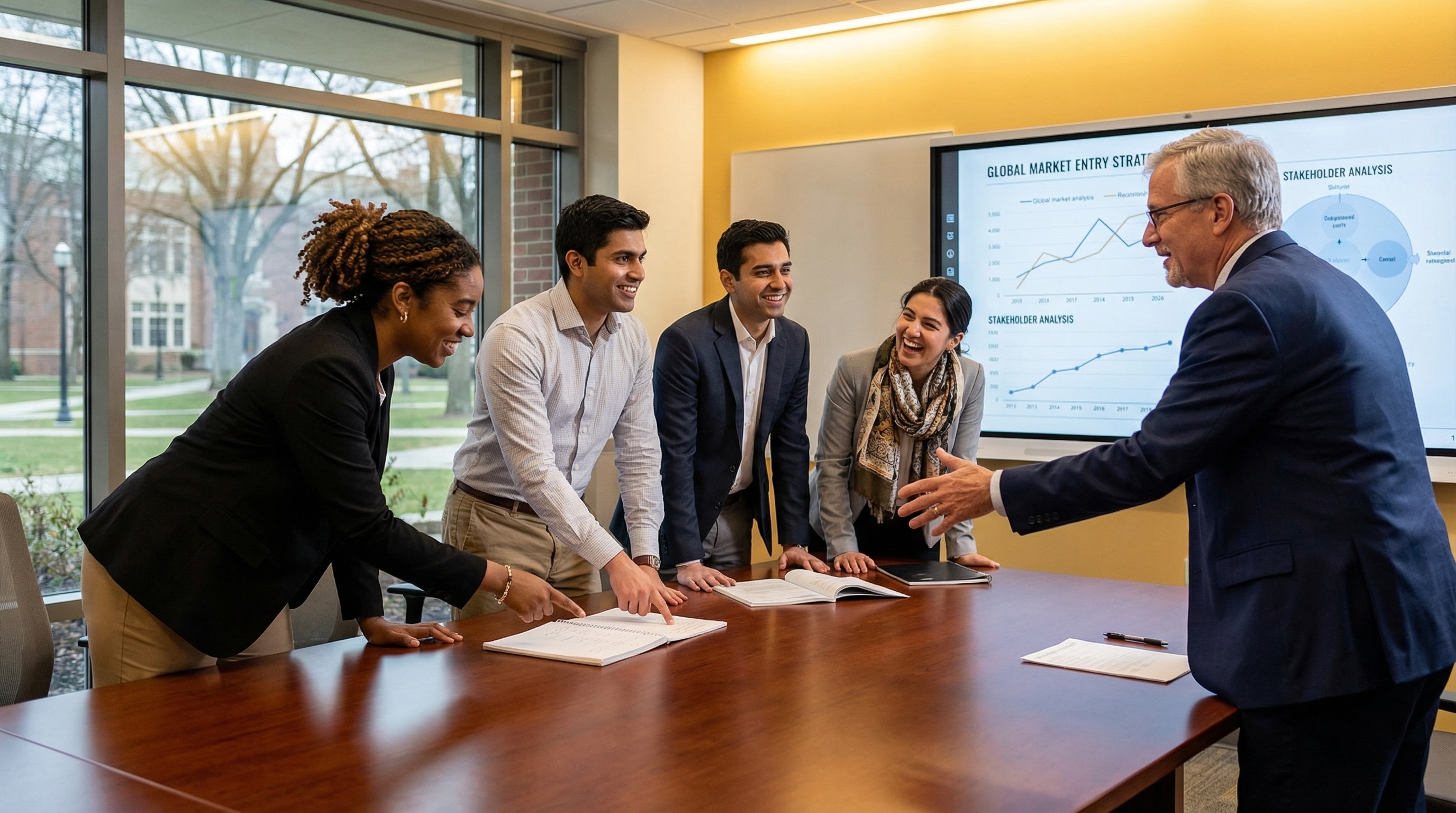
A master's in HR analytics prepares graduates for data-driven people management roles earning $98K-$122K at the senior level, compared to a $72,910 median for general HR Specialists. Programs teach predictive modeling, NLP for survey analysis, causal inference, and HRIS platforms like Workday and SAP SuccessFactors. The HR analytics market is projected to reach $8.59 billion by 2030, growing at 14.8% CAGR.
$8.59B
Market Size by 2030
$98K-$122K
Senior Analyst Salary
43%
AI Adoption in HR
+5%
HR Manager Growth Rate
Analytics Techniques at the Master's Level
Regression, classification trees, survival analysis for attrition, and gradient-boosted models for flight-risk scoring. This is the technique that separates master's-level analysts earning $98K-$122K from dashboard builders at the $72,910 HR Specialist median (BLS, May 2024; PayScale, 2026).
Key Points
- Regression analysis
- Classification trees
- Survival analysis
- Gradient-boosted models
Applied to open-ended survey responses, Glassdoor reviews, and exit interview transcripts. NLP allows HR teams to extract sentiment patterns and engagement themes from unstructured text at scale, replacing manual coding of qualitative data.
Key Points
- Sentiment analysis
- Text classification
- Topic modeling
- Survey text mining
Techniques like propensity score matching and difference-in-differences let you answer whether a new onboarding program actually reduced 90-day turnover or if something else changed at the same time. Critical for proving ROI on HR interventions.
Key Points
- Propensity score matching
- Difference-in-differences
- Instrumental variables
- Regression discontinuity
Designing controlled experiments for HR interventions: does offering a $2,000 stipend for professional development improve retention more than a four-day workweek? Moves HR from intuition-based to evidence-based decision-making.
Key Points
- Randomized controlled trials
- Statistical power analysis
- Control group design
- Intervention measurement
Source: Grand View Research
HR Analytics vs. Data Science: Choosing the Right Degree
Why HR Analytics Beats Generic Data Science for HR Careers
This is where the concentration differs from a standalone data science degree. Pure data science programs teach the same technical methods, but they don't contextualize them in employment law, psychometrics, or organizational behavior. An HR analytics student learns to build a turnover model and understands why using zip code as a predictor variable could create disparate impact liability. That legal and ethical overlay is what makes the specialization distinct, and it's what employers are paying a premium for.
Programs typically embed analytics coursework within a broader Master's in HR curriculum. At Cornell's ILR School, for instance, students take applied statistics and people analytics alongside labor economics and collective bargaining. At Illinois, the analytics track sits within the School of Labor and Employment Relations, which means you're also studying organizational theory and workforce policy. The result is a graduate who can run a random forest model and explain the output to a CHRO who has never opened a Jupyter notebook.
Cornell University
Why #1: Cornell University
Cornell's MILR through the Ivy League ILR School offers unmatched prestige and outcomes, with graduates earning a $97,473 average starting salary at elite employers.
Cornell University offers a 48-credit Master of Industrial and Labor Relations (MILR) through its Ivy League ILR School. The on-campus program produces graduates with a $97,473 average starting salary in HR, with top employers including Estee Lauder, JPMorgan, and S.C. Johnson.
Program Highlights
- SHRM-aligned curriculum
- AACSB-accredited business school
- Specializations: Industrial and Labor Relations
- Ivy League ILR School
- 48 credits
Key Strengths
- SHRM-aligned curriculum
- AACSB-accredited business school
- Specializations: Industrial and Labor Relations
- Ivy League ILR School
Program
- 48 credits
Sources
University of Southern California
Why #2: University of Southern California
Carries the USC brand and Trojan alumni network with a fast 12-month format, though the premium price and lack of SHRM alignment are trade-offs.
USC offers a 24-unit online Master of Science in Human Resource Management through Bovard College. The 12-month accelerated program costs $2,539 per unit ($60,936 total) with WSCUC accreditation but is NOT SHRM-aligned.
Program Highlights
- AACSB-accredited business school
- 12-month accelerated
- 24 units
- $2,539/unit ($60,936 total)
- NOT SHRM-aligned
Key Strengths
- AACSB-accredited business school
- 12-month accelerated
- 24 units
- $2,539/unit ($60,936 total)
Program
- 24 credits
Prerequisites
Bachelor's degree
Sources
University of Illinois Urbana-Champaign
Why #3: University of Illinois Urbana-Champaign
Choose UIUC for its deep specialization options in emerging areas like HR Data Analytics and International HR, backed by strong placement rates and competitive starting salaries.
The University of Illinois Urbana-Champaign offers a 48-credit Master of Human Resources and Industrial Relations (MHRIR) through its School of Labor and Employment Relations. The program is available on-campus and online with five specializations.
Program Highlights
- SHRM-aligned curriculum
- AACSB-accredited business school
- 5 specialization options including HR Data Analytics and Union Management
- 5 specializations
- 48-credit comprehensive program
Key Strengths
- SHRM-aligned curriculum
- AACSB-accredited business school
- 5 specialization options including HR Data Analytics and Union Management
- 5 specializations
Admissions
- GPA: 3
Program
- 48 credits
Prerequisites
Bachelor's degree
Sources
Technical Skills for HR Analytics
Programs that only teach Excel and SPSS are preparing graduates for 2015 job postings. The strongest programs integrate these tools directly into HR coursework -- you should be writing code to analyze real workforce datasets, not just running pre-built reports.
Statistical Programming
Primary language for predictive modeling, NLP, and machine learning in HR analytics. Used for building turnover prediction models, flight-risk scoring, and automated survey analysis.
Widely used in academic HR research and I/O psychology for statistical analysis, psychometric validation, and causal inference methods.
Required for querying HRIS databases. Every analytics role involves extracting and transforming employee data from enterprise systems.
Visualization & Reporting
Industry-standard visualization tool for building interactive HR dashboards showing turnover trends, diversity metrics, and compensation benchmarking.
Microsoft's visualization platform, dominant in organizations using the Microsoft enterprise stack. Increasingly common in HR departments already on Office 365.
Enterprise HRIS Platforms
Market leader for enterprise HR analytics. Hands-on experience saves months of on-the-job learning. Programs with vendor partnerships offer sandbox access.
Dominant in large multinational corporations. The analytics module requires understanding both the platform architecture and the statistical methods it supports.
Purpose-built people analytics platform growing rapidly in mid-market and enterprise organizations. Increasingly requested in job postings.
Enterprise HCM platform with embedded analytics capabilities. Common in large organizations with existing Oracle infrastructure.
Career Paths
HR Analyst
SOC 13-1071Builds reports, cleans HRIS data, and runs basic turnover analyses. Starting salary depends on market and industry. This is the table-stakes entry point.
Builds predictive models and presents findings to the C-suite. LinkedIn job postings at Deloitte, Amazon, and Microsoft show $122K base salary plus equity and bonuses.
People Analytics Manager / Director
SOC 11-3121Builds analytics teams, sets measurement strategy, and partners with finance on headcount planning. Analytics-focused managers sit at the top of the HR Manager salary range.
Management Analyst (Internal Consulting)
SOC 13-1111Redesigns compensation structures, evaluates learning program ROI, or builds workforce planning models for M&A decisions. 10% projected growth through 2034.
Data Scientist (HR Domain)
SOC 15-2051HR analytics background provides domain expertise that generic data scientists lack. Strong crossover for those who want to stay technical while leveraging people-domain knowledge.
Salary by Experience Level
Source: SHRM 2025 Cost of Talent Survey
How to Evaluate an HR Analytics Master's Program
Check the technical requirements
Look for programs that require SQL, Python or R, and at least one visualization tool (Tableau or Power BI). If the program only teaches Excel and SPSS, it's preparing you for 2015 job postings. The strongest programs -- Cornell, Illinois, Minnesota -- integrate statistical programming directly into HR coursework.
Verify HRIS platform exposure
Workday, SAP SuccessFactors, and Oracle HCM Cloud dominate the enterprise market. Ask whether the program has vendor partnerships or sandbox access. See our [HRIS specialization](/masters/hris/) page for platform-specific programs.
Choose between capstone and thesis
Applied programs require a capstone solving a real analytics problem for a partner organization. Research programs require a thesis with original methodology. Capstone is more marketable for industry roles; thesis builds credibility for teaching or organizational research.
Confirm accreditation and alignment
[SHRM-aligned programs](/masters/shrm-aligned/) map curriculum to SHRM's competency model for [SHRM-CP](/certifications/shrm-cp/) exam eligibility. AACSB accreditation signals rigor. Six of our top 10 hold SHRM alignment and eight hold AACSB accreditation.
Assess online vs. on-campus fit
Several top programs offer hybrid formats for mid-career professionals. On-campus offers better networking and research lab access; online lets you apply coursework to your current job. See our [online master's programs guide](/online/masters/) for distance-friendly options.
The Science of Measuring People
HR analytics sits at a methodological crossroads that most "data science for business" programs ignore entirely. You're measuring human behavior in organizational contexts, which means every dataset carries validity concerns, ethical constraints, and legal boundaries that don't apply when you're optimizing ad click-through rates. A master's program worth its tuition teaches you to navigate all three.
Psychometrics and measurement validity form the scientific backbone. When you design an employee engagement survey, you need to understand construct validity (are you actually measuring engagement or just satisfaction?), internal consistency (does the scale hold together?), and criterion validity (does the score predict anything useful, like voluntary turnover or productivity?). These are I/O psychology fundamentals, and they separate analysts who produce actionable insights from those who produce noise. Programs that pair analytics with organizational psychology coursework tend to cover this territory well.
Research design determines whether your findings mean anything. Most HR data is observational -- you didn't randomly assign employees to managers, and you can't run a controlled experiment on layoff decisions. This means you need quasi-experimental methods: regression discontinuity for policy thresholds, instrumental variables for causal claims, and at minimum, propensity score matching to control for selection bias. A good program teaches you when these methods work and when they don't, which is just as important.
The ethics of algorithmic HR decisions are not theoretical anymore. When you build a model that predicts which candidates will succeed, you need to audit it for disparate impact across protected classes. When you use NLP to analyze employee sentiment, you need a governance framework for data privacy and informed consent. SHRM's 2025 AI report found that 43% of HR departments now use AI tools, nearly doubling from 26% in 2024. That rapid adoption has outpaced most organizations' ethical frameworks, creating demand for people who understand both the technology and the guardrails.
This is where the HR analytics specialization proves its value over a generic data science approach. You learn to ask not just "can we predict this?" but "should we predict this, and what happens when we get it wrong?" An algorithm that flags employees as flight risks can become a self-fulfilling prophecy if managers treat flagged employees differently. A pay equity model that ignores legitimate compensable factors can create legal exposure. A master's program that takes measurement science seriously prepares you for these real-world complications in a way that a Python bootcamp never will.
Admission Requirements and Format
Most master's programs with analytics concentrations expect applicants to arrive with some quantitative foundation, though the bar varies. At minimum, you'll need an undergraduate degree (any field is usually acceptable), a GPA of 3.0 or higher, and two to three letters of recommendation. Programs housed in schools of labor relations (Cornell ILR, Illinois, Rutgers) tend to be more flexible on quantitative prerequisites than those embedded in business schools. Business school programs, especially AACSB-accredited ones, often expect a statistics course and may require the GRE or GMAT.
Professional experience matters more for analytics concentrations than for general HR master's programs. Most top-10 programs prefer one to three years of work experience, ideally involving data analysis, HRIS administration, or HR operations. If you're coming straight from undergrad, strong coursework in statistics, psychology research methods, or computer science can substitute. Several programs -- including Michigan State, Ohio State, and Penn State -- have waived GRE requirements for applicants with sufficient professional experience or quantitative undergraduate coursework.
Program duration ranges from 12 months (accelerated formats at some private universities) to 24 months for the standard full-time track. Part-time options typically run 24 to 36 months and are designed for working professionals. Most analytics concentrations require 36 to 48 credit hours, with 12 to 15 of those in analytics-specific coursework. Some programs -- particularly at R1 research universities like Minnesota and Ohio State -- allow students to take electives in the computer science or statistics department, which adds technical depth that pure HR programs can't match.
Format-wise, the landscape has shifted substantially since 2020. Several top programs now offer hybrid models: weekend intensives for cohort-building combined with asynchronous online coursework for technical modules. Fully online options exist but are less common at the top-ranked programs. If the online format matters to you, check our online HR analytics programs guide for programs specifically designed for remote delivery. For those considering whether a master's is worth the investment compared to the job market for working adults, the analytics concentration tends to have stronger ROI than general HR because the salary premium is larger and more immediate.
Frequently Asked Questions About HR Analytics Master's Programs
HR completions volume, CIP breadth, multi-level depth
SHRM alignment (+15), AACSB (+10) or ACBSP (+5)
IPEDS 6-year graduation rate
Carnegie 2021 classification
IPEDS reporting completeness
Data Sources
- 1.IPEDS 2023 (Rankings) — Rankings use our 5-factor HR Program Quality Index: program strength (25%), graduation rate (20%), career outcomes (15%), Carnegie classification (12%), selectivity (10%), industry recognition including SHRM alignment and AACSB accreditation (10%), institution stability (5%), and data transparency (3%).
- 2.BLS Occupational Employment and Wage Statistics, May 2024 — Salary data for HR Specialists (SOC 13-1071), HR Managers (SOC 11-3121), Management Analysts (SOC 13-1111), and Data Scientists (SOC 15-2051).
- 3.Grand View Research HR Analytics Market Report — Market size projections ($2.95B in 2022 to $8.59B by 2030 at 14.8% CAGR).
- 4.PayScale, January 2026 — Entry-level and senior-level salary benchmarks for HR Analyst and Senior HRIS Analyst roles.
- 5.SHRM 2025 AI in the Workplace Report — AI adoption statistics (43% of HR departments in 2025, up from 26% in 2024).
- 6.IPEDS Tuition Data (2023-24) — Published graduate tuition for the 2023-24 academic year. May not reflect negotiated rates, employer tuition assistance, or financial aid.
Related Resources

Taylor Rupe
Education Researcher & Data Analyst
B.A. Psychology, University of Washington · B.S. Computer Science, Oregon State University
Taylor combines training in behavioral science with data analysis to evaluate HR education programs. His research methodology uses IPEDS completion data, BLS employment statistics, and SHRM alignment data to produce evidence-based program rankings.