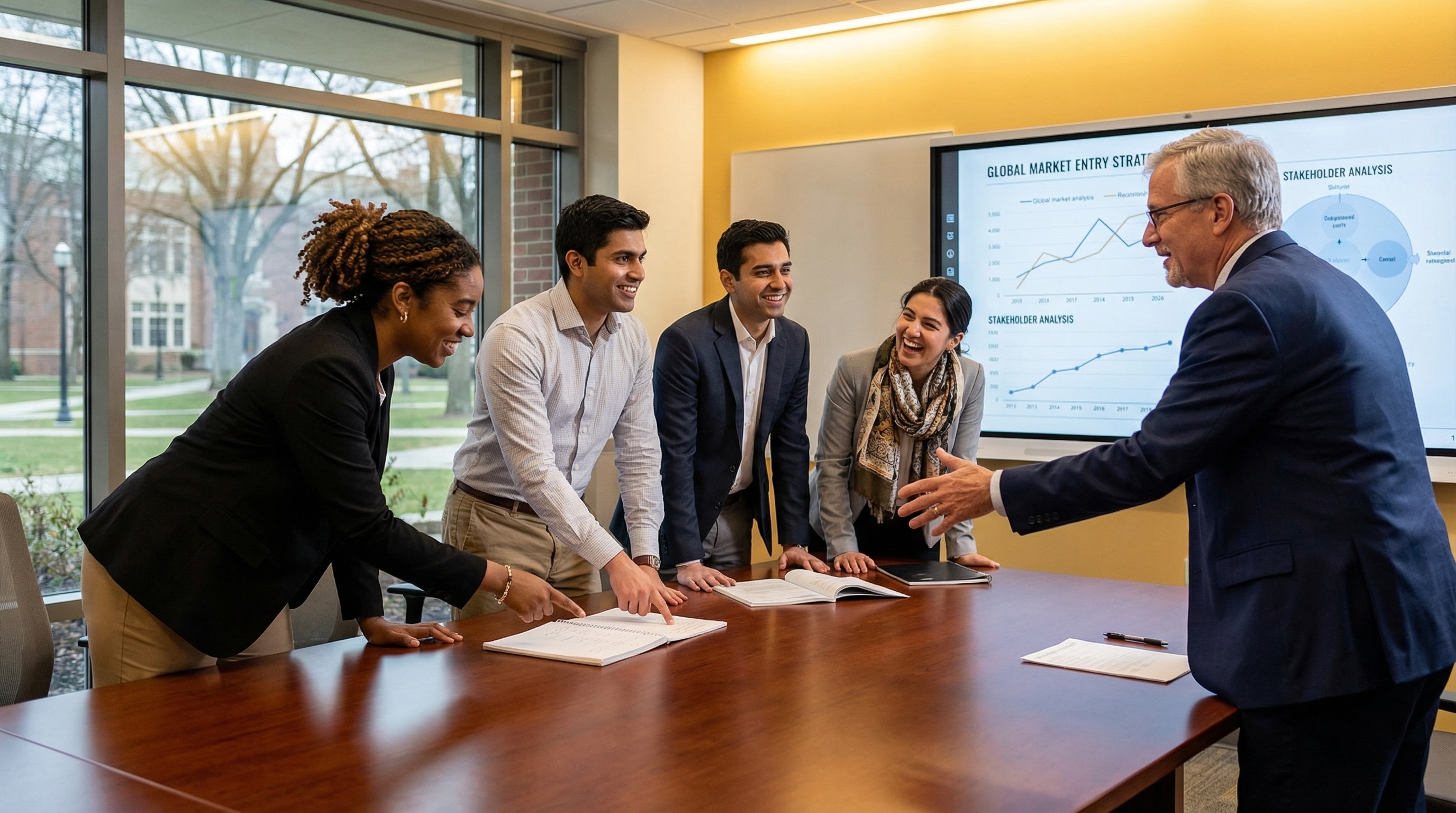
A master's in organizational development concentration prepares graduates for OD consulting, change management, and internal transformation roles. Training and Development Managers in OD earn a $127,090 median salary, while external OD consultants mapped to Management Analysts earn $99,410 with 10% projected growth through 2034. Cornell ILR leads our 10-program ranking with a 93.9 composite score based on IPEDS 2023 data.
$127,090
Training & Development Manager Median Salary
$99,410
Management Analyst Median Salary
452,300
Training Specialist Jobs Nationwide
+10%
Management Analyst Job Growth (2024-34)
What an OD Concentration Covers at the Master's Level
Organizational development is the discipline of planned, systematic change within companies, nonprofits, and government agencies. A master's in organizational development concentration sits inside broader Master's in HR programs and focuses specifically on how organizations diagnose problems, design interventions, and measure whether those interventions actually worked. If standard HR coursework teaches you to manage people, OD coursework teaches you to reshape the systems those people work within.
Coursework in these programs tends to be more applied than theoretical. You will likely encounter classes in organizational diagnosis, survey design and feedback, group facilitation, large-scale change methods, and consulting skills. Several programs on these rankings -- Cornell, Illinois, and Minnesota among them -- require a consulting practicum where students work with a real client organization. These practicums are where the classroom frameworks get tested against the messiness of actual corporate politics, budget constraints, and resistance to change.
OD overlaps meaningfully with industrial-organizational psychology, but the two are not identical. I/O psychology programs tend to emphasize individual-level phenomena -- hiring assessments, performance measurement, employee motivation. OD programs work at the group and system level: team effectiveness, organizational culture, restructuring, and merger integration. Many students interested in both fields look for programs that blend the two, and several SHRM-aligned curricula now incorporate elements of both disciplines.
Source: OD Network membership and conference attendance data
Core OD Methods Taught in Master's Programs
The backbone method of OD practice: collect data from an organization, analyze it collaboratively with stakeholders, implement a change, and study the results. Programs that skip this are teaching organizational behavior theory without the applied intervention framework that makes OD practitioners useful to employers.
Key Skills
Common Roles
- Internal OD Consultant
- Change Management Lead
- Organizational Effectiveness Analyst
Developed by David Cooperrider at Case Western Reserve, this method flips traditional problem-solving by asking organizations to identify what already works and build from there. Uses a four-phase cycle (Discovery, Dream, Design, Destiny) that shifts conversation from deficit-based problem-solving to strength-based possibility thinking.
Key Skills
Common Roles
- OD Consultant
- Culture Transformation Lead
- Employee Engagement Director
Drawn from Peter Senge's work at MIT on the 'learning organization,' this approach trains students to see organizations as interconnected wholes rather than isolated departments. A compensation restructuring affects retention, which affects workload, which affects burnout -- systems thinkers map these feedback loops before designing interventions.
Key Skills
Common Roles
- Strategic Transformation Officer
- Enterprise Change Architect
- VP of Organizational Development
University of Oklahoma-Norman Campus
Why #1: University of Oklahoma-Norman Campus
OU's MA in Human Resource Studies offers flexible delivery options from a flagship state university, though it lacks SHRM alignment.
The University of Oklahoma offers a 36-credit MA in Human Resource Studies through HLC accreditation. Available online, on campus, or in hybrid format, the program is NOT SHRM-aligned.
Program Highlights
- AACSB-accredited business school
- Specializations: Human Resource Studies
- 36 credits
- Online/campus/hybrid delivery
- HLC accredited
Key Strengths
- AACSB-accredited business school
- Specializations: Human Resource Studies
- 36 credits
- Online/campus/hybrid delivery
Program
- 36 credits
Sources
Temple University
Why #2: Temple University
Temple's 13-month accelerated MS HRM combines AACSB accreditation with SHRM alignment in a compact fully online format.
Temple University offers a 30-credit MS in HRM through the Fox School of Business with AACSB and MSCHE accreditation plus SHRM alignment. The fully online program can be completed in 13 months.
Program Highlights
- SHRM-aligned curriculum
- AACSB-accredited business school
- Specializations: Human Resource Management
- AACSB accredited
- 30 credits
Key Strengths
- SHRM-aligned curriculum
- AACSB-accredited business school
- Specializations: Human Resource Management
- AACSB accredited
Program
- 30 credits
Sources
University of Pennsylvania
Why #3: University of Pennsylvania
SHRM alignment with SHRM-CP exam eligibility from an AACSB-accredited program, giving graduates a fast track to professional certification.
Robert Morris University offers a BS in Business Administration with a Management HR concentration. The AACSB-accredited, SHRM-aligned program offers SHRM-CP exam eligibility.
Program Highlights
- SHRM-aligned curriculum
- AACSB-accredited business school
- Specializations: Management HR concentration
- SHRM-CP eligibility
- 40 annual HR graduates (IPEDS 2023)
Key Strengths
- SHRM-aligned curriculum
- AACSB-accredited business school
- Specializations: Management HR concentration
- SHRM-CP eligibility
Admissions
- GPA: 2.5
Program
- 120 credits
Prerequisites
Bachelor's admission requirements
Sources
| 1 | University of Oklahoma-Norman Campus | Norman, OK | Public | $5,070 | 8800% | 8 | 77.4 | false | true | false |
| 2 | Temple University | Philadelphia, PA | Public | $21,023 | — | 6 | 70.7 | true | true | false |
| 3 | University of Pennsylvania | Philadelphia, PA | Private | $58,620 | 10000% | 40 | 67 | false | true | false |
| 4 | Regent University | Virginia Beach, VA | Private | $18,986 | 6400% | 54 | 64.4 | true | false | true |
| 5 | Vanderbilt University | Nashville, TN | Private | $61,618 | 9900% | 38 | 62.6 | false | true | false |
| 6 | George Washington University | Washington, DC | Private | $64,508 | — | 13 | 61.8 | false | true | false |
| 7 | George Mason University | Fairfax, VA | Public | $10,095 | 8000% | 21 | 60.9 | true | false | false |
| 8 | Northwestern University | Evanston, IL | Private | $64,887 | 9000% | 5 | 59.4 | false | true | false |
| 9 | University of Colorado Denver/Anschutz Medical Campus | Denver, CO | Public | $9,096 | 9500% | 46 | 52.4 | false | false | false |
| 10 | Harvard University | Cambridge, MA | Private | $54,269 | — | 83 | 52.3 | false | true | false |
| 11 | University of the Incarnate Word | San Antonio, TX | Private | $33,700 | 7500% | 127 | 52 | false | false | false |
| 12 | Tiffin University | Tiffin, OH | Private | $30,900 | 9400% | 18 | 52 | false | false | false |
| 13 | Central Michigan University | Mount Pleasant, MI | Public | $13,862 | — | 8 | 44.9 | false | false | false |
| 14 | Mount St. Joseph University | Cincinnati, OH | Private | $35,450 | 8600% | 22 | 42.4 | false | false | false |
| 15 | Wayne State College | Wayne, NE | Public | $5,760 | 8300% | 38 | 40.4 | false | false | false |
| 16 | Brenau University | Gainesville, GA | Private | $31,000 | — | 19 | 39.7 | false | false | false |
| 17 | Fielding Graduate University | Santa Barbara, CA | Private | $0 | — | 75 | 38.3 | false | false | false |
| 18 | Bethel University | Saint Paul, MN | Private | $42,760 | — | 23 | 35.8 | false | false | false |
| 19 | Simpson University | Redding, CA | Private | $37,022 | 6700% | 13 | 35.4 | false | false | false |
| 20 | Pennsylvania State University-Penn State Harrisburg | Middletown, PA | Public | $15,388 | 7900% | 9 | 35.3 | false | false | false |
| 21 | Northern Kentucky University | Highland Heights, KY | Public | $10,512 | — | 18 | 35.1 | false | false | false |
| 22 | The College of Saint Scholastica | Duluth, MN | Private | $39,530 | — | 17 | 35 | false | false | false |
| 23 | Benedictine University | Lisle, IL | Private | $31,028 | — | 29 | 34.6 | false | false | false |
| 24 | Edgewood College | Madison, WI | Private | $34,850 | — | 12 | 34.2 | false | false | false |
| 25 | Azusa Pacific University | Azusa, CA | Private | $42,900 | — | 19 | 33.3 | false | false | false |
Showing 1–25 of 35
Career Paths
HR Manager (OD Specialization)
SOC 11-3121Generalist HR leaders who have added OD expertise, often running both the traditional HR function and the organizational effectiveness function. The subset with OD skills commands a premium because fewer HR managers have formal training in change management methodology.
Training and Development Manager
SOC 11-3131Internal OD directors and heads of organizational effectiveness. These roles involve designing company-wide learning strategies, leading culture transformation initiatives, and overseeing leadership development programs. When someone is VP of Organizational Development at a Fortune 500 company, their salary data maps here.
Management Analyst (OD Consultant)
SOC 13-1111External OD consultants and independent change management practitioners. The 10% growth rate -- fastest among OD-adjacent roles -- is driven by organizations hiring outside consultants for restructuring, digital transformation, and post-merger integration work.
Training and Development Specialist
SOC 13-1151Entry and mid-career OD role. The 11% growth projection is the highest among all four OD-adjacent categories. Typical progression moves toward manager-level roles within three to seven years, particularly for those who pursue SHRM-CP or CCMP credentials.
Source: BLS OES May 2024
What to Look for in an HR Organizational Development Master's Program
Verify action research is a required course, not an elective
Action research is the defining method of OD practice. Programs that skip it are teaching organizational behavior theory without the applied intervention framework. Cornell's MILR program and the University of Illinois School of Labor and Employment Relations both require formal action research coursework.
Evaluate the consulting practicum or field project requirement
Strong OD programs place you inside a real organization to diagnose a problem, design an intervention, implement it under faculty supervision, and report results. Rutgers SMLR and Ohio State Fisher both run structured consulting practicums with external clients -- fundamentally different from case study exercises.
Check for both individual and system-level diagnostics
A good OD curriculum teaches survey design and feedback, organizational network analysis, and culture assessment tools alongside traditional HR competencies covered by [SHRM-aligned programs](/masters/shrm-aligned/). Programs like Minnesota, Michigan State, and Penn State give you the broadest preparation.
Consider residency or intensive format options
OD is a relationship-intensive discipline -- facilitation skills, group dynamics, and intervention design are hard to teach entirely through asynchronous video lectures. Georgetown and Columbia use hybrid delivery models with intensive residencies, though at substantially higher tuition ($64,896 and $64,526 respectively, per IPEDS 2023).
Examine faculty research interests and publication records
OD is a small enough field that individual faculty shape entire programs. Look for faculty publishing in the Journal of Applied Behavioral Science or the Journal of Organizational Change Management. If OD courses are taught by adjuncts with no publication history, the concentration may be more marketing than substance.
OD and Change Management Certifications
Pairing a master's degree with one of these credentials signals both academic depth and practitioner credibility to employers.
Recommended Specializations
Certified Change Management Professional (CCMP)
Association of Change Management Professionals (ACMP)The most rigorous OD-specific credential available. Requires documented change management experience and a portfolio review, making it more substantive than certificate programs from training vendors. Core OD curriculum -- action research, appreciative inquiry, systems thinking, Lewin's change model -- maps directly to CCMP competencies.
More widely recognized by HR hiring managers than the CCMP if your goal is an internal OD role within an HR department rather than external consulting. Demonstrates both HR breadth and strategic leadership competency.
Entry-level SHRM credential for OD graduates early in their careers. Many master's graduates pursue this during their program and upgrade to SHRM-SCP after gaining sufficient experience. See our [SHRM-CP certification guide](/certifications/shrm-cp/) for full details.
Prosci Change Practitioner
ProsciIndustry-standard methodology certification focused on the ADKAR model for individual change. Widely adopted in corporate environments, particularly in IT and digital transformation contexts. Complements the broader OD perspective of a master's degree.
The Psychology of Organizational Change
Every OD concentration teaches change management frameworks, but the best programs ground those frameworks in behavioral science rather than treating them as checklists. Understanding why people resist change -- and why resistance is sometimes rational -- is what separates effective OD practitioners from consultants who just deploy pre-packaged change toolkits.
Kurt Lewin's three-stage model (unfreeze, change, refreeze) remains the foundational framework in most OD curricula, and for good reason: its simplicity forces practitioners to think about organizational inertia before jumping to solutions. The "unfreezing" stage -- creating enough discomfort with the current state that people become willing to consider alternatives -- is where most change initiatives fail. Organizations announce a restructuring, a new technology platform, or a culture shift without first building the psychological case for why the current state is no longer viable. Lewin's insight was that change is not a communication problem; it is a motivation problem.
David Rock's SCARF model, widely taught in programs with neuroscience-informed curricula, identifies five domains that trigger threat or reward responses during organizational change: Status, Certainty, Autonomy, Relatedness, and Fairness. When a restructuring threatens someone's status (their title changes), reduces their certainty (their role is ambiguous), eliminates their autonomy (decisions are now centralized), disrupts their relationships (their team is disbanded), or feels unfair (some groups are affected more than others), the brain processes these threats similarly to physical danger. OD practitioners trained in SCARF learn to design interventions that mitigate these threat responses rather than simply pushing through resistance.
Appreciative inquiry, originally developed at Case Western Reserve University, takes a different approach entirely. Rather than diagnosing what is broken and prescribing a fix, AI asks organizations to identify their peak experiences -- moments when the organization performed at its best -- and then design structures that make those peak experiences more common. The methodology uses a four-phase cycle (Discovery, Dream, Design, Destiny) that shifts organizational conversation from deficit-based problem-solving to strength-based possibility thinking. It sounds softer than traditional consulting, but research published in the Journal of Applied Behavioral Science shows that AI-based interventions produce more sustainable change outcomes than problem-centered approaches, particularly in organizations where morale is already low.
Systems thinking, the third pillar of most OD curricula, draws on Peter Senge's concept of the "learning organization" and earlier work by systems theorists like Russell Ackoff. The core principle is that organizations are complex adaptive systems where interventions in one area produce unintended consequences in others. A compensation restructuring affects retention, which affects workload distribution, which affects burnout rates, which affects the very performance metrics the compensation change was designed to improve. OD practitioners trained in systems thinking learn to map these feedback loops before designing interventions, reducing the likelihood of solving one problem by creating three new ones.
Return on Investment
If you are evaluating the return on investment, consider that the median salary gap between Training Specialists ($65,850) and Training and Development Managers ($127,090) is $61,240 annually (BLS OES 2024). Even at the highest tuition on our list, a master's degree that accelerates that transition by two to three years pays for itself quickly. Pairing the degree with a SHRM-SCP certification or the CCMP credential from the Association of Change Management Professionals strengthens the ROI further by signaling both HR breadth and OD depth to employers. Several of the most affordable master's programs offer OD electives even if they do not have a formal OD concentration.
Data Sources
Salary data from the Bureau of Labor Statistics Occupational Employment and Wage Statistics (OES), May 2024 release. Job growth projections from the BLS Occupational Outlook Handbook, 2024-2034 projections. Tuition, graduation rates, program completions, and Carnegie classifications from the Integrated Postsecondary Education Data System (IPEDS), 2023 survey year. SHRM alignment status verified against the SHRM-aligned program directory. AACSB and ACBSP accreditation status verified against each organization's accredited school database.
Frequently Asked Questions About Organizational Development Master's in HR
IPEDS 2023, SHRM Academic Alignment, AACSB, ACBSP
HR degree completions from IPEDS 2023 (sqrt normalized, cap 300), plus CIP code breadth and multi-level depth bonuses
SHRM-aligned curriculum (+15 pts) and AACSB (+10) or ACBSP (+5) business school accreditation
6-year graduation rate from IPEDS 2023
Carnegie 2021 classification (R1/R2 research universities score highest)
Completeness of IPEDS reporting (tuition, graduation rate, acceptance rate, Carnegie classification)
Sources
- 1.Bureau of Labor Statistics -- Occupational Employment Statistics — HR occupation salary and employment data (May 2024)
- 2.Society for Human Resource Management (SHRM) — HR industry research, benchmarks, and best practices
Related Resources

Taylor Rupe
Education Researcher & Data Analyst
B.A. Psychology, University of Washington · B.S. Computer Science, Oregon State University
Taylor combines training in behavioral science with data analysis to evaluate HR education programs. His research methodology uses IPEDS completion data, BLS employment statistics, and SHRM alignment data to produce evidence-based program rankings.