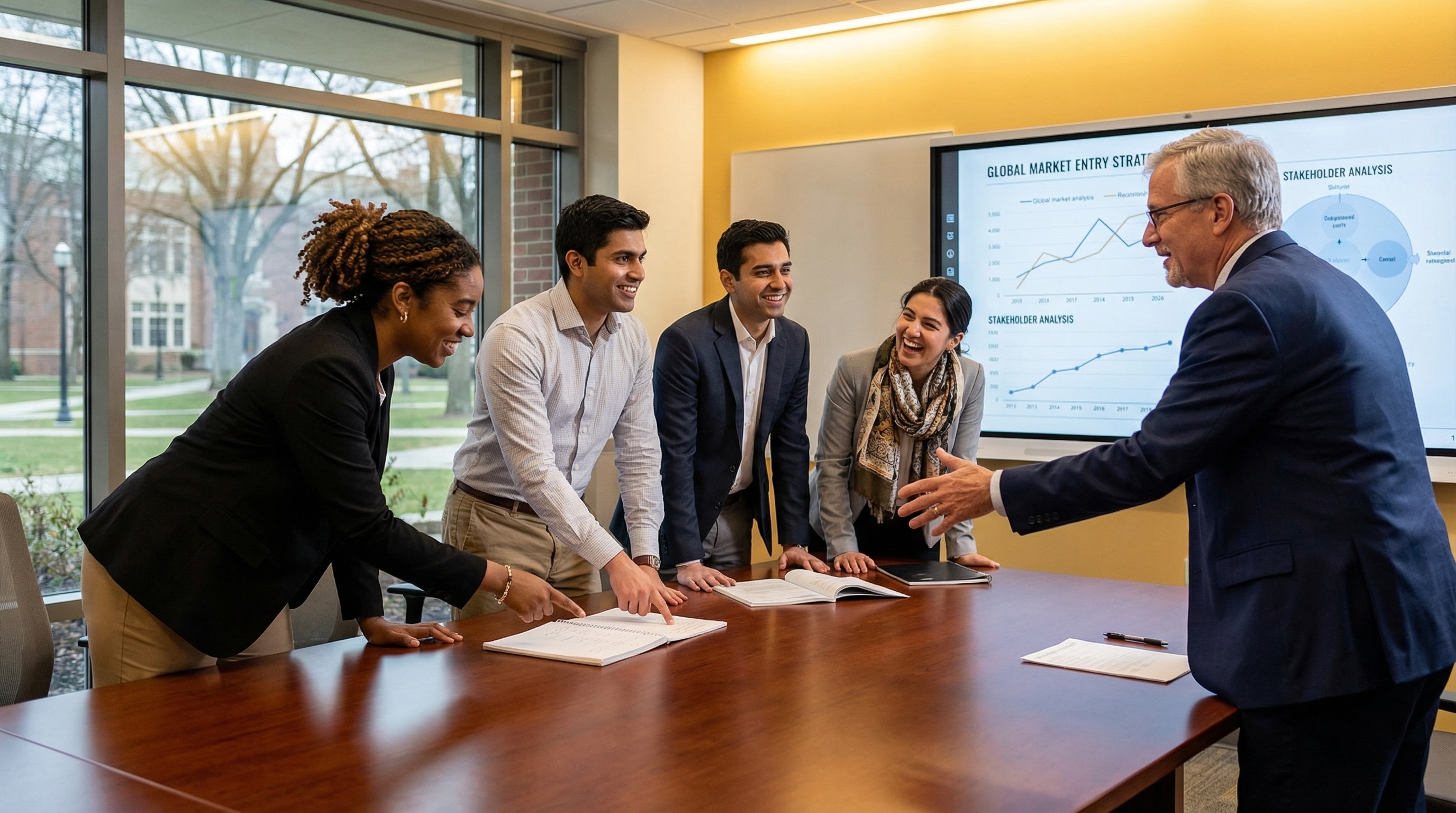
SHRM-aligned master's in HR programs have their curricula reviewed by the Society for Human Resource Management and mapped to its Body of Applied Skills and Knowledge competency model. Over 500 programs at roughly 425 institutions hold this designation. Students at aligned programs can sit for the SHRM-CP exam before graduating, and a master's degree reduces SHRM-SCP experience requirements by 1-2 years.
10
Top Programs Analyzed
80%
Top 10 with Dual SHRM + AACSB
$140,030
HR Manager Median Salary
~68%
SHRM-CP Overall Pass Rate
What SHRM Alignment Actually Means
SHRM curriculum alignment is a voluntary acknowledgment process run by the Society for Human Resource Management, the world's largest HR professional association with over 340,000 members across 180+ countries (SHRM About). When a graduate program earns alignment, it means the university submitted detailed course mapping documentation to SHRM's Academic Affairs team and received confirmation that its curriculum covers the content areas defined in the HR Curriculum Guidebook and Templates. The Guidebook was first published in 2006 and has been revalidated in 2010, 2013, and 2017 to keep pace with changes in the profession.
The substance of alignment centers on SHRM's Body of Applied Skills and Knowledge (SHRM BASK), which organizes HR practice into 9 behavioral competencies and 15 HR knowledge areas. An aligned master's program doesn't just mention these topics in a single survey course. It has to demonstrate that students receive substantive instruction across the full competency model, distributed throughout their coursework.
A critical distinction that confuses many applicants: SHRM alignment is not the same as SHRM accreditation. SHRM does not accredit programs. Institutional accreditation comes from regional accreditors like the Higher Learning Commission or Middle States Commission. Business school accreditation comes from bodies like AACSB or ACBSP. SHRM alignment specifically validates that the HR curriculum maps to professional competency standards. A program can hold AACSB accreditation without SHRM alignment, and it can be SHRM-aligned without AACSB. The strongest programs have both.
SHRM BASK Competency Domains
HR Strategy, Talent Acquisition, Employee Engagement & Retention, Learning & Development, Total Rewards. Covers how organizations attract, develop, and keep talent aligned with business goals.
Key Skills
Common Roles
- HR Manager
- Talent Acquisition Director
- L&D Manager
Structure & Functionality, Organizational Effectiveness & Development, Workforce Management, Employee & Labor Relations, Technology Management. Covers how HR shapes and supports organizational design.
Key Skills
Common Roles
- HRBP
- Labor Relations Specialist
- OD Consultant
HR in the Global Context, Diversity & Inclusion, Risk Management, Corporate Social Responsibility, U.S. Employment Law & Regulations. Covers compliance, ethics, and the work environment.
Key Skills
Common Roles
- Compliance Manager
- DEI Director
- Risk Analyst
Business & HR Strategy. Covers aligning HR initiatives with organizational strategy, using data-driven decision-making, and contributing to executive-level planning.
Key Skills
Common Roles
- CHRO
- VP of HR
- HR Analytics Director
Leadership, Ethical Practice, Relationship Management, Communication, Consultation, Critical Evaluation, Business Acumen, Global Mindset. These cross-cutting skills are tested via situational judgment on the SHRM-CP/SCP exams.
Key Skills
Common Roles
- HR Director
- Senior HRBP
- HR Consultant
Source: SHRM Program Directory
Source: SHRM About
SHRM Alignment vs. Other Accreditations
Cornell University
Why #1: Cornell University
Cornell's MILR through the Ivy League ILR School offers unmatched prestige and outcomes, with graduates earning a $97,473 average starting salary at elite employers.
Cornell University offers a 48-credit Master of Industrial and Labor Relations (MILR) through its Ivy League ILR School. The on-campus program produces graduates with a $97,473 average starting salary in HR, with top employers including Estee Lauder, JPMorgan, and S.C. Johnson.
Program Highlights
- Specializations: Industrial and Labor Relations
- Ivy League ILR School
- 48 credits
- On-campus only
- $97,473 avg starting salary
Key Strengths
- Specializations: Industrial and Labor Relations
- Ivy League ILR School
- 48 credits
- On-campus only
Program
- 48 credits
Sources
University of Southern California
Why #2: University of Southern California
Carries the USC brand and Trojan alumni network with a fast 12-month format, though the premium price and lack of SHRM alignment are trade-offs.
USC offers a 24-unit online Master of Science in Human Resource Management through Bovard College. The 12-month accelerated program costs $2,539 per unit ($60,936 total) with WSCUC accreditation but is NOT SHRM-aligned.
Program Highlights
- 12-month accelerated
- 24 units
- $2,539/unit ($60,936 total)
- NOT SHRM-aligned
- 112 annual HR graduates (IPEDS 2023)
Key Strengths
- 12-month accelerated
- 24 units
- $2,539/unit ($60,936 total)
- NOT SHRM-aligned
Program
- 24 credits
Prerequisites
Bachelor's degree
Sources
University of Illinois Urbana-Champaign
Why #3: University of Illinois Urbana-Champaign
Choose UIUC for its deep specialization options in emerging areas like HR Data Analytics and International HR, backed by strong placement rates and competitive starting salaries.
The University of Illinois Urbana-Champaign offers a 48-credit Master of Human Resources and Industrial Relations (MHRIR) through its School of Labor and Employment Relations. The program is available on-campus and online with five specializations.
Program Highlights
- 5 specialization options including HR Data Analytics and Union Management
- 5 specializations
- 48-credit comprehensive program
- On-campus + online delivery
- HLC-accredited
Key Strengths
- 5 specialization options including HR Data Analytics and Union Management
- 5 specializations
- 48-credit comprehensive program
- On-campus + online delivery
Admissions
- GPA: 3
Program
- 48 credits
Prerequisites
Bachelor's degree
Sources
SHRM Certification Credentials
Both SHRM credentials test against the same competency model that aligned programs teach, creating a direct curriculum-to-exam pipeline that non-aligned programs don't replicate.
Recommended Specializations
SHRM-CP (Certified Professional)
SHRMFor HR practitioners who implement policies, serve as point of contact for staff and stakeholders, and deliver HR services. 134 questions over 4 hours, mixing knowledge items with situational judgment scenarios. Students enrolled in SHRM-aligned programs can register before graduating. Overall pass rate is approximately 68%, with aligned program graduates reporting higher rates. See our [SHRM-CP certification guide](/certifications/shrm-cp/) for full details.
SHRM-SCP (Senior Certified Professional)
SHRMFor senior-level HR leaders who develop strategies, lead HR functions, and align HR initiatives with organizational goals. Standard eligibility requires 6-7 years of HR experience depending on degree level. A master's degree reduces that requirement by 1-2 years compared to a bachelor's, allowing master's graduates to pursue the SHRM-SCP earlier in their career. See our [SHRM-SCP certification guide](/certifications/shrm-scp/) for eligibility details.
Source: SHRM & AACSB Directories
How to Verify a Program's SHRM Alignment
Check SHRM's Official Directory
Search SHRM's [Academic Institution Program Directory](https://portal.shrm.org/Education/Institution/Directory.aspx) by institution name, state, or degree level. If a program appears here, SHRM has reviewed and acknowledged its curriculum alignment. If it doesn't appear, the program hasn't completed the process regardless of marketing claims.
Ask the Admissions Office Two Questions
First: Is the HR program listed in SHRM's Academic Institution Program Directory? They should point you to the listing. Second: When was the alignment last reviewed? SHRM's standards have been updated in 2006, 2010, 2013, and 2017. A program aligned in 2008 that hasn't been re-evaluated may not reflect current standards.
Watch for Misleading Terminology
"SHRM-endorsed" is not a real designation. "SHRM-certified" is wrong. "SHRM-accredited" is also incorrect since SHRM is not an accrediting body. The correct terms are "SHRM-aligned" or "acknowledged by SHRM." Programs using wrong terminology may not understand the designation well enough to have earned it.
Verify Online Format Coverage
For online programs, confirm that SHRM alignment applies to the online format, not just the on-campus version. Compare the program's course catalog to the [SHRM HR Curriculum Guidebook content areas](https://www.shrm.org/topics-tools/tools/hr-curriculum-guidebook-templates) to verify coverage yourself.
Cross-Check Business School Accreditation
Verify the business school's accreditation separately at [AACSB's directory](https://www.aacsb.edu/) or [ACBSP's directory](https://acbsp.org/). SHRM alignment alone doesn't confirm business school quality. Programs housed outside the business school (like Cornell's ILR School) may not carry AACSB but have distinct program-level strengths.
The Psychology Behind Professional Credentialing
Professional credentials work on multiple psychological levels, and understanding those mechanisms helps you make a more clear-eyed decision about whether (and how much) to invest in one. Signaling theory, developed by economist Michael Spence in the 1970s, provides the foundational framework. In labor markets where employers can't directly observe a candidate's competence, credentials serve as costly signals: they take time and effort to acquire, which makes them credible indicators of underlying ability. A SHRM-aligned master's degree signals that you invested two years in a curriculum vetted against professional standards. That signal reduces employer uncertainty during hiring.
But signaling theory only explains why credentials influence hiring decisions. It doesn't explain whether they predict performance. Research in industrial-organizational psychology consistently finds that cognitive ability, conscientiousness, and structured work experience are stronger predictors of job performance than credentials alone. A 2024 SHRM survey found that 86% of HR leaders say they pay more for specialized skills, which suggests the profession itself is moving toward competency-based evaluation. The irony is not lost: the HR profession's own data supports skills over credentials, even as SHRM's own certifications remain valued in the marketplace.
Identity formation is another dimension worth considering. Sociological research on professions shows that credentialing processes do more than validate knowledge. They shape professional identity. Students who go through an aligned program, study SHRM's competency model, join SHRM student chapters, attend SHRM conferences, and sit for SHRM exams develop a professional identity organized around SHRM's framework. Whether that's a benefit or a limitation depends on your perspective, but it's a real psychological effect that goes beyond resume signaling.
From a behavioral science standpoint, the strongest argument for aligned programs is curriculum coherence. One persistent criticism of HR education is that programs vary wildly in what they cover. A "human resources" degree from one school might emphasize employment law and compliance, while the same title at another focuses on organizational behavior and leadership. SHRM alignment standardizes the core, which means hiring managers have a shared baseline for what the degree represents. That standardization is genuinely useful in a field with no licensure requirement and no mandatory curriculum, where the title alone tells you very little about what someone actually studied.
Career Paths
Salary by Experience Level
Frequently Asked Questions About SHRM-Aligned HR Master's Programs
HR completions volume, CIP breadth, multi-level depth
SHRM alignment (+15), AACSB (+10) or ACBSP (+5)
IPEDS 6-year graduation rate
Carnegie 2021 classification
IPEDS reporting completeness
Sources
- 1.Bureau of Labor Statistics, Occupational Employment and Wage Statistics (OES) — May 2024 salary data. HR Managers (SOC 11-3121): $140,030 median, +5% growth 2024-2034. HR Specialists (SOC 13-1071): $72,910 median, +8% growth 2024-2034.
- 2.Integrated Postsecondary Education Data System (IPEDS) — 2023 data year. Institutional data on enrollment, graduation rates, tuition, program completions, acceptance rates, and Carnegie classifications.
- 3.SHRM Academic Initiative & HR Curriculum Guidebook — Curriculum alignment standards, competency model (9 behavioral competencies + 15 knowledge areas), and HR education guidelines. Guidebook created 2006, revalidated 2010, 2013, 2017.
- 4.SHRM Body of Applied Skills and Knowledge (SHRM BASK) — The competency model that defines SHRM-CP and SHRM-SCP exam content and aligned program curriculum requirements.
Related Resources

Taylor Rupe
Education Researcher & Data Analyst
B.A. Psychology, University of Washington · B.S. Computer Science, Oregon State University
Taylor combines training in behavioral science with data analysis to evaluate HR education programs. His research methodology uses IPEDS completion data, BLS employment statistics, and SHRM alignment data to produce evidence-based program rankings.