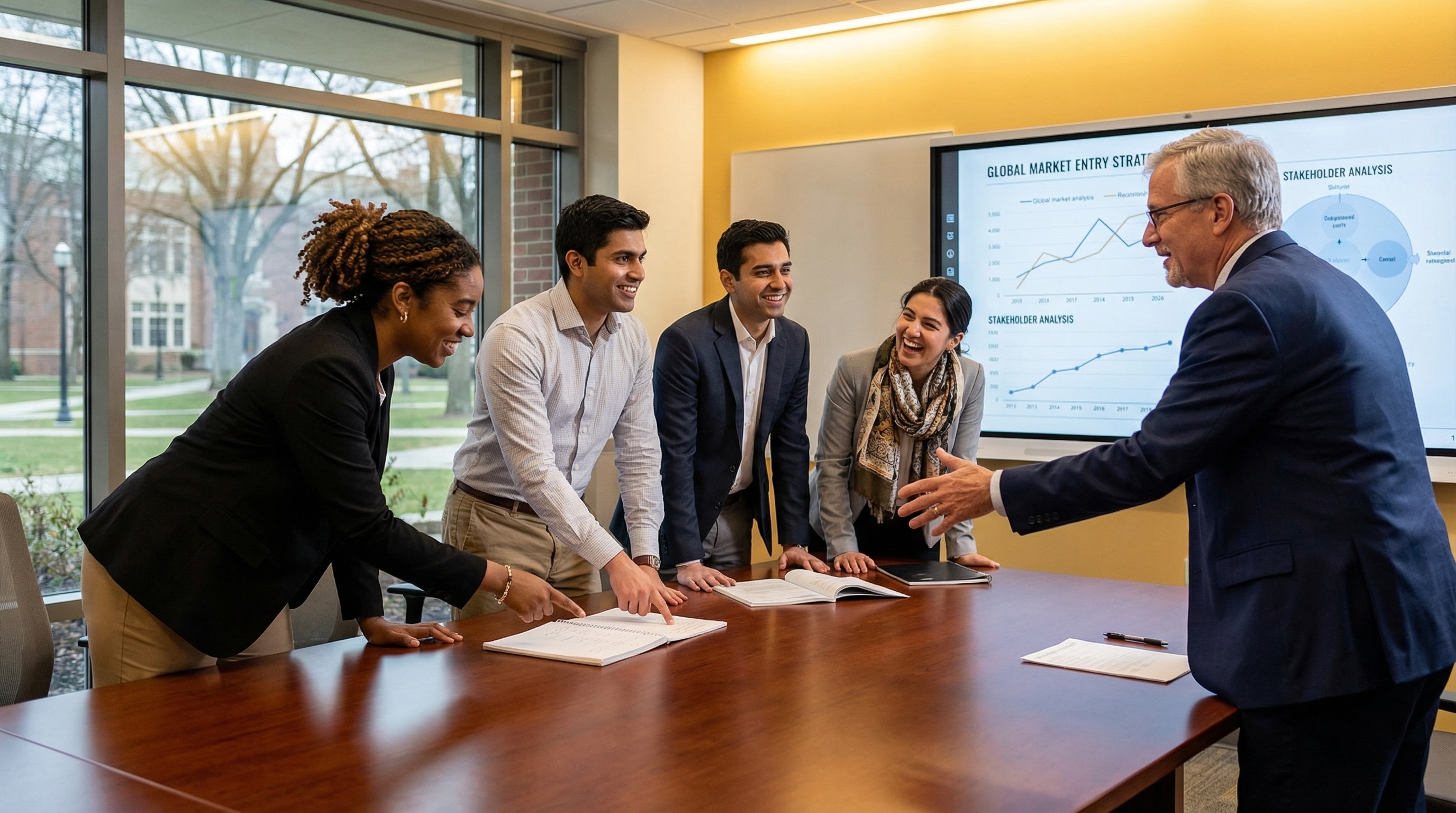
A master's in HR with a talent management concentration prepares you to lead the full talent lifecycle: workforce planning, succession, leadership development, and retention strategy. BLS data shows HR Managers earn $140,030 median, nearly double the HR Specialist median of $72,910. With 75% of organizations struggling to fill critical roles, demand for master's-prepared talent professionals is accelerating.
$140,030
HR Manager Median Salary
BLS May 2024 (SOC 11-3121)
+8%
HR Specialist Job Growth
Projected 2024-2034 (BLS)
75%
Orgs Struggling to Fill Roles
SHRM 2024 Talent Trends
$81,514
TM Specialist Avg Salary
Glassdoor 2025 Estimate
What a Talent Management Concentration Covers
A talent management concentration within a Master's in Human Resources goes well beyond the generalist HR curriculum. Where a standard MS in HR covers employment law, compensation structures, and organizational behavior in broad strokes, the talent management track zeroes in on how organizations identify, develop, and keep the people who actually drive results. That distinction matters more now than it did five years ago. According to SHRM's 2024 State of the Workplace report, 75% of organizations are struggling to fill critical roles, and the old playbook of posting jobs and hoping for the best is not cutting it anymore.
Core Areas of Talent Management Coursework
Using data to forecast staffing needs, identify skill gaps, and align talent strategy with business objectives. Programs at Cornell's ILR School and the University of Illinois integrate workforce analytics with hands-on data tools.
Key Skills
Common Roles
- Talent Intelligence Lead
- Workforce Planning Analyst
- People Analytics Manager
Designing frameworks to identify and develop high-potential employees for critical future roles. At Rutgers' SMLR, graduate students collaborate with Fortune 500 HR departments on succession planning models.
Key Skills
Common Roles
- Succession Planning Manager
- Talent Development Director
- Leadership Pipeline Lead
Creating structured programs that accelerate leadership capability at all organizational levels. Michigan State's program embeds practicum hours so students design real development programs.
Key Skills
Common Roles
- Director of Leadership Development
- L&D Program Manager
- Executive Development Lead
Building systems that connect individual performance to organizational goals while driving engagement and growth, moving beyond annual review cycles to continuous feedback models.
Key Skills
Common Roles
- Performance Management Lead
- HR Business Partner
- Total Rewards Analyst
Designing AI-driven platforms that match employees to internal opportunities based on skills, interests, and career goals. SHRM reports 35% of employers now use these platforms, up from 25% two years ago.
Key Skills
Common Roles
- Head of Talent Intelligence
- Internal Mobility Manager
- Talent Marketplace Lead
Developing evidence-based approaches to strengthen employee commitment, satisfaction, and discretionary effort across the full talent lifecycle from onboarding through exit.
Key Skills
Common Roles
- Employee Experience Director
- Engagement Program Manager
- Chief People Officer
Source: SHRM 2024 State of the Workplace Report
Source: SHRM 2025 Compensation Research
Public vs. Private Programs in Our Top 10
Program Format Comparison
Cornell University
Why #1: Cornell University
Cornell's MILR through the Ivy League ILR School offers unmatched prestige and outcomes, with graduates earning a $97,473 average starting salary at elite employers.
Cornell University offers a 48-credit Master of Industrial and Labor Relations (MILR) through its Ivy League ILR School. The on-campus program produces graduates with a $97,473 average starting salary in HR, with top employers including Estee Lauder, JPMorgan, and S.C. Johnson.
Program Highlights
- SHRM-aligned curriculum
- AACSB-accredited business school
- Specializations: Industrial and Labor Relations
- Ivy League ILR School
- 48 credits
Key Strengths
- SHRM-aligned curriculum
- AACSB-accredited business school
- Specializations: Industrial and Labor Relations
- Ivy League ILR School
Program
- 48 credits
Sources
University of Southern California
Why #2: University of Southern California
Carries the USC brand and Trojan alumni network with a fast 12-month format, though the premium price and lack of SHRM alignment are trade-offs.
USC offers a 24-unit online Master of Science in Human Resource Management through Bovard College. The 12-month accelerated program costs $2,539 per unit ($60,936 total) with WSCUC accreditation but is NOT SHRM-aligned.
Program Highlights
- AACSB-accredited business school
- 12-month accelerated
- 24 units
- $2,539/unit ($60,936 total)
- NOT SHRM-aligned
Key Strengths
- AACSB-accredited business school
- 12-month accelerated
- 24 units
- $2,539/unit ($60,936 total)
Program
- 24 credits
Prerequisites
Bachelor's degree
Sources
University of Illinois Urbana-Champaign
Why #3: University of Illinois Urbana-Champaign
Choose UIUC for its deep specialization options in emerging areas like HR Data Analytics and International HR, backed by strong placement rates and competitive starting salaries.
The University of Illinois Urbana-Champaign offers a 48-credit Master of Human Resources and Industrial Relations (MHRIR) through its School of Labor and Employment Relations. The program is available on-campus and online with five specializations.
Program Highlights
- SHRM-aligned curriculum
- AACSB-accredited business school
- 5 specialization options including HR Data Analytics and Union Management
- 5 specializations
- 48-credit comprehensive program
Key Strengths
- SHRM-aligned curriculum
- AACSB-accredited business school
- 5 specialization options including HR Data Analytics and Union Management
- 5 specializations
Admissions
- GPA: 3
Program
- 48 credits
Prerequisites
Bachelor's degree
Sources
What separates this concentration from a standalone organizational development or HR analytics track is its emphasis on the full talent lifecycle. You are not just studying how to recruit or how to train. You are learning to design the system that connects hiring decisions to development investments to retention outcomes. That systems-level thinking is exactly what SHRM's competency model calls "Business Acumen" and "Consultation," and it is why programs with SHRM curriculum alignment give graduates a head start on the SHRM-SCP exam.
Career Paths
HR Manager
SOC 11-3121Oversees HR operations including talent acquisition, employee relations, and strategic workforce planning. 221,900 positions nationwide. Master's-prepared professionals in this role earn roughly $67,000 more per year than HR Specialist counterparts.
Training and Development Manager
SOC 11-3131Designs and implements organizational learning strategies, leadership development programs, and employee upskilling initiatives aligned with talent management goals.
Talent Acquisition Director
SOC 11-3121Oversees an organization's entire hiring strategy, from employer branding to candidate pipeline development. Salary ranges from $120,000 to $170,000 depending on company size and market.
Talent Management Specialist
SOC 13-1071Manages talent assessment, succession planning, and internal mobility programs. Average salary of $81,514 per Glassdoor 2025, with senior-level positions exceeding $100,000.
Head of Talent Intelligence
SOC 11-3121Emerging role combining people strategy with data analytics. Leads AI-driven talent platforms and workforce intelligence. SHRM reports 43% of organizations actively use AI in HR functions as of 2025.
Chief People Officer
SOC 11-3121Senior executive overseeing all people operations. Increasingly drawn from talent management backgrounds at organizations that have shifted from administrative HR to strategic people operations.
Salary by Experience Level
The ROI calculation for a two-year master's program depends on where you start and where you land. If you are currently an HR Specialist earning around $73,000 and a master's degree moves you into a management track within three to five years, the salary increase of $50,000 to $70,000 annually quickly outpaces tuition costs, even at private institutions charging $60,000 or more per year. Public university programs in our top 10, like the University of Illinois ($35,900) and Rutgers ($32,436), offer particularly strong value when you factor in SHRM alignment and AACSB accreditation alongside lower tuition.
What to Look for in an HR Talent Management Master's Program
Verify Accreditation and SHRM Alignment
Start with AACSB or ACBSP accreditation, then check for SHRM curriculum alignment. Seven of our top 10 programs are SHRM-aligned, meaning their curriculum maps directly to [SHRM-SCP exam](/certifications/shrm-scp/) competencies. This saves time if you plan to pursue the credential.
Check IPEDS Program Completions Data
A program graduating 95 students per year (like Cornell) has a different alumni network and employer pipeline than one graduating 21 per year (like Penn State). Larger programs tend to have dedicated career coaching staff; smaller programs may offer more individual faculty attention and research opportunities.
Confirm R1 Carnegie Classification
All schools in our top 10 hold Doctoral: Very High Research (R1) classification, giving access to faculty who actively produce research on talent management, organizational behavior, and workforce analytics. This matters for evidence-based practice and degree credibility at the director level.
Evaluate Format and Flexibility
Several programs offer hybrid or [online options](/online/talent-management/) without relocating. USC delivers the same curriculum online as on-campus. Rutgers and Minnesota offer flexible scheduling. Ask about cohort models versus self-paced structures since networking value differs significantly.
Investigate Employer Partnerships and Practica
The best programs have standing relationships with organizations for applied projects. Cornell's ILR School partners with major employers for consulting projects. Ohio State's Fisher College integrates employer-sponsored case studies. These experiences outweigh elective courses on a resume.
The Psychology of Talent Retention
The best talent management programs do not just teach you how to build systems. They teach you why those systems work, and that means grounding your practice in organizational psychology. Self-determination theory, developed by Deci and Ryan, remains one of the most robust frameworks for understanding employee motivation. The theory identifies three psychological needs that drive intrinsic motivation: autonomy, competence, and relatedness. When organizations design talent systems that support all three, engagement goes up and turnover goes down. When they do not, even generous compensation cannot prevent attrition.
Psychological safety, a concept popularized by Harvard Business School professor Amy Edmondson, has become central to how leading organizations think about talent retention. Google's well-known Project Aristotle found that psychological safety was the single strongest predictor of team effectiveness, ahead of dependability, structure, meaning, and impact. For talent management professionals, the practical implication is clear: retention strategies that focus exclusively on compensation and benefits are incomplete. If employees do not feel safe taking risks, admitting mistakes, or challenging ideas, they will leave for environments where they can, regardless of what you pay them.
Employee engagement research reinforces this point. Gallup's ongoing workplace studies consistently show that engagement is driven more by the quality of the manager-employee relationship than by organizational perks. Talent management programs at schools like Cornell and Minnesota integrate this research into their curriculum, teaching students to design development programs and performance systems that strengthen that relationship rather than undermine it. The practical difference shows up in how graduates approach common challenges. A generalist HR professional might respond to high turnover by adjusting compensation bands. A talent management specialist trained in engagement psychology will also examine manager effectiveness, team dynamics, career pathing clarity, and learning opportunities.
The intersection of behavioral science and talent technology is where the field is moving fastest. Internal talent marketplaces, skills-based hiring, and AI-powered career pathing tools all rely on psychological principles to work effectively. A marketplace that surfaces opportunities but does not account for employees' need for autonomy in choosing their development path will see low adoption. An AI matching system that ignores competence-building progressions will frustrate rather than engage users. Master's programs that integrate behavioral science with technology courses prepare you to evaluate and implement these tools with an understanding of why they succeed or fail.
For professionals coming from a psychology or behavioral science background, the talent management concentration is a natural extension. Taylor Rupe, this site's lead researcher, holds a B.A. in Psychology from the University of Washington alongside a B.S. in Computer Science from Oregon State, and that combination of people-science and data-analysis training is exactly what employers increasingly look for in senior talent roles. If you already think in terms of motivation, cognition, and behavior, a master's in HR with a talent management focus gives you the organizational context and strategic frameworks to apply that thinking at scale.
Admission Requirements and Format Options
Academic Requirements
From an accredited institution in any field. Programs housed within schools of labor/industrial relations (Cornell ILR, Rutgers SMLR) tend to value social science backgrounds.
Standard across most programs, though competitive applicants to top-10 programs typically hold a 3.3 or higher.
Several programs including University of Minnesota and Ohio State have moved away from requiring the GRE, reflecting a broader trend toward holistic admissions.
Professional Experience
Cornell and Columbia explicitly prefer applicants with two or more years. Georgetown's program is designed for working professionals.
Michigan State and Penn State welcome career changers and early-career applicants. Psychology, education, and business backgrounds transfer directly to talent management work.
Application Materials
Explain your interest in talent management specifically. Committees want to see you understand what TM is and why you are choosing it over a generalist HR degree or MBA.
Standard across all 10 programs. Professional references preferred for applicants with work experience.
Highlight any HR, people management, training, or organizational development experience.
Application deadlines vary, but most programs operate on a fall-start admissions cycle with priority deadlines in January or February and final deadlines in April or May. Some programs, particularly those designed for working adults, offer spring or summer start options. Rolling admissions are less common at the top-10 level but do exist at some programs outside our ranked list. If you are targeting a specific program, check the deadline early and plan to submit at least two weeks before it. Late applications are occasionally accepted, but financial aid and scholarship availability decreases significantly after priority deadlines.
Frequently Asked Questions About Talent Management Master's in HR
HR completions volume, CIP breadth, multi-level depth
SHRM alignment (+15), AACSB (+10) or ACBSP (+5)
IPEDS 6-year graduation rate
Carnegie 2021 classification
IPEDS reporting completeness
Data Sources and Methodology
- 1.Bureau of Labor Statistics (BLS) Occupational Employment and Wage Statistics, May 2024 — Median salary, employment counts, and projected growth for HR Managers (11-3121), HR Specialists (13-1071), and Training Managers (11-3131).
- 2.IPEDS (Integrated Postsecondary Education Data System), 2023 — Program completions, graduation rates, tuition, and institutional characteristics for ranked schools. CIP codes 52.1001, 52.1002, 52.1003.
- 3.SHRM 2024 State of the Workplace Report — Organizational talent challenges, including the 75% of employers struggling to fill roles and internal talent marketplace adoption rates.
- 4.SHRM 2025 Compensation and Benefits Research — Data on AI adoption in HR (43%) and the 86% premium paid for specialized HR skills.
- 5.Glassdoor Salary Data, 2025 — Average salary of $81,514 for talent management specialist roles.
- 6.AACSB International Accredited Schools — Business school accreditation status for ranked programs.
- 7.SHRM Academic Alignment Program — SHRM curriculum alignment status for ranked programs.
Related Resources

Taylor Rupe
Education Researcher & Data Analyst
B.A. Psychology, University of Washington · B.S. Computer Science, Oregon State University
Taylor combines training in behavioral science with data analysis to evaluate HR education programs. His research methodology uses IPEDS completion data, BLS employment statistics, and SHRM alignment data to produce evidence-based program rankings.