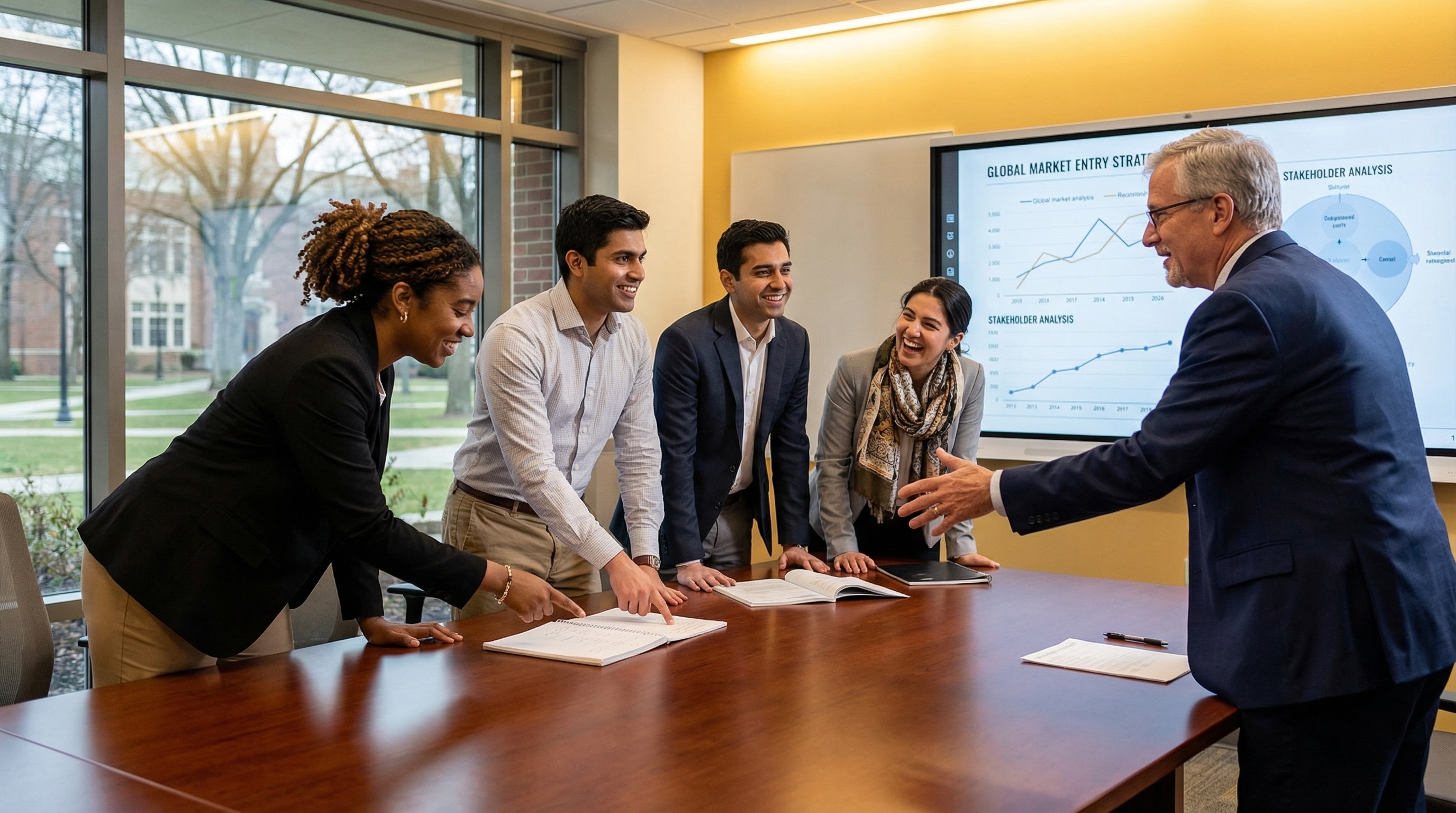
A master's in training and development prepares you to diagnose organizational learning gaps, design evidence-based interventions using ADDIE or SAM frameworks, build them with professional authoring tools, and measure their business impact through Kirkpatrick's evaluation model. The career trajectory spans from Training Specialist ($65,850) to Training Manager ($127,090) to Chief Learning Officer ($175,000-$250,000+). Cornell ILR leads these rankings at 93.9, followed by USC Marshall (91.6) and Illinois (86.4). The CPTD from ATD is the field's signature credential, and SHRM alignment ensures broader HR certification eligibility.
$127,090
Training & Development Manager Median Salary
+11%
Training Specialist Job Growth (2024-34)
452,300
Training Specialist Jobs Nationwide
43,900
Annual Job Openings (Specialists)
What T&D Covers at the Master's Level
Training and development at the master's level goes well beyond standing in front of a classroom with a slide deck. A T&D concentration inside a Master's in HR program trains you to diagnose organizational learning gaps, design interventions that close them, build those interventions using professional authoring tools, and then measure whether the training actually changed behavior on the job. That last part -- measurement -- is where the master's degree separates itself from certificate programs and professional workshops. Anyone can deliver a training session. Far fewer people can prove it worked.
Learning technology is now a core component, not an elective. Programs in these rankings cover e-learning authoring tools like Articulate Storyline, Articulate Rise, and Adobe Captivate -- the tools that instructional designers actually use in corporate environments. You will also encounter learning management system (LMS) administration, with platforms like Cornerstone OnDemand and Docebo appearing regularly in coursework. The shift toward AI-powered learning platforms has accelerated since 2023, and programs at Illinois, Minnesota, and Penn State have added coursework on adaptive learning algorithms and AI-generated content curation.
Needs analysis -- the process of diagnosing what an organization actually needs to learn versus what stakeholders assume it needs -- is another defining skill. A master's-level needs analysis goes beyond surveying employees about what training they want. It involves analyzing performance data, observing workflows, conducting structured interviews with managers and subject matter experts, and triangulating multiple data sources to identify the gap between current and desired performance. Many performance problems that get labeled "training issues" turn out to be process problems, incentive misalignments, or resource constraints that no amount of training will fix. Learning to distinguish between them is a core competency that separates T&D professionals from corporate trainers.
Core Frameworks & Models in Training and Development
The industry-standard instructional design model: Analyze, Design, Develop, Implement, Evaluate. A linear, phase-gated approach still required for compliance training in regulated industries (healthcare, finance, government). Most master's programs teach ADDIE as required core coursework.
Key Skills
Common Roles
- Instructional Designer
- Training Specialist
- Curriculum Developer
An agile alternative to ADDIE that uses rapid prototyping and iterative development cycles instead of ADDIE's linear waterfall approach. Preferred by product training teams and startups for faster iteration. Programs that teach only ADDIE are preparing you for half the market.
Key Skills
Common Roles
- E-Learning Developer
- Learning Experience Designer
- Training Project Manager
Level 1: Reaction (Did they find it useful?). Level 2: Learning (Did they acquire the skills?). Level 3: Behavior (Are they applying it on the job?). Level 4: Results (Did it improve business outcomes?). Most organizations never get past Level 1. Phillips' fifth level adds financial ROI calculation.
Key Skills
Common Roles
- Training Manager
- L&D Director
- Learning Analytics Specialist
A framework for understanding how professionals develop: 70% from on-the-job experience, 20% from peer interactions and coaching, and 10% from formal training. Shifts the T&D role from solely designing courses to building learning ecosystems that support all three channels.
Key Skills
Common Roles
- Talent Development Manager
- Organizational Development Consultant
- Chief Learning Officer
Source: BLS OES May 2024
Master's in T&D vs. Instructional Design vs. Organizational Development
The Science of Learning: Why Psychology Matters
The most expensive mistake in corporate training is assuming that delivering information is the same as producing learning. Organizations spend billions annually on training programs that employees forget within weeks. Research on the transfer problem -- the gap between what people learn in training and what they actually apply on the job -- consistently finds that only 10-20% of training content transfers to workplace behavior. A master's program with strong psychological foundations teaches you why that gap exists and how to close it.
Malcolm Knowles' theory of andragogy -- adult learning theory -- is the starting point. Knowles identified five principles that distinguish adult learners from children: adults need to know why they are learning something, they bring prior experience that serves as a foundation (and sometimes a barrier), they are motivated by problems rather than subjects, they need to see immediate applicability, and they are driven by internal motivation more than external rewards. These principles have direct design implications. A compliance training module that opens with "the company requires you to complete this" violates almost every principle Knowles identified. A module that opens with a realistic scenario showing the consequences of non-compliance respects them. The design choice is rooted in psychology, and the outcome difference is measurable.
Cognitive load theory, developed by John Sweller, explains why so much training content fails to stick. Working memory can hold roughly four to seven chunks of information at once. When a training module overloads working memory -- through dense text, simultaneous narration and on-screen text, or too many new concepts introduced without practice -- learners experience cognitive overload and retention collapses. Strong T&D programs teach you to design with cognitive load in mind: chunking content into manageable segments, using multimedia principles that reduce extraneous processing (Richard Mayer's multimedia learning theory), and building in retrieval practice so learners actively reconstruct information rather than passively receiving it.
Spaced practice -- distributing learning over time rather than concentrating it in a single session -- is one of the most robustly supported findings in cognitive psychology. Ebbinghaus's forgetting curve, demonstrated in 1885 and replicated hundreds of times since, shows that memory for new material drops roughly 70% within 24 hours of initial exposure if no review occurs. Spaced repetition systems, which schedule review sessions at increasing intervals, dramatically improve long-term retention. Yet most corporate training still follows the workshop model: an eight-hour day of instruction with no structured follow-up. Master's programs that teach spaced practice design are preparing you to build learning programs that actually change behavior over weeks and months, not just produce favorable end-of-session evaluations.
Cornell University
Why #1: Cornell University
Cornell's MILR through the Ivy League ILR School offers unmatched prestige and outcomes, with graduates earning a $97,473 average starting salary at elite employers.
Cornell University offers a 48-credit Master of Industrial and Labor Relations (MILR) through its Ivy League ILR School. The on-campus program produces graduates with a $97,473 average starting salary in HR, with top employers including Estee Lauder, JPMorgan, and S.C. Johnson.
Program Highlights
- SHRM-aligned curriculum
- AACSB-accredited business school
- Specializations: Industrial and Labor Relations
- Ivy League ILR School
- 48 credits
Key Strengths
- SHRM-aligned curriculum
- AACSB-accredited business school
- Specializations: Industrial and Labor Relations
- Ivy League ILR School
Program
- 48 credits
Sources
University of Southern California
Why #2: University of Southern California
Carries the USC brand and Trojan alumni network with a fast 12-month format, though the premium price and lack of SHRM alignment are trade-offs.
USC offers a 24-unit online Master of Science in Human Resource Management through Bovard College. The 12-month accelerated program costs $2,539 per unit ($60,936 total) with WSCUC accreditation but is NOT SHRM-aligned.
Program Highlights
- AACSB-accredited business school
- 12-month accelerated
- 24 units
- $2,539/unit ($60,936 total)
- NOT SHRM-aligned
Key Strengths
- AACSB-accredited business school
- 12-month accelerated
- 24 units
- $2,539/unit ($60,936 total)
Program
- 24 credits
Prerequisites
Bachelor's degree
Sources
University of Illinois Urbana-Champaign
Why #3: University of Illinois Urbana-Champaign
Choose UIUC for its deep specialization options in emerging areas like HR Data Analytics and International HR, backed by strong placement rates and competitive starting salaries.
The University of Illinois Urbana-Champaign offers a 48-credit Master of Human Resources and Industrial Relations (MHRIR) through its School of Labor and Employment Relations. The program is available on-campus and online with five specializations.
Program Highlights
- SHRM-aligned curriculum
- AACSB-accredited business school
- 5 specialization options including HR Data Analytics and Union Management
- 5 specializations
- 48-credit comprehensive program
Key Strengths
- SHRM-aligned curriculum
- AACSB-accredited business school
- 5 specialization options including HR Data Analytics and Union Management
- 5 specializations
Admissions
- GPA: 3
Program
- 48 credits
Prerequisites
Bachelor's degree
Sources
Career Paths
Designs and delivers training programs, facilitates workshops, creates e-learning content, and manages LMS platforms. A bachelor's degree gets you in; a master's accelerates promotion to senior specialist or lead instructional designer, skipping the first two to three years of entry-level work.
Instructional Coordinator
Designs curricula for K-12 school systems, community colleges, and higher education institutions. A parallel track for T&D graduates who prefer education-sector work. Growth is lower than corporate T&D, but work-life balance tends to be better and public-sector benefits add value beyond salary.
Sets learning strategy for departments or business units, manages T&D budgets, oversees teams of instructional designers and facilitators, and reports training ROI to senior leadership. The master's degree is close to essential at this level.
Director of Learning & Development
Typically earns $130,000-$170,000 depending on company size and industry. Requires T&D expertise plus strong business acumen and cross-functional management experience. Falls under BLS HR Managers (SOC 11-3121, $140,030 median).
Chief Learning Officer (CLO)
C-suite role commanding $175,000-$250,000+ in total compensation at large organizations. Sets enterprise-wide learning strategy, manages multimillion-dollar budgets, and sits on senior leadership teams. The path requires 12-15 years of progressive T&D experience and demonstrated ability to tie learning programs to business outcomes.
Salary by Experience Level
Essential Skills for Training & Development Careers
Instructional Design & Content Creation
Building modules in Articulate Storyline/Rise 360, Adobe Captivate, or similar tools. The single most marketable technical skill in L&D.
Translating learning objectives into structured programs. ADDIE for regulated industries, SAM for agile environments. Programs that teach only one model prepare you for half the market.
Screen recording and editing with Camtasia, plus familiarity with hosting platforms like Vimeo or Panopto for spaced microlearning sequences.
Managing enterprise platforms like Cornerstone OnDemand, SAP SuccessFactors Learning, or Docebo at scale.
Assessment & Analytics
Diagnosing actual performance gaps through interviews, surveys, performance data, and business outcome analysis before designing interventions. Many problems labeled 'training issues' turn out to be process or incentive problems.
Evaluating training at all four Kirkpatrick levels plus Phillips' financial ROI. Requires statistical literacy, control group design, and the ability to isolate training effects from confounding variables.
Pulling data from LMS platforms, analyzing completion and performance correlations, and presenting findings to leadership. This is where T&D intersects with [HR analytics](/masters/hr-analytics/).
Facilitation & Consulting
Running engaging sessions that hold attention through experiential workshops, case studies, and peer-learning cohorts rather than lecture-based delivery.
Presenting data-driven recommendations to senior leadership, translating behavior change into dollar figures that finance teams and executives actually care about.
Leveraging generative AI for content drafting, adaptive learning paths, and automated evaluation. 43% of organizations now use AI in HR processes (SHRM 2025).
What to Look for in an HR Training & Development Master's Program
Verify instructional design methodology is required, not elective
A strong T&D program teaches both ADDIE and SAM as required coursework. ADDIE gives you the structured approach that regulated industries require. SAM gives you the agile approach that tech companies and fast-moving L&D teams prefer. Cornell, Illinois, and Minnesota in our top 10 all require formal instructional design coursework covering both frameworks.
Evaluate the technology component
If a program does not include hands-on work with e-learning authoring tools (Articulate Storyline, Articulate Rise, or Adobe Captivate), LMS platforms, and at minimum an introduction to AI-powered learning tools, it is training you for a version of the profession that no longer exists. Ohio State and Michigan State have dedicated learning technology labs where students build actual e-learning modules.
Look for a capstone design project or consulting practicum
The best T&D concentrations require you to partner with a real organization, conduct a needs analysis, design a learning intervention, pilot it, and measure outcomes. Rutgers' SMLR and Penn State both run structured consulting projects with external clients that give students a portfolio piece and client-facing experience before graduation.
Check SHRM alignment
Programs aligned with SHRM's curriculum guidelines cover T&D as part of the broader HR competency model, meaning your coursework counts toward [SHRM-CP](/certifications/shrm-cp/) and SHRM-SCP eligibility. Seven of our top 10 programs are SHRM-aligned. This gives you both specialist credibility and generalist flexibility.
Confirm research methods and evaluation coursework
Programs that teach you to design evaluation studies, run quasi-experimental analyses, and interpret effect sizes prepare you to be an evidence-based practitioner -- someone who can tell a CFO exactly how much a leadership development program reduced turnover. This research literacy separates $65,000 facilitators from $127,000 managers and $200,000+ learning executives.
Key Certifications for T&D Professionals
The right credential signals depth of expertise and can justify the salary jump from specialist to manager. Graduate coursework directly accelerates certification preparation.
Recommended Specializations
Certified Professional in Talent Development (CPTD)
Association for Talent Development (ATD)The premier credential specific to training and development. Requires at least 5 years of professional experience plus 60 hours of professional development, followed by a knowledge exam covering instructional design, training delivery, learning impact evaluation, and change management. Graduate coursework covers the same competency domains the CPTD exam tests, substantially reducing preparation time.
Associate Professional in Talent Development (APTD)
Association for Talent Development (ATD)Entry-level ATD credential for professionals with at least 3 years of experience. A stepping stone toward the full CPTD, covering foundational competencies in instructional design, training delivery, and learning technologies. Ideal for master's students to pursue during their program.
SHRM Certified Professional (SHRM-CP)
Society for Human Resource ManagementCovers broader HR competencies including Learning & Development as a defined functional area. A better first credential for early-career professionals since it validates general HR knowledge alongside T&D skills. Seven of our top 10 programs carry SHRM alignment, meaning coursework directly counts toward eligibility.
SHRM Senior Certified Professional (SHRM-SCP)
Society for Human Resource ManagementSenior-level SHRM credential for strategic HR leadership. Relevant for T&D managers and directors who oversee the full L&D function and need to demonstrate broad HR strategy expertise alongside training specialization. Pairs with the CPTD for maximum credibility.
Source: Training transfer research
Admission Requirements and Format
Admission requirements for T&D concentrations within master's HR programs vary by institutional type, but the overall pattern is consistent. Business school programs (USC Marshall, Georgetown McDonough, Ohio State Fisher) may request GMAT or GRE scores, though most have adopted test-optional policies since 2020. Labor relations and education programs (Cornell ILR, Illinois, Rutgers SMLR) typically weight professional experience more heavily than standardized test performance, with many requiring two to five years of work experience for admission.
Standard requirements across program types include a bachelor's degree from an accredited institution in any field. T&D programs attract career changers from education, military, nonprofit management, and corporate operations -- you do not need an undergraduate HR degree to be competitive. Most programs expect a minimum 3.0 GPA, two to three letters of recommendation (at least one professional reference), a statement of purpose, and a current resume. Some programs request a writing sample or ask applicants to describe a training program they have designed, delivered, or evaluated.
Format options have expanded significantly. The University of Illinois, Penn State, and Michigan State all offer T&D-relevant coursework in fully online or hybrid formats, making them accessible to mid-career professionals who cannot relocate. Cornell offers its MILR program with a limited-residency option. Georgetown and Columbia use intensive hybrid models that combine online coursework with periodic in-person residencies. Program length ranges from 12 months (accelerated full-time at Illinois and Minnesota) to 36 months (part-time at Columbia and Georgetown). The typical timeline for working adults is 18 to 24 months. Tuition at public universities in our top 10 ranges from $32,436 at Rutgers to $43,700 at Michigan State (IPEDS 2023). Private universities range from $64,526 at Columbia to $66,640 at USC. Several of the most affordable master's programs offer T&D electives even without a formal concentration.
Source: BLS OES 2024 + IPEDS 2023 tuition data
Data Sources
Salary data from the Bureau of Labor Statistics Occupational Employment and Wage Statistics (OES), May 2024 release. Job growth projections and annual openings from the BLS Occupational Outlook Handbook, 2024-2034 projections. Tuition, graduation rates, program completions, and Carnegie classifications from the Integrated Postsecondary Education Data System (IPEDS), 2023 survey year. SHRM alignment status verified against the SHRM-aligned program directory. AACSB and ACBSP accreditation status verified against each organization's accredited school database. AI adoption data from SHRM 2025 State of the Workplace report. L&D demand data from SHRM 2025 HR skills survey.
Frequently Asked Questions About Training & Development Master's in HR
HR completions volume, CIP breadth, multi-level depth
SHRM alignment (+15), AACSB (+10) or ACBSP (+5)
IPEDS 6-year graduation rate
Carnegie 2021 classification
IPEDS reporting completeness
Sources
- 1.Bureau of Labor Statistics -- Occupational Employment Statistics — HR occupation salary and employment data (May 2024)
- 2.Society for Human Resource Management (SHRM) — HR industry research, benchmarks, and best practices
Related Resources

Taylor Rupe
Education Researcher & Data Analyst
B.A. Psychology, University of Washington · B.S. Computer Science, Oregon State University
Taylor combines training in behavioral science with data analysis to evaluate HR education programs. His research methodology uses IPEDS completion data, BLS employment statistics, and SHRM alignment data to produce evidence-based program rankings.