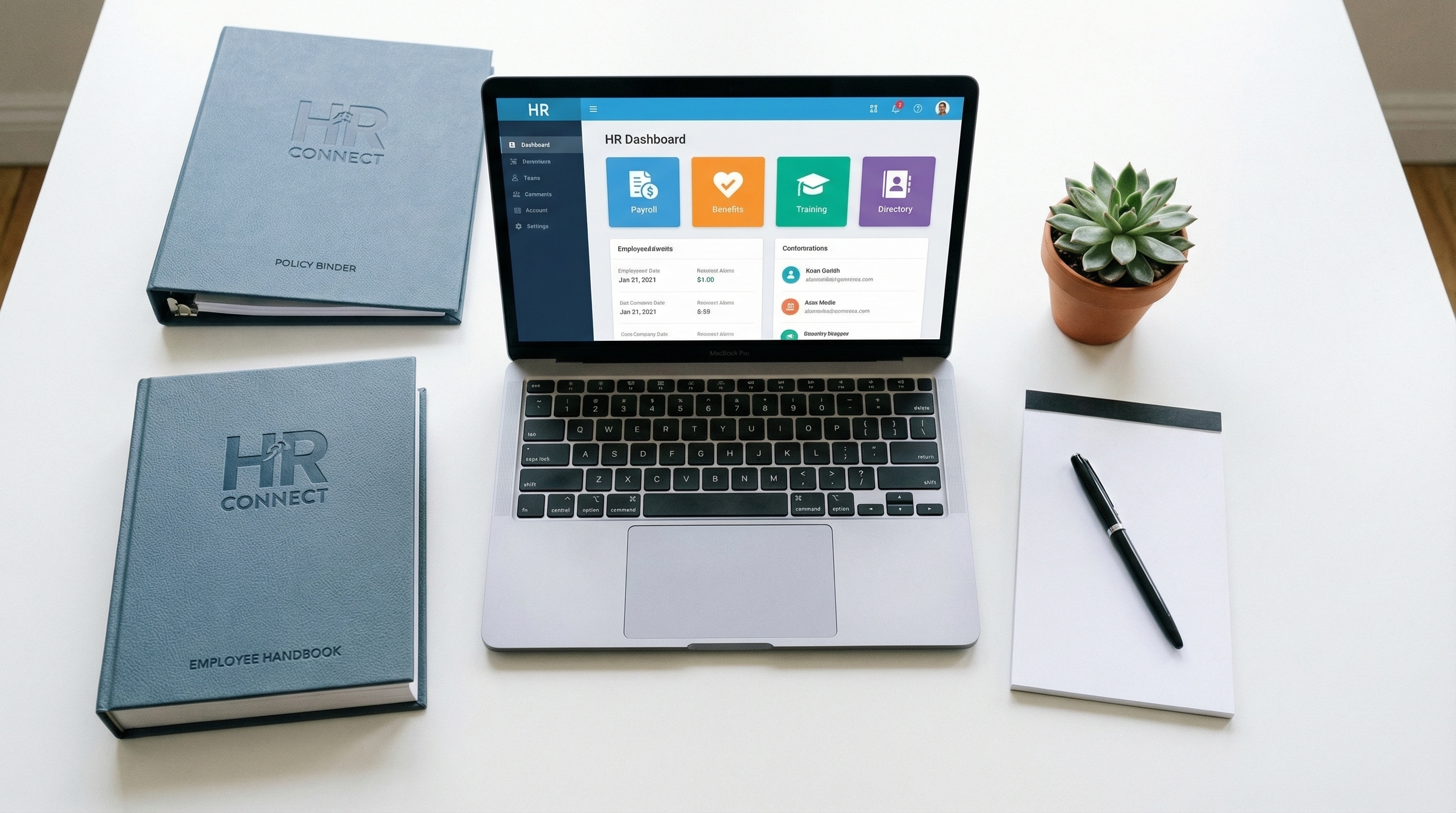
- 1.AI is augmenting HR functions, not replacing HR professionals. The shift is from administrator to advisor, with AI handling routine tasks while humans focus on judgment, empathy, and strategy
- 2.Skills-based hiring is replacing degree requirements at organizations from Google to state governments. This expands talent pools and reduces credential-based bias, but requires new assessment capabilities
- 3.Employee experience has become a strategic priority, not just an engagement initiative. It encompasses the full employee journey from candidate through alumni, designed intentionally at every touchpoint
- 4.Hybrid work is permanent, not transitional. The organizations still treating it as a temporary arrangement are losing talent to competitors who've embraced flexibility as a design principle
- 5.HR is evolving from administrative function to strategic partner. Data literacy, technology fluency, and business acumen are becoming baseline requirements, not differentiators
76%
Orgs Increasing AI Investment in HR
44%
Workers' Skills Disrupted by 2028
23%
Global Employees Engaged
85M
Unfilled Jobs by 2030
AI in Human Resources
AI is making real impact in several HR areas right now: resume screening and candidate matching, employee self-service chatbots, predictive analytics for turnover risk, writing assistance for job descriptions and communications, and process automation for routine tasks. These aren't future predictions. They're current capabilities that organizations of all sizes are implementing.
The current reality, stripped of vendor hype: AI tools are proliferating across HR technology, but adoption remains uneven. Larger organizations are further ahead. Most implementations are narrow AI designed for specific tasks, not general AI replacing HR professionals. ROI varies significantly by use case, with writing assistance and chatbots showing the fastest returns.
The concerns are legitimate. Algorithmic bias in hiring and talent decisions remains a significant risk, particularly when AI is trained on historical data that reflects past biases. Privacy and data security implications grow as AI processes more employee information. Compliance with emerging AI regulations adds another layer. See HR analytics tools for practical implementation considerations.
For HR professionals personally, AI changes the nature of your work rather than eliminating it. AI handles routine tasks. You focus on judgment-intensive work that requires empathy, context, and ethical reasoning. New skills are needed: data literacy, AI oversight capability, and ethical technology governance. HR professionals who understand AI will be more valuable. Those who resist it will find their roles shrinking.
Skills-Based Hiring
The shift from credentials to capabilities is accelerating. Organizations are moving from requiring degrees and specific titles to assessing demonstrable skills. This is driven by talent shortages that degree requirements worsen, growing evidence that degrees don't reliably predict job performance, and the example of major employers like Google, Apple, and IBM who've dropped degree requirements for many roles.
Implementation isn't simple. How do you reliably assess skills? How do you describe jobs in skills terms rather than credential terms? How do you change hiring manager mindsets that equate 'bachelor's degree required' with 'quality candidate'? Skills taxonomies and assessment tools are still maturing, and the infrastructure for a truly skills-based organization is still being built.
The benefits are compelling when it works. Skills-based hiring expands talent pools significantly, reduces bias from credential proxies that often correlate with socioeconomic status, enables better matching of actual capabilities to job requirements, and supports internal mobility and reskilling. See job description templates for guidance on writing skills-based job descriptions.
For HR teams, this means building skills inventory and assessment capabilities, redesigning job architecture around skills rather than titles, creating career paths based on skill adjacencies, and tying learning and development programs directly to identified skill gaps. It's a fundamental shift in how you think about talent, not just a tweak to job postings.
Employee Experience
Employee experience goes beyond engagement surveys to encompass the full employee journey: candidate experience, onboarding, daily work, development, offboarding, and alumni relationships. It's about designing every touchpoint intentionally rather than letting them happen by default. See onboarding checklist and offboarding checklist for process design.
Why it matters strategically: tight labor markets give employees more choices, and experience drives retention, productivity, and referrals. Poor employee experience creates brand risk through Glassdoor reviews and social media, and research consistently links customer experience to employee experience. The organizations that treat their people well tend to treat their customers well, and vice versa.
Designing employee experience borrows from consumer product design: think like a user, map employee journeys to identify friction points, use data to understand pain points, personalize experiences where possible, and commit to continuous improvement rather than one-time projects.
Technology enables better experiences when implemented well. HRIS user experience matters because employees interact with it regularly. Employee self-service reduces friction for routine tasks. Mobile-first design matters for frontline workers who don't sit at desks. Integration between systems reduces the frustration of entering the same information in three different places.
Hybrid and Flexible Work
Remote work proved viable for many roles during the pandemic, and the genie isn't going back in the bottle. Full return-to-office mandates face significant resistance, and organizations enforcing them are seeing elevated attrition among their most marketable employees. Hybrid models, 2-3 days in the office, are the most common approach, though organizations are still experimenting with what works. See remote work statistics for current data.
The real challenges are coordination complexity (who's in the office when?), equity between remote and in-office workers in terms of visibility and advancement, maintaining culture and connection in distributed environments, building manager capability for leading hybrid teams, and making smart decisions about real estate and workspace design.
Policy approaches are evolving from rigid company-wide mandates toward team-level flexibility based on what the work actually requires. The shift is toward outcomes-focused measurement rather than presence-focused monitoring. Trust is the foundation, and micromanagement that doesn't scale in person scales even less remotely.
For HR specifically, hybrid work creates complex policy questions around location-based pay, benefits for remote workers including home office stipends, inclusion in hybrid meetings and promotion opportunities, and performance management that avoids proximity bias favoring those who show up in person.
HR's Evolving Role
Transaction processing is being automated, which means HR's value increasingly comes from strategy, internal consulting, and complex problem-solving. Business partnership is the expectation, not the exception. The ability to analyze data and connect workforce insights to business outcomes is becoming table stakes, not a differentiator.
New capabilities are required across the profession: data literacy and people analytics, change management and organizational development, technology fluency for evaluating and implementing HR tech, business acumen that connects workforce strategy to organizational strategy, and consultation and influence skills that don't rely on positional authority.
Organizational models for HR are evolving. Centers of excellence provide specialized expertise in compensation, talent acquisition, or learning. HR business partners embed in business functions. Shared services handle transactions, often outsourced or automated. The Chief People Officer sits as a C-suite peer, not as a support function head reporting through the CFO.
Career implications are significant. Pure generalist roles are contracting while specialists and strategists are growing. Technical HR skills in areas like compensation and employment law remain valuable but aren't sufficient on their own. Leadership and business skills differentiate at every level. See HR career path for how to plan your career development in this evolving landscape.
Other Trends to Watch
Pay transparency legislation requiring salary ranges in job postings is spreading across states and countries. This drives internal pay equity analysis, changes how you communicate compensation, and makes compensation benchmarking more important than ever. If you're not already conducting pay equity reviews, the regulatory environment will force the issue.
Mental health and holistic wellbeing have moved from nice-to-have benefits to strategic priorities. Benefits are expanding to cover mental health, financial wellness, and caregiving support. Manager training increasingly covers recognizing and supporting employees who are struggling. Burnout prevention is being treated as an organizational design challenge, not an individual resilience problem.
DEI work is evolving from standalone programs to systemic integration into core business practices. There's backlash in some quarters and doubling down in others. The organizations doing it well are focusing on measurement, accountability, and embedding inclusive practices into existing processes rather than creating parallel initiatives. See diversity hiring statistics for current data.
Internal mobility is receiving increased attention as organizations emphasize developing and moving existing talent rather than defaulting to external hiring. Internal talent marketplaces connect employees to projects and roles across the organization. Career development framed as a retention strategy is gaining traction. Succession planning is becoming more critical as experienced leaders retire.
Frequently Asked Questions
Sources
- 1.Bureau of Labor Statistics -- Occupational Employment Statistics — HR occupation salary and employment data (May 2024)
- 2.Society for Human Resource Management (SHRM) — HR industry research, benchmarks, and best practices
Related Resources

Taylor Rupe
Education Researcher & Data Analyst
B.A. Psychology, University of Washington · B.S. Computer Science, Oregon State University
Taylor combines training in behavioral science with data analysis to evaluate HR education programs. His research methodology uses IPEDS completion data, BLS employment statistics, and SHRM alignment data to produce evidence-based program rankings.