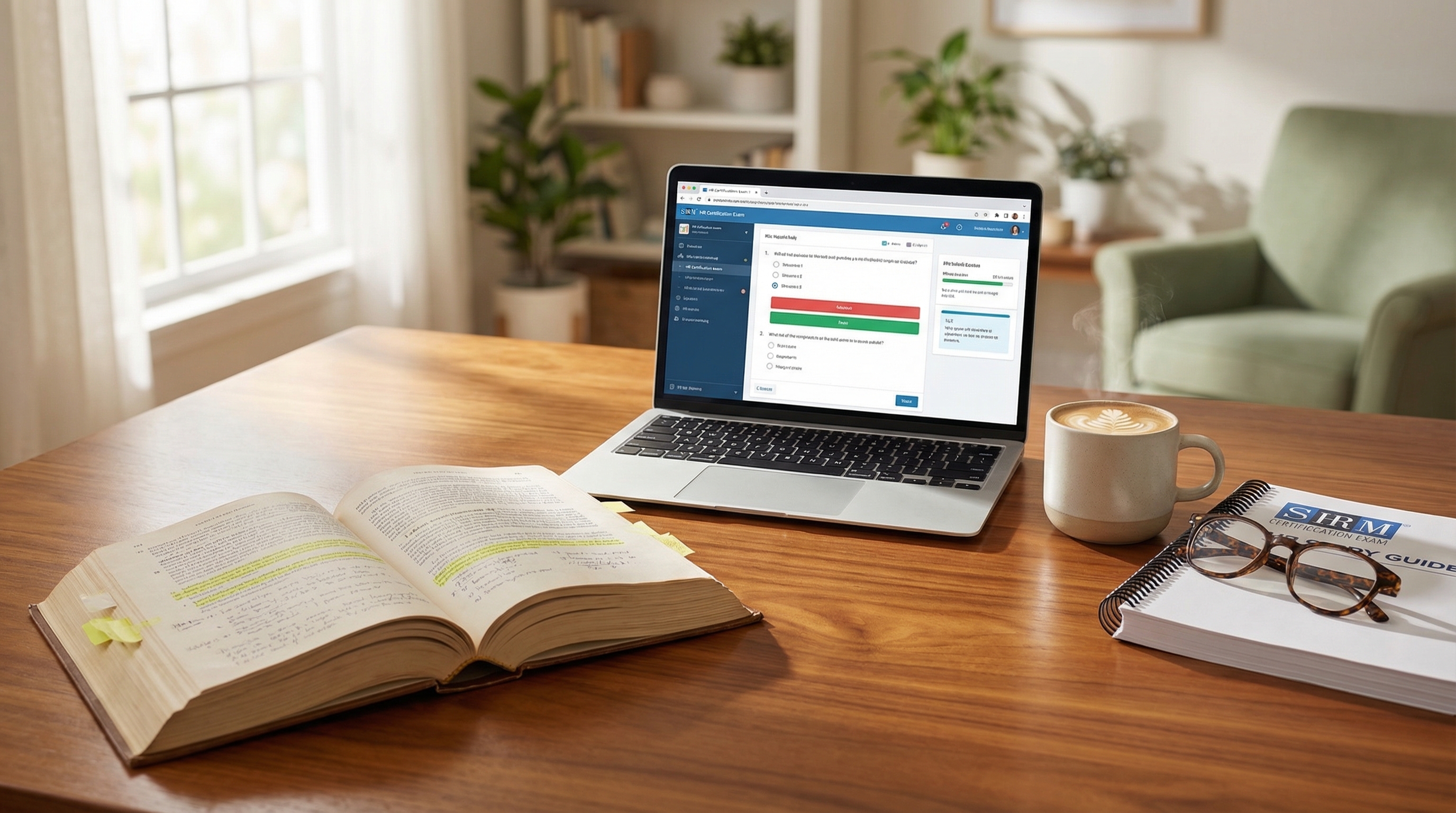
How Much Do HR Certifications Cost in 2026?
HR certification costs in 2026 (verified at HRCI and SHRM): aPHR $400 ($100 application + $300 exam), PHR $495 ($100 + $395), SPHR $595 ($100 + $495), GPHR $595 (HRCI). SHRM-CP and SHRM-SCP both cost $350-$499 depending on SHRM membership and registration timing — the $50 application fee is included in the exam fee. Study materials add $200-$1,200. Specialty credentials run higher: WorldatWork CCP costs $5,000-$15,000 across multiple exams; CEBS runs ~$4,000 across 5 courses. Total first-year investment ranges from $500 (aPHR self-study) to over $8,000 (CCP bundle).
First-year HR certification costs range from $500 (aPHR self-study) to over $8,000 (WorldatWork CCP multi-exam bundle). The two most popular operational credentials, SHRM-CP and PHR, cost $550-$1,700 in the first year depending on SHRM membership status and study materials. Industry analyses cite a 5-15% salary premium for certified HR professionals, translating to $3,600-$10,900 in additional annual compensation at the BLS HR Specialist median of $72,910 (May 2024). At those numbers, even the most expensive operational certification pays for itself within the first year.
$400
Cheapest HR Cert (aPHR Total)
$350-$499
SHRM-CP Cost Range
$3.6K-$10.9K
Annual Salary Premium (5-15%)
<1 year
Typical ROI Payback
Complete HR Certification Cost Breakdown (Verified 2026 Data)
| Certification | Exam Fee | Application Fee | Study Materials | Prep Course (Optional) | Recertification | Total First-Year Cost |
|---|---|---|---|---|---|---|
| aPHR (HRCI) | $300 | $100 | $100-$300 (self-study) | $200-$500 | $169 / 3 years | $500-$900 |
| PHR (HRCI) | $395 | $100 | $200-$500 (self-study) | $400-$2,500 (instructor-led) | $169 / 3 years | $700-$3,500 |
| SPHR (HRCI) | $495 | $100 | $200-$500 (self-study) | $800-$2,500 (instructor-led) | $169 / 3 years | $800-$3,600 |
| GPHR (HRCI) | $495 | $100 | $200-$400 | $500-$1,500 | $169 / 3 years | $800-$2,500 |
| SHRM-CP (member, early-bird) | $350 | Included in exam fee | $100-$400 (self-study) | $820+ (SHRM Learning System) | $165 / 3 years | $450-$1,570 |
| SHRM-CP (member, standard) | $399 +$49 deadline | Included | $100-$400 | $820+ (SHRM Learning System) | $165 / 3 years | $548-$1,668 |
| SHRM-CP (non-member, early-bird) | $450 | Included | $100-$400 | $820+ | $210 / 3 years | $550-$1,670 |
| SHRM-CP (non-member, standard) | $499 +$49 deadline | Included | $100-$400 | $820+ | $210 / 3 years | $648-$1,768 |
| SHRM-SCP (member, early-bird) | $350 | Included | $100-$400 | $820+ | $165 / 3 years | $450-$1,570 |
| SHRM-SCP (non-member, standard) | $499 +$49 deadline | Included | $100-$400 | $820+ | $210 / 3 years | $648-$1,768 |
| APTD (ATD member) | $499 | Included | $200-$400 | $500-$1,000 | Recert every 3 years | $699-$1,899 |
| CPTD (ATD member) | $1,099 | Included | $200-$500 | $500-$1,500 | Recert every 3 years | $1,299-$3,099 |
| CPTD (ATD non-member) | $1,500 | Included | $200-$500 | $500-$1,500 | Recert every 3 years | $1,700-$3,500 |
| CCP (WorldatWork bundle) | $5,000-$15,000 | Included in bundle | Included in bundle | Included in bundle | $200 / year | $5,000-$15,200 |
All fees verified at HRCI Exam Fees, SHRM Exam Options & Fees, td.org, and WorldatWork.org as of May 2026. Fees subject to change. SHRM membership runs ~$275-$300/year for professionals and saves ~$100 on the SHRM-CP/SHRM-SCP exam alone. HRCI does not offer member discounts on exam fees.
How to Get Your Employer to Pay
Most HR departments have professional development budgets, and HR certifications are among the most commonly reimbursed expenses. The key is knowing how to ask and when to ask. Start by checking your company's tuition reimbursement or professional development policy. Many organizations cover $2,000-$5,000 per year in professional development costs, and some cover the full expense of HR certifications including exam fees, study materials, and conference attendance.
Frame the request in terms of business value, not personal benefit. 'I would like to pursue SHRM-CP certification because it will deepen my knowledge of compliance requirements and talent management best practices, which directly supports our department goals' works better than 'I want to get certified to advance my career.' Reference the SHRM competency model and show how the certification content maps to your current responsibilities.
Timing matters. The best time to ask is during performance reviews, budget planning season (typically Q4 for the following year), or immediately after a positive performance outcome. If your company lacks a formal policy, propose a simple agreement: they pay the exam fee and study materials, and you commit to staying for 12-18 months after certification. This is a common arrangement that protects both parties.
If your employer will not pay, consider the IRS tax-free educational assistance benefit. Under Section 127 of the Internal Revenue Code, employers can provide up to $5,250 per year in tax-free educational assistance. If your company has this benefit but is not actively offering it for certifications, point this out. It costs them nothing in taxes, and it may be easier to approve than a discretionary budget request.
Three Ways to Pay for HR Certification
You cover all costs out of pocket: exam fee, study materials, and recertification. This is the most common path for people who are between jobs, early in their career, or working for small employers without professional development budgets. Total first-year cost ranges from $500 (aPHR self-study) to $3,500 (SPHR with instructor-led prep). The upside is complete control over timing and pace. The downside is the financial risk if you need a retake.
Key Skills
Common Roles
- Career changers
- Job seekers
- Early-career professionals
Your employer covers some or all certification costs as part of professional development. This is the ideal path and more common than people realize. Ask your HR manager, check the employee handbook under 'professional development' or 'tuition reimbursement,' or propose a certification reimbursement agreement. Many employers cover the full exam fee and study materials, and some also provide paid study time. The catch: most require you to pass and some require you to stay for a set period after certification.
Key Skills
Common Roles
- Current HR employees
- Mid-career professionals
- Anyone with a development-focused manager
Some SHRM-aligned university programs include certification preparation as part of their curriculum. If you are pursuing a bachelor's or master's degree in HR, check whether the program integrates SHRM-CP or PHR prep into coursework. SHRM offers discounted student exam rates: $150 (member early bird) to $325 (non-member standard). This is the most cost-effective path if you are already investing in a degree.
Key Skills
Common Roles
- Current students
- Degree-seeking professionals
- Career changers pursuing formal education
How to Budget for HR Certification
Calculate your total first-year cost
Add up: exam fee + application fee + study materials + optional prep course. For SHRM-CP (member, early bird): $420 exam + $50 application + $200 self-study guide = $670 minimum. For PHR: $395 exam + $100 application + $250 self-study = $745 minimum. For aPHR: $300 exam + $100 application + $100 self-study = $500 minimum. Add $250-$500 for the retake buffer. If your employer will pay, you can skip the budget, but do the math anyway so you know what you are asking for.
Factor in ongoing recertification costs
Certifications are not one-time expenses. Budget $250-$600 per year for maintenance: recertification fee ($165-$210 every 3 years, or roughly $55-$70/year) plus continuing education credits ($200-$500/year in webinars, courses, and conferences). SHRM membership ($264/year) is practically required for SHRM credential holders. HRCI membership is optional but provides resources. Plan for these costs to continue for the life of your career.
Check employer reimbursement before paying out of pocket
Review your employee handbook for professional development, tuition reimbursement, or educational assistance policies. Talk to your manager about certification goals during your next one-on-one or performance review. Ask HR (if you are not HR) about available funds. Many employers have unused professional development budgets that go unclaimed because employees do not know to ask.
Choose the right certification for your career stage
Do not overspend on a credential you do not need yet. Entry-level? The [aPHR](/certifications/aphr/) at $400-$500 total is the right starting point. 2-4 years of experience? [SHRM-CP](/certifications/shrm-cp/) ($670-$1,500) or [PHR](/certifications/phr/) ($695-$1,500). Senior-level? [SHRM-SCP](/certifications/shrm-scp/) ($670-$1,800) or [SPHR](/certifications/sphr/) ($795-$3,600). Specializing in compensation? WorldatWork CCP ($7,800+) is worth it only if your employer pays.
Set a savings timeline and stick to it
If you are self-paying, open a dedicated savings account and automate deposits. For SHRM-CP at $750 total cost: save $125/month for 6 months. For PHR at $750: same timeline. For aPHR at $500: save $125/month for 4 months. Align your savings timeline with the next exam window so you have funds ready when registration opens. SHRM offers early bird pricing that can save you $75-$100 if you register early.
Frequently Asked Questions
Sources
- 1.HRCI. Exam Fees for All Certifications — Official 2026 exam fees: aPHR ($400), PHR ($495), SPHR ($595), GPHR ($595). Application fee $100 for all certifications.
- 2.HRCI. Recertification Fees and Deadlines — Recertification fee: $169 per credential per 3-year cycle. Suspended fee: $100. 60 credit hours required per cycle.
- 3.SHRM. Certification Exam Options and Fees — 2026 exam fees: SHRM-CP $420-$595, SHRM-SCP $520-$695, student $150-$325 depending on membership and timing.
- 4.SHRM. Recertification Requirements — Recertification fee: $165 (members), $210 (non-members) per 3-year cycle. 60 PDCs required.
- 5.ATD. APTD and CPTD Certification Costs — APTD exam: $499 (members), $699 (non-members). CPTD exam: $1,099 (members), $1,500 (non-members).
- 6.WorldatWork. CCP Certification Course Bundle — CCP bundle: $7,812 (includes 8 e-learning courses and exams). Annual renewal: $200/year.
- 7.PayScale. HR Certification Salary Premium Data — Certified HR professionals earn 10-20% more than non-certified peers in comparable roles.
Related Certification Guides

Taylor Rupe
Education Researcher & Data Analyst
B.A. Psychology, University of Washington · B.S. Computer Science, Oregon State University
Taylor combines training in behavioral science with data analysis to evaluate HR education programs. His research methodology uses IPEDS completion data, BLS employment statistics, and SHRM alignment data to produce evidence-based program rankings.